
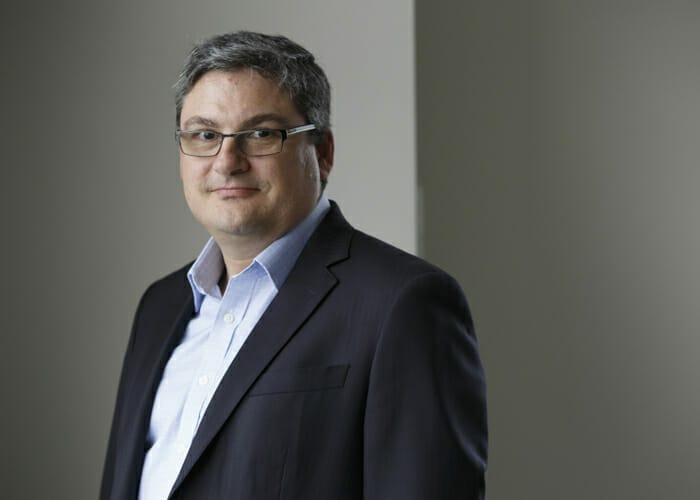

Joel Posters, the head of ESG at Australia’s A$150 billion ($120 billion) Future Fund, is set to have his remit expanded as the sovereign wealth fund turns its attention to insulating the portfolio from technological risks.
This month marks three years since Posters was recruited from his previous role as global head of sustainability for the Rabobank Group, based in the Netherlands, to move to Melbourne and join the Future Fund as its head of ESG.
Over the past three years Posters has led a program to embed responsibility for managing environmental, social, and governance (ESG) risks with every single member of the Future Fund’s 50-person in-house investment team.
Future Fund chief investment officer Raphael Arndt told conexust1f.flywheelstaging.com that he is now looking at how to expand Poster’s role to include responsibility for helping the fund navigate emerging technological risks.
“Joel’s current job is to look at how the Future Fund is managing ESG risks,” Arndt said, “and that is not a world away from looking at the possible disruptions coming from technological change, which we get to see a lot of through our venture capital portfolio.”
He believes the lessons learned from embedding ESG risk management processes into the Future Fund’s portfolio can be readily applied to helping the fund improve its risk management for technological change.
“And there is no shortage of technological disruption on the horizon,” Arndt said.
The Future Fund needs to ensure its investment portfolio is resilient to big technology trends such as the rising influence of robotics and artificial intelligence.
“When you think about something like driverless cars,” he said, “that’s a technological trend that’s going to have an impact not just on car manufacturers but also delivery businesses, taxis, ride-sharing, parking stations and shopping centres.
“We need to ensure our managers are all thinking about these sorts of issues and investing appropriately.”
ESG embedded through the chain
The Future Fund manages roughly $150 billion across five separate funds, including Australia’s $130 billion sovereign wealth fund. This money is managed by a combination of internal teams and external managers.
The Future Fund describes its approach to ESG risk management as commercially driven and in line with its mandate to maximise returns over the long term without taking excessive risk. The mandate does not provide specific direction on how to approach these ESG issues. However, it does require the fund to show regard to international best practice for institutional investment in determining its approach to corporate governance principles.
“The wealth disparity which has widened since the global financial crisis, and the corresponding rise in support for populist policies around the world, mean investors must be concerned that companies they invest in maintain their social licence to operate,” Arndt said.
“Companies must be mindful of the operating environment and society’s expectations – and where they aren’t, governments are increasingly prepared to step in and regulate or impose other sanctions.”
He said that as a long-term investor the Future Fund incorporates ESG issues into consideration of all new investment proposals and investment manager appointments.
Rather than this being siloed in a separate department, Posters and his team act as “knowledge champions” or coaches to help asset class heads, their portfolio manager and analysts improve their ESG monitoring skills.
“This integrated approach is, in our view, fundamental to being an effective long-term investor,” Arndt said.
“For us, ESG issues don’t sit separately from our investment function but are integrated into it.
“Considering these issues is a key risk mitigation tool in an era where volatility is on the rise and regulatory and policy risks are elevated.”
Arndt said that as long-term investors ESG was like any other risk the Future Fund seeks to understand when assessing what price it should pay when making new investments or allocating capital.
“Where there is uncertainty over future cash flow – whether due to ESG risk or any other risk – or where there is risk that future cash flow might be impaired, we are inclined to pay less,” Arndt said.
Engagement over exclusion
As a general rule, the Future Fund favours engagement over exclusion, with a couple of notable exceptions.
“Our approach is commercially focused, and as a general rule we don’t believe in exclusions,” Arndt said.
“We believe limiting our investment universe is inconsistent with the mandate given to us by government to maximise risk-adjusted returns.
“Having said this, a small number of exclusions apply to activities that contravene an international treaty that Australia is party to – in practice this means companies involved in cluster munitions and landmines.
“Furthermore, the board has made a decision to exclude companies directly involved in the manufacture of complete tobacco products.”
Beyond those exceptions, where an ESG issue is identified, the Future Fund prefers to work with its managers and the end companies they invest in to help them improve their performance.
“The decision to appoint new managers includes consideration of environmental, social and governance issues,” Arndt said.
“Inputs from our ESG team help define the due diligence to be undertaken for each opportunity – and we have rejected investment opportunities on ESG and reputational grounds.
“All of this activity occurs to provide the most rigorous and complete assessment of the risk/reward equation for these investments over the long run.”
Over the past two years the Future Fund has assessed 38 of its investment managers on their ESG approach, has reviewed new managers and done refreshing work on existing managers.
“This process involves face-to-face meetings or phone contact, and is not just an exercise in filling in questionnaires,” Arndt said.
“For instance, in the case of an infrastructure manager, it might involve discussing with them how they incorporate thinking around carbon risk and the future path of energy prices into their assessment of investments.
“Or in the case of a distressed debt investment manager, it might involve a discussion on how they’d behave if a mining company they lent to went into administration and the approach they would take to voting our interests to ensure that the company meets any environmental clean-up and site remediation obligations.”
He said this work is delivering results and that he had been particularly pleased to see improvements made by one emerging market manager that had previously been lagging.
“We worked with them and following proactive engagement from us they now more fully incorporate ESG considerations into their investment process,” he said.
“Indeed, they’re proudly highlighting their new skills in their market with other investors.”








Leave a Comment
You must be logged in to post a comment.
Login