
Debt beats equity in data centre boom as scarce capital lifts credit yields

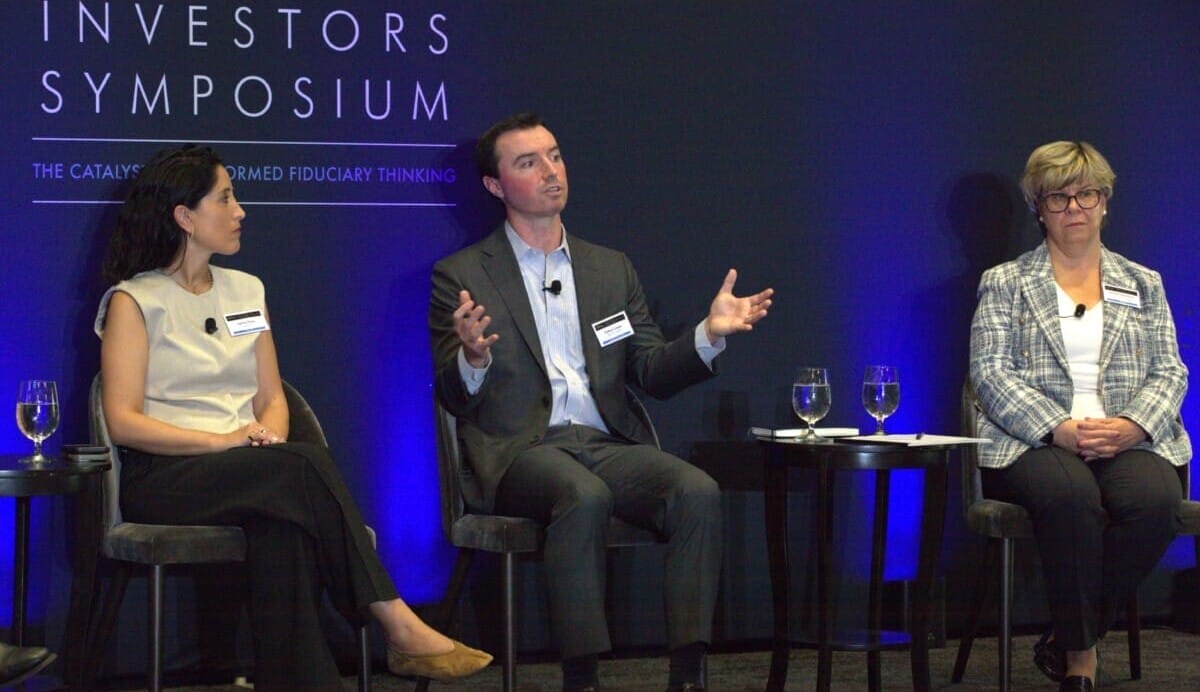
(From left to right): The Future Fund's Tammi Fisher, Blue Owl's Patrick Lawler, and IMCO's Jennifer Hartviksen.

(From left to right): The Future Fund's Tammi Fisher, Blue Owl's Patrick Lawler, and IMCO's Jennifer Hartviksen.

Red-hot demand for data centres and a lack of infrastructure capital is creating a rare market dynamic in which lower-risk credit can yield more than equity investments in the sector, according to investors speaking at the Fiduciary Investors Symposium at Stanford University.

“Given the lack of debt capital relative to equity capital, we can generate some nice premiums,” said Jennifer Hartviksen, managing director and head of global credit at Canada’s Investment Management Corporation of Ontario (IMCO), citing high single-digit to low double-digit returns for single-B to BB- risk.

“Twelve months ago, when spreads were wider, we were seeing mid-teens for those types of paper that have really great structural downside protections with very nice returns relative to what we get in other markets and, in some cases, relative to what the equity below us can be getting.”

She said there were probably only 20 infrastructure credit funds targeting below investment grade that were lending to data centres, with the sector requiring a completely different skill set than investing in the far more popular direct middle market loan space.

“There’s just not a lot of folks doing that type of lending, and there’s really only two or three that do big funds that are multi-billion funds, so there’s a lot less capital there. And as a result of that, the spreads have come in less.”

Patrick Lawler, portfolio manager and head of core acquisitions on Blue Owl Capital’s digital infrastructure team, said some equity deals were closing with negative leverage, where the year-one cap rate is below the cost of debt. Those investors were betting on mark-to-market rent increases over the next few years.

Sponsored Content

“It can still be an attractive risk-adjusted return over a seven- to 10-year hold… given the immense rental growth we’ve seen in top markets.”

Data centres sit at the intersection of power and communications infrastructure, and years of investment in established tier-1 hubs such as Ashburn, Virginia, have created powerful network effects. The flip side, Lawler warned, is that “all the top markets are effectively out of space and power,” forcing developers and investors toward tertiary or even frontier markets to secure capacity.

Tammi Fisher, managing director, real assets, at Australia’s Future Fund said refinancing risk and rental renewal risk hadn’t yet been tested through a full cycle.

“We’ll talk to our partners and some of them are definitely more cautious about that, like how do you price that risk that’s maybe 10-15 years out in data centre locations that are highly customised, super-spec’d for a specific tenant. How do you think about that end-of-life risk, if there is end of life? You’ve got others who are much more optimistic about that, and, you know, and there’s so much growth in it,”

The booming energy needs of data centres is also transforming once “sleepy” infrastructure holdings, which now require large capex programs and different operating skill sets from management.

AI builds on existing cloud demand

While AI is attracting significant attention, hyperscale cloud computing remains the underlying demand driver for data centres, Lawler said. For example, Amazon Web Services generated more than $100 billion in revenue last year with about 30 per cent operating margins.

“You have this existing wave of cloud computing demand, and then you have a second entirely independent wave of demand coming from AI. They’re independent, and very importantly, they’re not cannibalizing each other.”

However, one way to de-risk investments in data centres was to structure the deal so that returns were not dependent on the unpredictable future path of AI. Hartviksen said the loans they were making were typically five-to seven-year maturities, with a lot of customisation in the space allowing for enhanced terms.

“We don’t need to think about the technology risk or what these data centres are going to look like beyond the term of our loans, which is another reason we find it very attractive.”

Lawler said Blue Owl owns the building, including the mechanical, electrical and plumbing infrastructure that will support a data centre’s use cases, but it does not own servers, networking equipment, or GPU chips.

“I don’t think anyone here knows exactly what AI is going to look like in seven to 10 years, but what we want to be able to do is look at our investment and say over this 15-year lease term, even if the residual value is effectively zero – so an enormously draconian scenario just by virtue of the lease payments and all the different structure that we’ve built in – we can still generate a positive and attractive, risk-adjusted return for our partners.”

Be part of the conversation next year – register now for the Fiduciary Investors Symposium Stanford 2026. Asset owners only.

Our next event is at the University of Oxford, November 4-6 2025. Register today – asset owners only.

Leave a Comment

Condoleezza Rice: Globalisation’s borderless era is coming undone

Condoleezza Rice: Globalisation’s borderless era is coming undone

Condoleezza Rice, the 66th US Secretary of State and current director of Stanford University’s Hoover Institution, said the new world order will have several characteristics of which there are already signs: more protectionist trade policies, a redistribution of security burdens, and louder voices for those marginalised in globalisation. 

Sort content by

Investors unpack regime-based portfolio thinking 

Funds are operating in an extraordinary environment, with Scott Chan, chief investment officer of CalSTRS, saying he has never witnessed so many “large shifts stacked on top of the other” in his investment career. Amid the change, investors are increasingly shifting to a scenario and regime-based asset allocation.  

AI investors face post-Moore’s Law reality

Mark Horowitz, a leading computer scientist and electrical engineer at Stanford University, has declared that Moore’s Law is “basically over”, which will have significant ramifications for artificial intelligence investors who are counting on more computing power to feed into more complex models.  

Public-private partnerships key to fixing US infrastructure

The size of the current infrastructure investment gap and the speed at which it is widening mean there is both a desire and a need for more public-private partnerships to unlock funding. Investors say that collaboration with local governments and raising public awareness of private investment benefits are crucial. 

Federal backing vital for US innovation: Stanford president 

Stanford president Jonathan Levin said the university’s top priority is maintaining the partnership with the federal government while safeguarding its operational freedom, as the institution balances financial reliance on Washington and political scrutiny from the Trump administration. 

Why CalPERS doesn’t want to miss the climate revolution

If CalPERS had put more money into the Silicon Valley companies in its own backyard earlier it might be fully funded by now, jokes its sustainable investment head. But it won’t miss the same opportunities in climate investing.

AI beyond the black box

The artificial intelligence revolution is taking place against a backdrop of rising fiscal deficits and a realignment of the geopolitical order. Applying cutting-edge AI technology to navigate markets is helping asset managers such as Bridgewater make sense of a shifting landscape.