
Inside NBIM’s AI playbook to hone investment edge

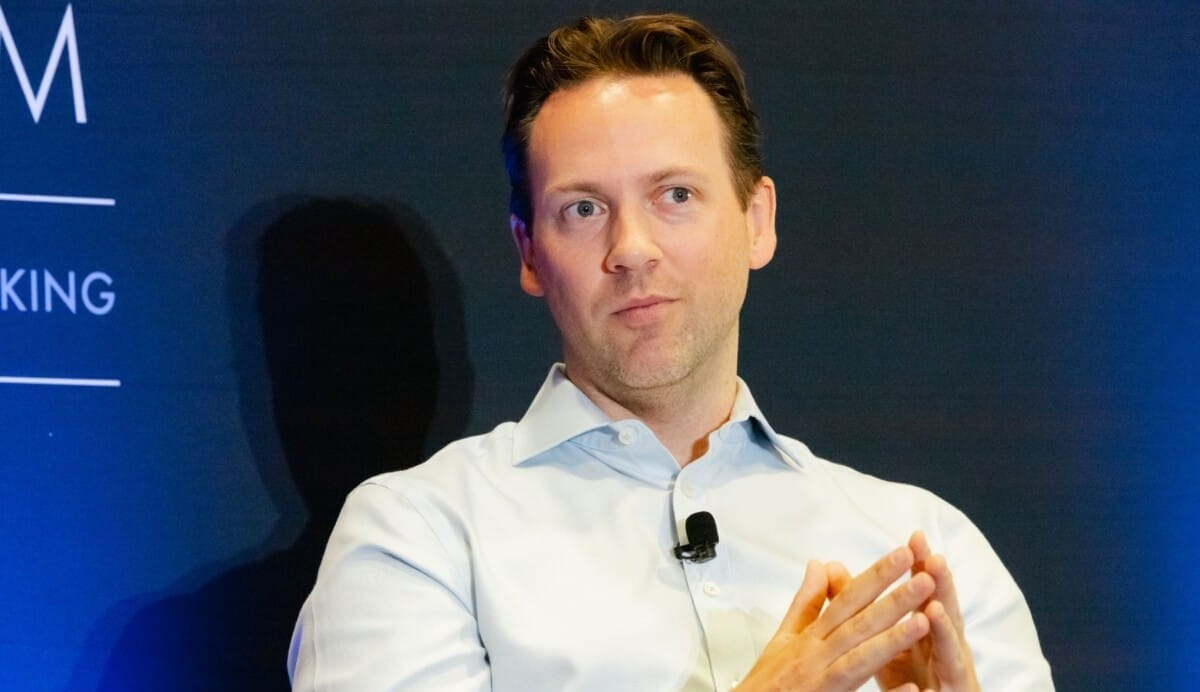
Thomas Larsen. Photo: Jack Smith

Norges Bank Investment Management is a lean organisation despite managing a $2.2 trillion portfolio. Across the fund’s four global offices, there are only 700 staff, or $3 billion per person, which is why it has made pursuing AI-driven efficiency a core organisation initiative – and a non-negotiable requirement for its employees. 

The momentum for change came from the top. At the Fiduciary Investors Symposium, Thomas Larsen, lead portfolio manager of external strategies at NBIM, recalled CEO Nicolai Tangen once told staff in a town hall that “this [AI] ship is sailing, get on board or find a new place to work”. 

“There’s not an awful lot of space for building out redundancies and building out big teams. We don’t want to be more people. We want to stay as nimble as we can,” Larsen told the symposium at Stanford University.  

“We are limited in number of people, this will allow you to 10x your output. This will allow us to do more targeted work and focus more on the things that you are good at.” 

NBIM has seven portfolio managers who can each spend up to a quarter each year on the road visiting external managers – a total of 110 people managing more than $100 billion. How AI can make these visits less overwhelming is by conducting preliminary analysis on manager reports and other performance data.  

The fund’s AI agent, Claude by Anthropic, is plugged into its database, which has daily trading data for every manager it has had since 1998. 

Sponsored Content

“If someone sends me a snapshot of the portfolio a couple of periods backwards, I just drop that in [to Claude]. Then I can see what all my other portfolios in the same market did at the same time,” Larsen said.  

But behind this progressive technological push, Larsen acknowledged that staff development is top of mind for team leaders. The fund is striving to find the balance between improving efficiency while leaving room for junior staff to make mistakes and learn.  

“With these new tools, a lot of what I’m asking AI to do now is exactly the tasks that my PMs asked me to do when I joined as an analyst 12 years ago,” he said. 

“I can ask those questions at 2am in the morning or from an airport in Singapore – I’m not beholden to what time my analyst is awake anymore, but it also means that I am at risk of destroying my own pipeline of talent. 

“We’re thinking a lot about how do we still curate a talent pool and a pipeline of people who are going to be the next guys making the decisions, when they don’t actually have the luxury of making the mistakes that everyone else makes in the first couple of years.” 

Another progressive use case of AI in NBIM’s investment process is a scoring system for internal and external portfolio managers that can pick up subtle behavioural biases when they are executing a trade.  

For example, portfolio managers who are good at timing trades would receive the suggestion from the AI system to “swing bigger” while placing trades, and those who have a tendency to destroy value when trading would receive the opposite advice, Larsen said.  

“[With external managers] we can see do they make money when they are putting contrarian bets, if they trade before or after earnings, if they trade into something with momentum, if they trade out of something that is downward revisions,” he said. 

“We took it out to some of the managers, and 10 out of 10 came back and said ‘can we have two hours with the team that built this? Because we wanted to understand more’.” 

Above all the experiments, Larsen said it is critical that the board and stakeholders are brought into the process early through advocacy and education about the technology.  

“Show them how it works, show them what it can do,” he said. 

“Make sure that you have compliance on board, you have all the people who can say no, that they are comfortable, and can also speak to it [the technology] in an intelligent way, because otherwise you are going to run into roadblocks.” 

Leave a Comment

Condoleezza Rice: Globalisation’s borderless era is coming undone

Condoleezza Rice: Globalisation’s borderless era is coming undone

Condoleezza Rice, the 66th US Secretary of State and current director of Stanford University’s Hoover Institution, said the new world order will have several characteristics of which there are already signs: more protectionist trade policies, a redistribution of security burdens, and louder voices for those marginalised in globalisation. 

Sort content by

AI investors face post-Moore’s Law reality

Mark Horowitz, a leading computer scientist and electrical engineer at Stanford University, has declared that Moore’s Law is “basically over”, which will have significant ramifications for artificial intelligence investors who are counting on more computing power to feed into more complex models.  

Public-private partnerships key to fixing US infrastructure

The size of the current infrastructure investment gap and the speed at which it is widening mean there is both a desire and a need for more public-private partnerships to unlock funding. Investors say that collaboration with local governments and raising public awareness of private investment benefits are crucial. 

Federal backing vital for US innovation: Stanford president 

Stanford president Jonathan Levin said the university’s top priority is maintaining the partnership with the federal government while safeguarding its operational freedom, as the institution balances financial reliance on Washington and political scrutiny from the Trump administration. 

Debt beats equity in data centre boom as scarce capital lifts credit yields

Asset owners continue to weigh up the shifting risk-return attributes of the booming data centre sector including deal structures, refinancing, energy requirements, and the future of AI.

Why CalPERS doesn’t want to miss the climate revolution

If CalPERS had put more money into the Silicon Valley companies in its own backyard earlier it might be fully funded by now, jokes its sustainable investment head. But it won’t miss the same opportunities in climate investing.

AI beyond the black box

The artificial intelligence revolution is taking place against a backdrop of rising fiscal deficits and a realignment of the geopolitical order. Applying cutting-edge AI technology to navigate markets is helping asset managers such as Bridgewater make sense of a shifting landscape.