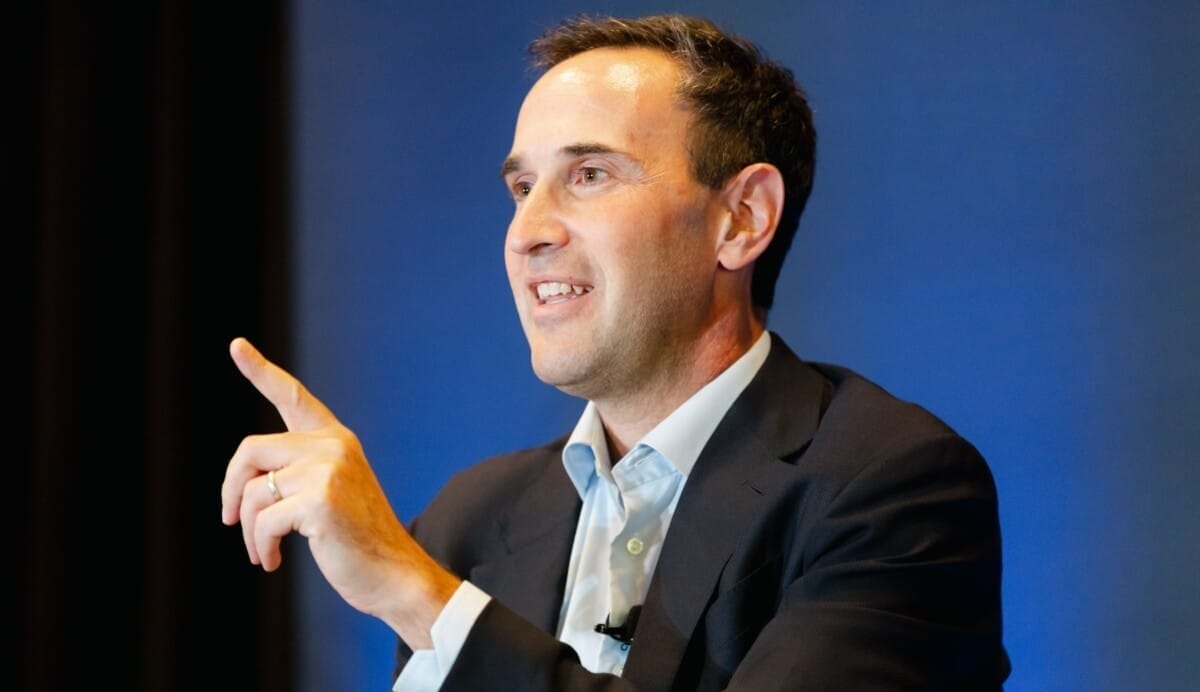

Federal backing vital for US innovation: Stanford president 

Jonathan Levin

Stanford president Jonathan Levin said the university’s top priority is maintaining the partnership with the federal government while safeguarding its operational freedom, as the institution balances financial reliance on Washington and political scrutiny from the Trump administration. 

The university has been swept up in US president Donald Trump’s crackdown on the nation’s higher education institutions, which he has repeatedly criticised as “liberal” and “woke” with an “anti-American” or antisemitic bias, using the reduction of federal funding as powerful leverage. This August, Stanford made 363 staff redundant, citing budget reductions.  

But at the Top1000funds.com Fiduciary Investors Symposium hosted on the Stanford campus, Levin said some recent criticisms directed at American universities are not new and are, in fact, fair. 

“The US is a country that has become more and more politically divided over the last however many years, and university faculty and student populations are, by and large, on one side of that political divide,” said Levin, who is also an economist and Bing Presidential Professor at the university.  

“We should learn a lesson from that and make sure that, going forward, universities are not so enmeshed institutionally in politics. The students and the faculty can be involved and that’s their freedom to do that, but the institutions shouldn’t.” 

Levin said that at the heart of American universities’ excellence is their ability to operate freely and independently, including in setting curriculum and pursuing research projects. That freedom stems from the post-World War II framework for federal support of science established by Vannevar Bush, an engineer and the head of the US Office of Scientific Research and Development at the time. 

Sponsored Content

The framework established the federal government’s responsibility to fund research and development as industry support would lack appropriate scale, and emphasised a peer-reviewed, merit-based allocation of grants. 

“Stanford – probably more than any other university – was a beneficiary of that. Stanford was founded in 1891 and coming out of World War II, we were a regional university of fairly modest calibre,” Levin said. 

“We were in financial difficulty at the time too, because the endowment hadn’t been that well managed, and folks leading Stanford at the time saw there would be an opportunity with federal funding for science to build up a research enterprise.” 

The university built up its engineering and science departments, and later complemented them with humanities, history and other arts departments. It also lent land to technology companies such as Fairchild and Varian, which cemented Stanford’s leadership in the early development of Silicon Valley. 

“That really all came out of the federal-university partnership that led to the US having this extraordinary innovation economy. It’s a great story, and it’s still the best recipe that this country has to be the leader in innovation and to be at the frontiers of knowledge,” Levin said. 

“So a big focus for us right now is how do we sustain that great partnership that universities have enjoyed with the federal government, and get back to a place where the American people support us enough to fund us, and give us the freedom that allows our universities to be exceptional, respected and contributing to the country and to the world.” 

Leave a Comment

Condoleezza Rice: Globalisation’s borderless era is coming undone

Condoleezza Rice: Globalisation’s borderless era is coming undone

Condoleezza Rice, the 66th US Secretary of State and current director of Stanford University’s Hoover Institution, said the new world order will have several characteristics of which there are already signs: more protectionist trade policies, a redistribution of security burdens, and louder voices for those marginalised in globalisation. 

Sort content by

Investors unpack regime-based portfolio thinking 

Funds are operating in an extraordinary environment, with Scott Chan, chief investment officer of CalSTRS, saying he has never witnessed so many “large shifts stacked on top of the other” in his investment career. Amid the change, investors are increasingly shifting to a scenario and regime-based asset allocation.  

AI investors face post-Moore’s Law reality

Mark Horowitz, a leading computer scientist and electrical engineer at Stanford University, has declared that Moore’s Law is “basically over”, which will have significant ramifications for artificial intelligence investors who are counting on more computing power to feed into more complex models.  

Public-private partnerships key to fixing US infrastructure

The size of the current infrastructure investment gap and the speed at which it is widening mean there is both a desire and a need for more public-private partnerships to unlock funding. Investors say that collaboration with local governments and raising public awareness of private investment benefits are crucial. 

Debt beats equity in data centre boom as scarce capital lifts credit yields

Asset owners continue to weigh up the shifting risk-return attributes of the booming data centre sector including deal structures, refinancing, energy requirements, and the future of AI.

Why CalPERS doesn’t want to miss the climate revolution

If CalPERS had put more money into the Silicon Valley companies in its own backyard earlier it might be fully funded by now, jokes its sustainable investment head. But it won’t miss the same opportunities in climate investing.

AI beyond the black box

The artificial intelligence revolution is taking place against a backdrop of rising fiscal deficits and a realignment of the geopolitical order. Applying cutting-edge AI technology to navigate markets is helping asset managers such as Bridgewater make sense of a shifting landscape.