
How next-gen investors at GIC, Temasek harness AI potential

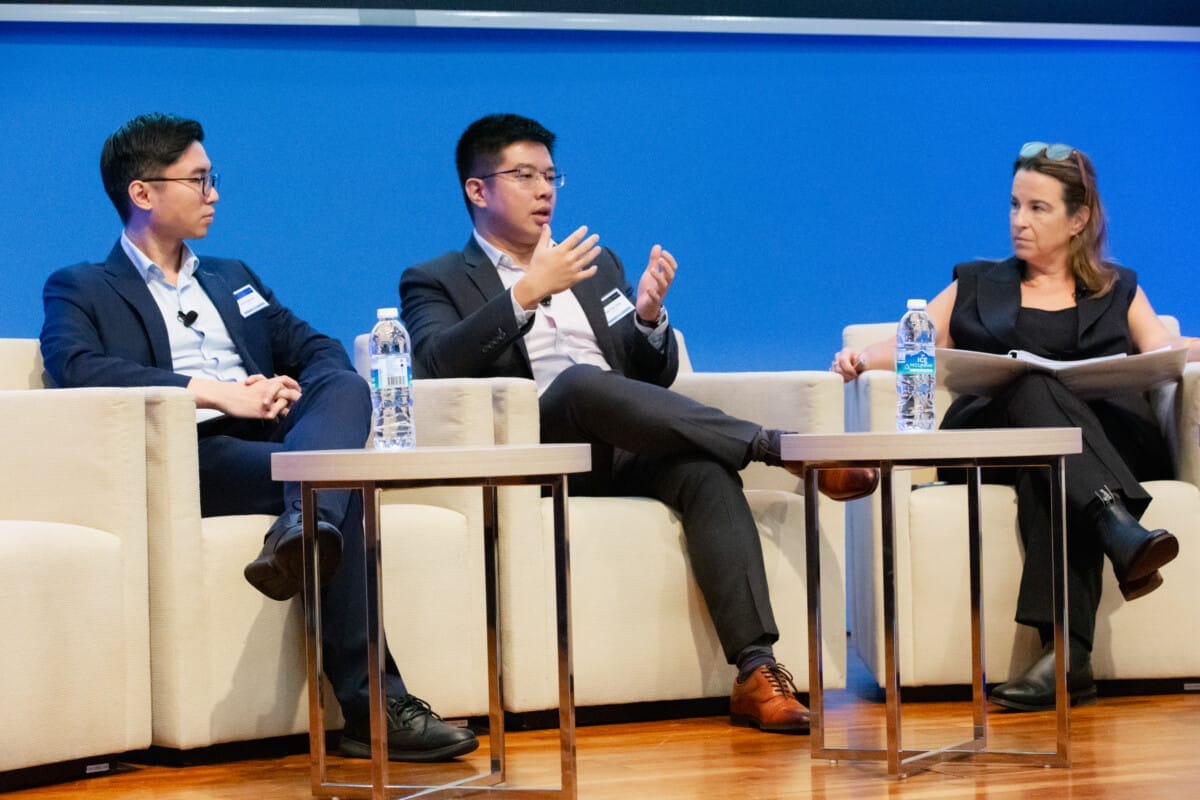
Kah Thong Loh (L), Wei Chin Tang and Amanda White (Conexus Financial). Photo: Jack Smith

A new generation of investors are starting their careers with artificial intelligence on their side as not only an investment trend that offers immense return potential but also a critical portfolio management tool.   

At the Top1000funds.com Fiduciary Investors Symposium, professionals from Singapore-based global investors GIC and Temasek said both sovereign wealth funds are using AI extensively in portfolio management after taking significant steps to integrate it into their operations.  

One of the most common uses for AI in GIC’s investment team is summarisation, but vice president and quantitative strategist Kah Thong Loh said the team sometimes refers to it as “opinion mining”.   

“This really helps us to focus on the key insights in this information-overloaded world,” he told the symposium in Singapore. “For example, our public equity department typically uses it to interpret the annual reports, management call transcripts and other alternative data.  

“And some of our private strategy teams use it to draft the investment underwriting reports or use a list of AI-generated questions to assess the deal more thoroughly by asking tough question that generated by AI.”  

These exercises are done via the fund’s bespoke ChatGPT-like bot, ChatGIC, which ensures a secure environment that prevents its proprietary data from being used to train the underlying GPT model.  

Sponsored Content

GIC is also conducting research into various AI topics to explore their potential in portfolio optimisation in collaboration with Ortec Finance. For example, it is exploring reinforcement learning – where the algorithm learns to make optimised decisions based on reward or penalty signals in an environment – as a technique to help create investment strategies more adaptable to market volatility.   

“What we think is that reinforcement learning agents can potentially replace the traditional methods such as mean variance optimisation [and] Markowitz Efficient Frontier, by dynamically adjusting our portfolio allocations through different paths using more complex portfolio objective, different reward function, and most importantly, dynamic constraints that can be scenario driven,” Loh said.   

Loh said that reinforcement learning can help an investor capitalise on short-term opportunities, and that the investment approaches it generates can often provide returns on par or higher, with lower risks compared to traditional models.     

Temasek vice president of artificial intelligence strategy and solutions Wei Chin Tang said the fund has a centralised program called AI@Temasek which helps to align thinking across the organisation on AI.  

This includes internal considerations like what the technology means for workflow management and investment decision-making, but also what it means externally for Temasek’s portfolio companies.   

“We work very closely with our portfolio development group. These are the guys that look after the large Singapore-based holdings we have, [which is] roughly half of our portfolio,” Tang said.   

“How can we identify and mitigate against the risks that AI could arise, but also what are some of the opportunities that our portfolio companies should perhaps be moving a bit faster [on].”  

Tang said Temasek’s portfolio companies under the AI thematic can be broadly put into four buckets. The first three are AI enablers, which create the technological infrastructure like chips; AI adopters, such as SaaS companies that incorporate AI to generate revenue uplift and product loyalty; and AI natives, which are the new companies that this technological era will eventually create.   

But Tang said the fourth and final bucket is one that holds great potential value. 

“That is, how can our existing incumbent companies benefit from AI? We do think that a lot of the value will come from the application of AI within some of these businesses,” he said, adding that Temasek is working with them to drive productivity and a competitive edge with AI adoption.   

“By adoption, it’s not just how many POCs (proof of concept) we’re putting out, or how many GenAI applications we have.  

“It’s really looking inward at which domains within the business could potentially be transformed and going through that…change management process.” 

Leave a Comment

The world in flux and Trump’s role in a new equilibrium

The world in flux and Trump’s role in a new equilibrium

The second Trump administration has so far brought a lot of things: market shocks, volatile trade policies, and turbulent foreign relationships. But beyond the chaos, renowned geopolitics expert Stephen Kotkin says Trump has an unwitting role to help the world rebalance and reach a “new equilibrium” in the global order.

Sort content by

How Asia-Pacific investors can navigate Trump’s America first plan

President Trump is dramatically reshaping geopolitics, creating new risks and opportunities for investors across the Asia-Pacific.

How new technologies are changing the game in private markets

With the ability to uncover hard-to-find information and enable more frequent trading in traditionally illiquid asset classes, new technologies like artificial intelligence and tokenisation could be the biggest disruption most private markets investors will see in their lifetime. 

How capital markets became a weapon of choice in great power conflict

Capital markets continue to be a key battlefield of power between Beijing and Washington, and whether the yuan has a serious chance of taking over the dollar as the international currency is the next big question for the world economic order. 

Investors brace for life after the US dollar 

A world where the US dollar is no longer the reserve currency seems increasingly likely by the day, and institutional investors are wary that it could fundamentally change the way they construct portfolios. 

Future of Asia now ‘a more difficult story’ as multilateralism crumbles

The global environment in which small Asian economies have thrived over the past seven decades is being dismantled as the US retreats as an advocate of multilateralism, globalisation and internationalism, warned leading geopolitics academic and economist Danny Quah.

Geopolitical uncertainty forces investors to adopt more granular approach

The radical shift in world geopolitics has prompted investors like the Monetary Authority of Singapore, Khazanah Nasional Berhad and the Hong Kong Monetary Authority to rethink their strategic asset allocations in favour of a more granular approach.