
Investors brace for life after the US dollar 

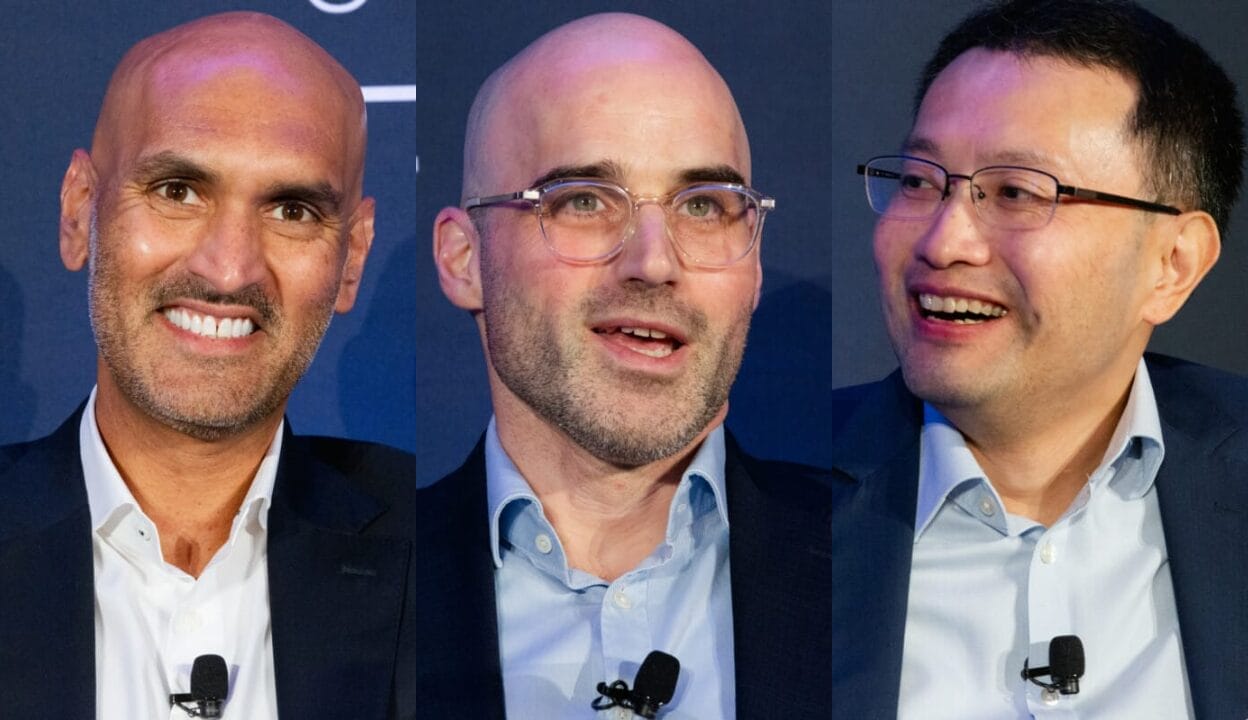
L-R: Atul Lele, Derek Walker and Man Keung Tang. Photo: Jack Smith

A world where the US dollar is no longer the reserve currency seems increasingly likely by the day, and institutional investors are wary that it could fundamentally change the way they construct portfolios. 

At the Top1000funds.com Fiduciary Investors Symposium, Bridgewater Associates head of portfolio strategist group Atul Lele said one cause of the de-dollarisation trend – where the greenback’s status as the world’s main reserve currency is challenged – is the so-called “modern mercantilist” trade policies.  

“[Modern mercantilism] is the idea that governments are really looking after their own sovereignty as their number one priority; seeing trade deficits as being something that is a transfer of wealth to other nations; and seeing the need for national champions to come back,” he told the symposium in Singapore, adding that one of its latest manifestations is the US tariffs. 

US equities make up 70 per cent of the MSCI World Index and need strong capital inflows to maintain that status. But Lele said investors may be less willing to put their money into the market given restrictive new trade policies.  

“One thing that’s for sure is that capital moves quicker than trade,” Lele said.  

“The US trying to enforce a number of these policies is something that could be an accelerant towards funds not only not continuing to invest their marginal dollar into the US, which is a negative pressure on the US dollar, but also potentially pulling out.”  

Sponsored Content

Another force behind de-dollarisation is political conflicts, Lele said.  

“[After the] confiscation of US assets from Russia, you immediately saw not only Russia’s holdings shift away from US Treasuries to other assets, but the rest of the world starting to shift as well,” he said. 

“That was accelerating a path that was already underway from countries such as China, who were moving away from the US dollar into assets such as gold. 

“The question becomes, what do we actually trade in if we’re not going to be trading in US dollars?” 

Planning ahead 

CPP Investments’ head of portfolio design and construction, total funds management, Derek Walker, said that it’s not easy to scenario plan around de-dollarisation. 

“The scenarios we run capture some elements of that [de-dollarisation possibility], but I think it’s a really challenging one to work that all the way through,” he said. 

“We are trying to capture – in the scenarios that we’re running – different states of the world that are more disrupted than the current one, but maybe not to that extreme like a major de-dollarisation of the [world] economy.” 

For example, CPP Investments would examine different allocations and asset class relations in a world with stable inflation and growth, as well as in a world with higher inflation and more volatile and lower growth.  

But Bridgewater’s Lele said a lot of investors today are making a big bet on a continuation of the past 10+ years of a pro-corporate, pro-liquidity, pro-growth, disinflationary boom and period of global harmony. Understanding different regimes is critical, as investors seeking portfolio resilience need to think about the probabilities of a range of investment outcomes and be conscious of which scenario they are betting on. 

“[Investors] are saying, probabilistically, we are keeping our allocation the way it is, a 70/30 global portfolio, [then] they’re making a bet that you’re going to see a repeat of what is amongst the top 5 per cent of performances going back over the last 100 years.” 

“So building resilience includes: number one, thinking about what resiliency means to you; number two, recognising the full range of outcomes that you can get and where your vulnerabilities are; and number three, starting to pull the levers that you can pull to mitigate those vulnerabilities. 

“These are the things that really start to impact the path of your returns over time.” 

Also presenting on the panel was Man Keung Tang, managing director of macro strategy at Singapore’s Temasek. 

Leave a Comment

The world in flux and Trump’s role in a new equilibrium

The world in flux and Trump’s role in a new equilibrium

The second Trump administration has so far brought a lot of things: market shocks, volatile trade policies, and turbulent foreign relationships. But beyond the chaos, renowned geopolitics expert Stephen Kotkin says Trump has an unwitting role to help the world rebalance and reach a “new equilibrium” in the global order.

Sort content by

Why the energy transition won’t die with Trump 2.0

Despite the uptick in anti-ESG sentiment that’s come with Donald Trump’s return to the White House, large institutional investors are certain that innovations in transition technology will continue and that the broader world has not changed course on the journey to decarbonisation.  

How Asia-Pacific investors can navigate Trump’s America first plan

President Trump is dramatically reshaping geopolitics, creating new risks and opportunities for investors across the Asia-Pacific.

How new technologies are changing the game in private markets

With the ability to uncover hard-to-find information and enable more frequent trading in traditionally illiquid asset classes, new technologies like artificial intelligence and tokenisation could be the biggest disruption most private markets investors will see in their lifetime. 

How capital markets became a weapon of choice in great power conflict

Capital markets continue to be a key battlefield of power between Beijing and Washington, and whether the yuan has a serious chance of taking over the dollar as the international currency is the next big question for the world economic order. 

Future of Asia now ‘a more difficult story’ as multilateralism crumbles

The global environment in which small Asian economies have thrived over the past seven decades is being dismantled as the US retreats as an advocate of multilateralism, globalisation and internationalism, warned leading geopolitics academic and economist Danny Quah.

Geopolitical uncertainty forces investors to adopt more granular approach

The radical shift in world geopolitics has prompted investors like the Monetary Authority of Singapore, Khazanah Nasional Berhad and the Hong Kong Monetary Authority to rethink their strategic asset allocations in favour of a more granular approach.