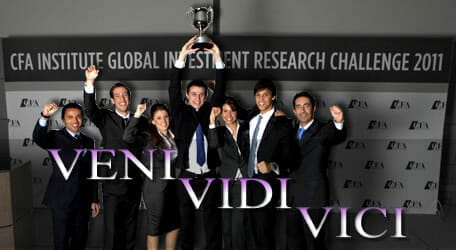
Veni, vidi, vici

Five Italian university students have won the prestigious CFA Institute Global Investment Research Challenge, beating more than 2,500 students from more than 500 universities worldwide to take out the $10,000 prize.

The team of five (pictured) from Italy’s Politecnico di Milano were all studying for the Master of Science in Management, Economics and Industrial Engineering, and took part in the fifth annual competition which took place over a year.

Team leader Nicolo Rolando said the competition was a “long and tough experience” and had been the team’s “top priority” for the past five months. “The result has been well worth it,” he said, “and we’ve learned a lot. We’ve also realised that there is still much more to be learned.”

The other team members were Anna Belli, Francesca Maria Claudio, Giacomo Saibene and Stefano Vigano. Their winning entry was a report on Piaggio & C SpA (PIA:IM) to a panel of industry experts.

The Piaggio Group manufactures scooters, mopeds and motorcycles from 50 to 1,200 cc marketed under the Piaggio, Vespa, Gilera, Aprilia, Moto Guzzi, Derbi and Scarabeo brands. The group also operates in the three- and four-wheeled light transport sector with its Ape, Porter and Quargo ranges of commercial vehicles.

Over the year of the challenge, more than 100 CFA Institute member societies worldwide hosted local competitions in which students had to analyse public companies while being mentored by professional research analysts, write research reports, and then present – and defend – their reports and recommendations to a high-profile panel of experts.


Sponsored Content

Leave a Comment

Sort content by

Experts mull strategies in slow growth climate

Speaking at the Fiduciary Investors Symposium at Oxford University’s Rhodes House Fiona Trafford-Walker, director of consulting at Frontier Advisors argues that Australian investors are operating in a changed environment and need to “get used to slower economic growth.” Speaking as part of an expert panel on how the continued environment of slow growth and low

Macro diversification: How do investors diversify risk?

“Geopolitics does matter and how to navigate geopolitical events on a portfolio is challenging,” argues Tom Clarke, partner and portfolio manager at William Blair speaking at the Fiduciary Investors Symposium at Rhodes House, Oxford University. In a session dedicated to macro strategies for investors to best navigate today’s complex investment universe and diversify risk, Clarke argues that “hiding” from

Oxford Professor urges urgent European reform

The University of Oxford’s distinguished Professor of Economics David Vines predicted the ongoing crisis in Europe will turn into a “train wreck with implications for investors” unless governments undertake significant reforms. He urges for large write downs of the sovereign debt of southern European countries, a loosening of austerity in those countries and a significant

Indexing pressure improves active management

A new study of active and indexed-based mutual funds shows the impact of different countries’ regulatory and financial market environments. The study finds that the average alpha generated by active management is higher in countries with more explicit indexing and lower in countries with more closet indexing. The evidence suggests that explicit indexing improves competition in the mutual fund

Investors need to revamp portfolio construction

Investors should re-consider their investment processes in order to achieve the needed “step-change in efficient portfolio construction” in a low return environment, the chief executive of the A$109 billion ($83 billion) Future Fund, David Neal, says. “It is the investment process that turns the universe of opportunities into a portfolio, and right now that process

Investors need to rethink operating model

A neat little story of investment flows, asset allocation changes, and relationship and service demands is emerging from the third annual Top1000funds.com/Casey Quirk Global Fiduciary CIO Survey. If you’re a CIO of an asset owner what that means is more control but also more responsibilities and the demands of more internal resources. For managers it

Previous



