
Macro diversification: How do investors diversify risk?

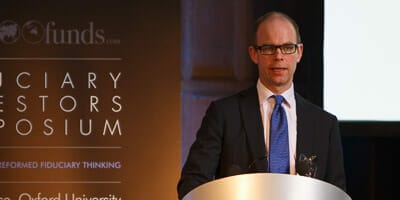
“Geopolitics does matter and how to navigate geopolitical events on a portfolio is challenging,” argues Tom Clarke, partner and portfolio manager at William Blair speaking at the Fiduciary Investors Symposium at Rhodes House, Oxford University.

In a session dedicated to macro strategies for investors to best navigate today’s complex investment universe and diversify risk, Clarke argues that “hiding” from geopolitical events “isn’t diversifying: what we want is insight.”

Clarke’s advice is for investors to see geopolitical risk as “strategic players” trying to produce their own outcomes in a series of bargaining exercises.

“Who are the players that matter, what do they want and will they achieve it?” he asks. “What matters is whether geopolitical risk prices will be pushed, or pulled away from valuation,” he says.

Applying this analysis to the crisis in the Eurozone, he believes diversified Eurozone equities “are attractive.” However the Euro – and it is always important to consider a jurisdiction’s currency and asset differently since “currencies go in different direction to assets” – is unattractive. “When it comes to the Euro my view is that it is unattractive and overvalued,” he says.

Staffan Sevon, head of tactical asset allocation and hedge fund investments at Finland’s €29-billion ($39-billion) Ilmarinen fund has a similar drill down approach to macro risk.

Sponsored Content

“Understanding the drivers of the market is so important. You can’t just have an opinion on US equities – you have to look at how that asset class should return relative to others,” he says.

But diversifying geopolitical and macro risk is difficult. “How do markets react during war?” he asks, pointing out that equities don’t necessarily fall during a conflict. Similarly, he argues that if Greece leaves the Euro it could be seen as strengthening Europe on one hand but also very damaging if investors flee the continent.

Studying correlations between asset classes can offer insight, although he warns “when you look at correlations be careful how you measure them and select a time frame that is relevant to you.” Sevon believes that global equity is by far the strongest connecting point, adding: “If you don’t have an idea about equities, you don’t have an idea about other assets. Equities tend to control others – there is a strong, positive correlation.”

But the breakdown in correlations and their usefulness in flagging macro risk was an issue raised by Peter Wallach, head of the United Kingdom’s Merseyside Pension Fund, a £5.75 billion open, defined-benefit local authority scheme.

“It worries me that correlations between bonds and equities has broken down in the recent past,” he says. “We need a better way to diversify and manage risk going forward,” he says.

Leave a Comment

Chinese market’s many pros and cons

Chinese market’s many pros and cons

The Asian giant has a vibrant tech sector, a growing middle class, and a government making changes to improve access. It’s enough to make many take on the market’s volatility and other issues.

Sort content by

Strong governance begins with robust culture and teams in place

Keith Ambachtsheer, Director Emeritus, Rotman International Centre for Pension Management argues that good governance begins with having “the right team in the room.” This means robust human resource teams, the ability to address issues around understaffing and raising the effectiveness of board members. “Board governance is still a work in progress today,” he argues, speaking

Experts mull strategies in slow growth climate

Speaking at the Fiduciary Investors Symposium at Oxford University’s Rhodes House Fiona Trafford-Walker, director of consulting at Frontier Advisors argues that Australian investors are operating in a changed environment and need to “get used to slower economic growth.” Speaking as part of an expert panel on how the continued environment of slow growth and low

Institutions look to hedge funds to meet portfolio expectations

“Do hedge funds make sense?” asks Jean-Marc Stenger, chief investment officer for alternative investments at Lyxor Asset Management speaking at the Fiduciary Investors Symposium at Oxford University’s Rhodes House. Hedge fund assets may have reached a record $3 trillion in 2014 but the decision by a number of high profile pension funds to drop hedge funds from

Oxford Professor urges urgent European reform

The University of Oxford’s distinguished Professor of Economics David Vines predicted the ongoing crisis in Europe will turn into a “train wreck with implications for investors” unless governments undertake significant reforms. He urges for large write downs of the sovereign debt of southern European countries, a loosening of austerity in those countries and a significant