
Institutions look to hedge funds to meet portfolio expectations

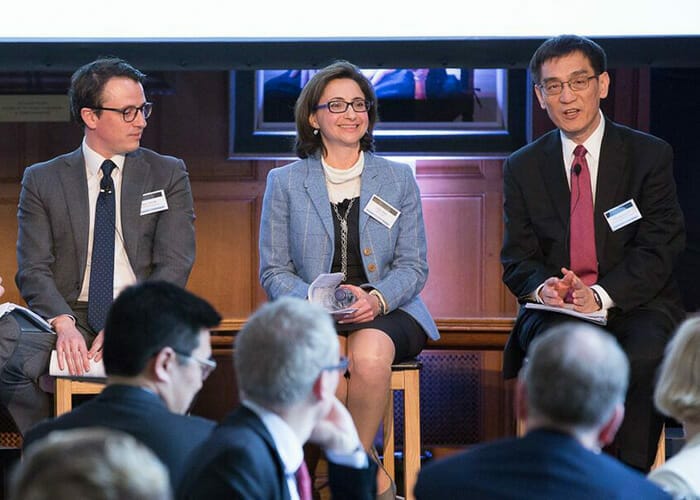
“Do hedge funds make sense?” asks Jean-Marc Stenger, chief investment officer for alternative investments at Lyxor Asset Management speaking at the Fiduciary Investors Symposium at Oxford University’s Rhodes House.

Hedge fund assets may have reached a record $3 trillion in 2014 but the decision by a number of high profile pension funds to drop hedge funds from their allocation has sparked questions around the role of these funds going forward.

Although Stenger lists recent criticisms around the industry, including underperformed compared to all other asset classes since 2009, a risk perception, light regulation and, perhaps most importantly of all, the high fees still associated with hedge funds, he argues that over a long time frame hedge funds returns are “outstanding” and that structural and cyclical factors explain the problem.

Hedge funds are struggling in a low volatility environment where Central Banks have distorted asset prices with QE, he argues. Hedge funds have an important role around diversification including offering different investment styles and flexibility for investors. The regulatory framework is now robust enough for hedge funds to invest public money and transparency has increased. The industry is maturing; fees are falling, he argues.

High fees is one of the biggest bugbears at the BBC Pensions Trust, which manages £12.5 billion ($18.5 billion) of assets for the UK’s state broadcaster.

“Any alpha created is taken out with high fees,” argues Ajay Ahuja, pensions investment manager at the fund. “

Sponsored Content

We look at what skills they are delivering, and what our take should be on that given we are putting up risk capital,” he says. “It’s difficult but worthwhile. We look for sensible fees, high hurdle rates and an alignment of interest. We are seeing fees come down but it is still sticky.”

Fees are also an issue at USS Investment Management, argues speaker Kathryn Graham, head of strategy co-ordination at the at Universities Superannuation Scheme, USS, which operates one of the largest pension schemes in the UK, with total fund assets of more than £40 billion ($60 billion). “Returns have come down astronomically but fees haven’t. Hedge funds are never going to be a big allocation because we do quite a bit in house,” she says.

Nor do hedge funds always offer the kind of diversification investors seek, argues the BBC’s Ahuja. “Hedge funds can have high correlations,” he says, adding: “There are other, non-hedge fund ways to protect with more certainty like equity options or moving to cash. We use options in our schemes.”

Managing hedge funds also requires resources, he says. “Hedge funds make sense but don’t just diversify for sake of it. Hedge fund investing requires lots of governance, even if outsourced.”

For Magnus Eriksson, chief investment officer of the Fourth Swedish National Pension Fund, AP4, the main conflict within the fund’s hedge fund allocation is balancing hedge fund strategies with AP4’s commitment to long term investment.

“AP4 don’t invest in hedge funds unless they are completely transparent offering real-time access to their portfolios,” he says. The fund is also “fee sensitive” with investment costs for the entire fund kept to 10 basis points. Hedge funds work to a fixed fee based around this budget with “no leakage,” says Eriksson.


Leave a Comment

Chinese market’s many pros and cons

Chinese market’s many pros and cons

The Asian giant has a vibrant tech sector, a growing middle class, and a government making changes to improve access. It’s enough to make many take on the market’s volatility and other issues.

Sort content by

Strong governance begins with robust culture and teams in place

Keith Ambachtsheer, Director Emeritus, Rotman International Centre for Pension Management argues that good governance begins with having “the right team in the room.” This means robust human resource teams, the ability to address issues around understaffing and raising the effectiveness of board members. “Board governance is still a work in progress today,” he argues, speaking

Experts mull strategies in slow growth climate

Speaking at the Fiduciary Investors Symposium at Oxford University’s Rhodes House Fiona Trafford-Walker, director of consulting at Frontier Advisors argues that Australian investors are operating in a changed environment and need to “get used to slower economic growth.” Speaking as part of an expert panel on how the continued environment of slow growth and low

Macro diversification: How do investors diversify risk?

“Geopolitics does matter and how to navigate geopolitical events on a portfolio is challenging,” argues Tom Clarke, partner and portfolio manager at William Blair speaking at the Fiduciary Investors Symposium at Rhodes House, Oxford University. In a session dedicated to macro strategies for investors to best navigate today’s complex investment universe and diversify risk, Clarke argues that “hiding” from

Oxford Professor urges urgent European reform

The University of Oxford’s distinguished Professor of Economics David Vines predicted the ongoing crisis in Europe will turn into a “train wreck with implications for investors” unless governments undertake significant reforms. He urges for large write downs of the sovereign debt of southern European countries, a loosening of austerity in those countries and a significant