
Alternative investments grow in attractiveness

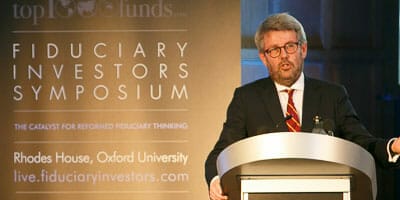
Alternative investments have become a valuable income stream and liability matching tool at UK pension fund Centrica says Chetan Ghosh, Chief investment Officer at the £6.7 billion pension fund. With current gilt yields making liability matching expensive, the fund has begun investing in alternative strategies that include solar panel installations benefiting from the government’s Feed-in-Tariff, new builds benefiting from ground rental income and social housing, explains Ghosh, speaking at the Fiduciary Investors Symposium at Oxford University’s Rhodes House.

“We are quite a young pension scheme, spun out of British Gas in 1997. It means we have no legacy of pensioners from the 1950s and 1960s and this allows us a long-term horizon. However the tensions we are trying to solve involve taking risk off the table, with a long-term ambition to meet our liabilities and the pension promises we made, but also wanting to invest to grow our asset base,” he says. The fund currently has around 7.5 per cent of assets in long-dated cash flow generating mandates, avoiding the need to buy gilts at very low yields.

Centrica eschews any fixed or static allocation to alternatives warning that an assets attractiveness – like rental income – can “change quickly” requiring a fleet-of-foot. Centrica funded its alternative purchases by selling some of its Gilt portfolio, but synthetically retaining a gilts exposure.

Its alternative allocation is characterised as long-dated and illiquid, inflation linked – although the fund is starting to look at assets that aren’t inflation linked – and with high levels of cash flow. Offering advice to other investors, Ghosh counsels patience as deploying money to alternative investments can take time, and the importance of having a manager “you can trust.” Scarcity of supply is another bugbear although he says “time is on our side to build up our allocation; we will be fussy.” Centrica’s alternatives program has also “thrown off a lot of cash flow” requiring a “continuous program of investment.”

Tomas Franzen, Chief Investment Strategist, at the Second Swedish National Pension Fund AP2 has sought out alternative investments in line with the fund’s risk management strategy to diversify.

“Our core business is compensation for taking on risk. But as we take on risk we also need to manage that, and the most important risk management tool is diversification,” he explains.

Sponsored Content

Although Franzen “isn’t trying to replicate hedge fund strategies” in his alternative portfolio, investment ideas have come from research of the hedge fund space and he admits it is a “cheaper way than investing in hedge funds.” Strategies include benefiting from currency carry or unexpectedly sharp currency depreciation, merger arbitrage, shorting volatility and insurance linked securities, he says.


Asset Owner:AP Fonden 2 (AP2)

Leave a Comment

Chinese market’s many pros and cons

Chinese market’s many pros and cons

The Asian giant has a vibrant tech sector, a growing middle class, and a government making changes to improve access. It’s enough to make many take on the market’s volatility and other issues.

Sort content by

Experts mull strategies in slow growth climate

Speaking at the Fiduciary Investors Symposium at Oxford University’s Rhodes House Fiona Trafford-Walker, director of consulting at Frontier Advisors argues that Australian investors are operating in a changed environment and need to “get used to slower economic growth.” Speaking as part of an expert panel on how the continued environment of slow growth and low

Institutions look to hedge funds to meet portfolio expectations

“Do hedge funds make sense?” asks Jean-Marc Stenger, chief investment officer for alternative investments at Lyxor Asset Management speaking at the Fiduciary Investors Symposium at Oxford University’s Rhodes House. Hedge fund assets may have reached a record $3 trillion in 2014 but the decision by a number of high profile pension funds to drop hedge funds from

Macro diversification: How do investors diversify risk?

“Geopolitics does matter and how to navigate geopolitical events on a portfolio is challenging,” argues Tom Clarke, partner and portfolio manager at William Blair speaking at the Fiduciary Investors Symposium at Rhodes House, Oxford University. In a session dedicated to macro strategies for investors to best navigate today’s complex investment universe and diversify risk, Clarke argues that “hiding” from

Oxford Professor urges urgent European reform

The University of Oxford’s distinguished Professor of Economics David Vines predicted the ongoing crisis in Europe will turn into a “train wreck with implications for investors” unless governments undertake significant reforms. He urges for large write downs of the sovereign debt of southern European countries, a loosening of austerity in those countries and a significant