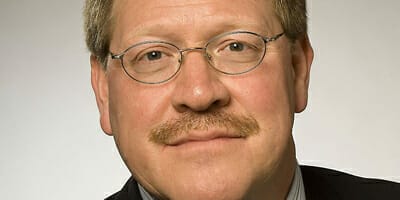
Eijffinger’s decade of financial repression

Financial repression will define the economic landscape for at least another decade, according to professor of financial economics at Tilburg University, Sylvester Eijffinger, which has serious implications for institutional investors.

Eijffinger, who also is also a visiting professor at Harvard, sits on the monetary experts panel of the European Union and is an adviser to the International Monetary Fund, says negative interest rates are the major issue of our time.

Negative real interest rates are here to stay, a realisation that has huge implications for investors.

“Governments have to de-leverage risk in times of low growth and they are not prepared to increase taxes; they have to do it with financial repression,” he says. “As an investor, be prepared. You have to realise that low interest rates are here to stay at the short-end and possibly at the long-end of the yield curve. This has huge implications for investments.”

By way of example, he says the European Central Bank’s policy rate stands at 0.5 per cent, while the eurozone’s annual inflation rate is 2.5 per cent. The Bank of England keeps its policy rate at only 0.5 per cent, despite an inflation rate that hovers above 2 per cent. And, in the United States, where inflation exceeds 2 per cent, the Federal Reserve’s benchmark federal funds rate remains at an historic low of 0 to 0.25 per cent.

This will be the financial and economic environment of the immediate future.

Sponsored Content

He says negative interest rates, which he describes as a kind of wealth tax, are necessary for governments to de-risk, but they come at the expense of savers.

“People who save should be aware that governments need to do this for at least a decade,” he says.

Eijffinger will give a keynote address at the Fiduciary Investors Symposium, an event that brings together institutional investors to examine the power and responsibility of fiduciary investment.

The event, which is convened by Conexus Financial, the publisher of conexust1f.flywheelstaging.com, will be held in Amsterdam from October 20 to 22, 2013. www.fiduciaryinvestor.com

Read an article by Eijffinger on the subject here.



Leave a Comment

Sort content by

UniSuper defies accepted thinking

Mention any asset class to John Pearce, chief investment officer of Australian superannuation fund UniSuper, and he will doggedly set out the good and bad thinking around it. A common source of his ire is the sight of investors herding around a belief based on a lack of rigorous thinking. Good practice for him involves

OTPP deals with underfunding

Even the most successful and well run pension plans are facing underfunding challenges. The $129-billion Ontario Teachers’ Pension Plan is the latest to investigate solutions to solve the mismatch between the pension promise and the funds required to meet that, says Jim Leech, chief executive of the organisation . OTPP has appointed a taskforce – chaired

Fewer, bigger funds for UK?

Australia, the US, Canada and Denmark have all done it. Kazakhstan and even Oman are talking about it. Increasingly, public sector pension funds are merging or pooling their assets into fewer bigger schemes. It’s no surprise the debate is gathering momentum in the United Kingdom, ripe for consolidation with a Local Government Pension Fund Scheme

Scenario analysis: applicable to anything?

Attempts to apply a formula to asset allocation based on an asset’s historical volatility and relationship with other assets tend to fail when presented with black-swan events. Equities tend to rise along with commodities except when presented with political events such as the price hikes in oil in 1973 that sent equities into free fall.

Kurtzer on Holy Land of opportunity

The Middle East is in a state of dynamic flux, with positive change manifesting itself in the countries going through an economic and financial revolution as much as a political one. Institutional investors from all parts of the world have a role to play in that revolution, according to former US ambassador to Egypt and

CFA to lead industry out of crisis

Protecting the pension system is one of six key themes at the centre of the CFA Institute’s Future of Finance initiative as it aims to empower the investment industry to take leadership in restoring trust. Speaking at the sixty-sixth annual CFA Institute conference in Singapore this week, president and chief executive of the CFA Institute,

Previous




