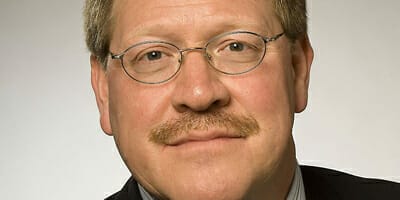
Eijffinger’s decade of financial repression

Financial repression will define the economic landscape for at least another decade, according to professor of financial economics at Tilburg University, Sylvester Eijffinger, which has serious implications for institutional investors.

Eijffinger, who also is also a visiting professor at Harvard, sits on the monetary experts panel of the European Union and is an adviser to the International Monetary Fund, says negative interest rates are the major issue of our time.

Negative real interest rates are here to stay, a realisation that has huge implications for investors.

“Governments have to de-leverage risk in times of low growth and they are not prepared to increase taxes; they have to do it with financial repression,” he says. “As an investor, be prepared. You have to realise that low interest rates are here to stay at the short-end and possibly at the long-end of the yield curve. This has huge implications for investments.”

By way of example, he says the European Central Bank’s policy rate stands at 0.5 per cent, while the eurozone’s annual inflation rate is 2.5 per cent. The Bank of England keeps its policy rate at only 0.5 per cent, despite an inflation rate that hovers above 2 per cent. And, in the United States, where inflation exceeds 2 per cent, the Federal Reserve’s benchmark federal funds rate remains at an historic low of 0 to 0.25 per cent.

This will be the financial and economic environment of the immediate future.

Sponsored Content

He says negative interest rates, which he describes as a kind of wealth tax, are necessary for governments to de-risk, but they come at the expense of savers.

“People who save should be aware that governments need to do this for at least a decade,” he says.

Eijffinger will give a keynote address at the Fiduciary Investors Symposium, an event that brings together institutional investors to examine the power and responsibility of fiduciary investment.

The event, which is convened by Conexus Financial, the publisher of conexust1f.flywheelstaging.com, will be held in Amsterdam from October 20 to 22, 2013. www.fiduciaryinvestor.com

Read an article by Eijffinger on the subject here.



Leave a Comment

Sort content by

Ventures on the risk spectrum

Hershel Harper received an early education in finance when he used to read Business Week in High School. The 43-year old now at the helm of the $27-billion South Carolina Retirement Systems, investing on behalf of South Carolina’s 350,000 public sector workers, says he knew back then he wanted to manage money: “I really am

Getting the commodities mix just right

While commodities are a controversial and problematic asset class to some investors, for others they are an ideal diversifier looking more attractive than ever. A mini-revival in commodity investing among US pension funds suggests the asset class may be enjoying a resurgence. The Los Angeles Fire and Police Pension System, Municipal Retirement System of Michigan

The end of beauty contest active management?

Designing and implementing concentrated, long-horizon investment mandates would support longer term thinking, align pension organisation’s goals with its stakeholders, and reduce transaction costs. This was one of the recommendations of a two-day workshop in Toronto last month, attended by a delegation of 80 pension fund executives from around the globe. Aimed at uncovering the meaning

Italian fund rides out crisis in style

The wrath of the European sovereign debt crisis may have left its mark on Italy in more ways than one, with both its financial and political scenes regularly sliding into crisis mode for the past year or two. However, the nation’s largest private pension investor, the €7.75-billion ($10.1-billion) Cometa fund, has firmly kept on track

Paul Marsh: live with low returns

The London Business School’s emeritus professor of finance Paul Marsh admits that you have to be slightly mad to embark on the kind of research detailed in the latest edition of Global Investment Returns Yearbook. This year Marsh and colleagues Elroy Dimson and Mike Staunton – Marsh describes the three of them, pictured below, as

Blinder: a power of paradox at Princeton

Pension funds or any investor holding a slug of long-term fixed income needs to factor in some capital losses soon, says Princeton academic and former vice president of the Federal Reserve, Alan Blinder. “The timing is difficult to predict, but three or 15 months, it doesn’t matter. It is predictable,” he says. “The unpredictable part

Previous




