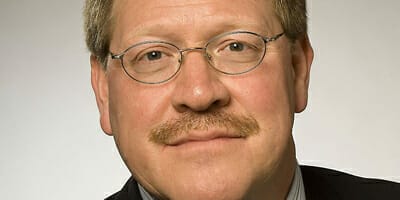
Eijffinger’s decade of financial repression

Financial repression will define the economic landscape for at least another decade, according to professor of financial economics at Tilburg University, Sylvester Eijffinger, which has serious implications for institutional investors.

Eijffinger, who also is also a visiting professor at Harvard, sits on the monetary experts panel of the European Union and is an adviser to the International Monetary Fund, says negative interest rates are the major issue of our time.

Negative real interest rates are here to stay, a realisation that has huge implications for investors.

“Governments have to de-leverage risk in times of low growth and they are not prepared to increase taxes; they have to do it with financial repression,” he says. “As an investor, be prepared. You have to realise that low interest rates are here to stay at the short-end and possibly at the long-end of the yield curve. This has huge implications for investments.”

By way of example, he says the European Central Bank’s policy rate stands at 0.5 per cent, while the eurozone’s annual inflation rate is 2.5 per cent. The Bank of England keeps its policy rate at only 0.5 per cent, despite an inflation rate that hovers above 2 per cent. And, in the United States, where inflation exceeds 2 per cent, the Federal Reserve’s benchmark federal funds rate remains at an historic low of 0 to 0.25 per cent.

This will be the financial and economic environment of the immediate future.

Sponsored Content

He says negative interest rates, which he describes as a kind of wealth tax, are necessary for governments to de-risk, but they come at the expense of savers.

“People who save should be aware that governments need to do this for at least a decade,” he says.

Eijffinger will give a keynote address at the Fiduciary Investors Symposium, an event that brings together institutional investors to examine the power and responsibility of fiduciary investment.

The event, which is convened by Conexus Financial, the publisher of conexust1f.flywheelstaging.com, will be held in Amsterdam from October 20 to 22, 2013. www.fiduciaryinvestor.com

Read an article by Eijffinger on the subject here.



Leave a Comment

Sort content by

CalPERS: a new framework of economy

CalPERS has adopted 10 preliminary investment principles following a board offsite in July, but a number of topics, including the role of active management, are still under debate ahead of the September board meeting that is the deadline for the principles’ adoption. The $266-billion Californian fund began the process for establishing investment principles in January

Social networks in the investment web

Reels of financial data and analysis coupled with the occasional piece of market gossip or personal hunch are the time-honoured tools investors rely on in building an active portfolio. More recently, an element of sustainability or corporate governance analysis has tried to muscle into the process. Soon there will be another revolutionary option complementing financial

Is reviving Europe a suspended apparition?

Getting Europe’s swelling institutional capital to support long-term projects that could benefit its uninspired economies was an idea that sent heads nodding around the continent as it suffered the brunt of the financial crisis. Get pension, insurance and foundation money into where it is most needed with the attraction of reliable long-term cash flows and

Let’s talk about underfunding

Even using the assets of the pension plan was not enough of a leg-up to save the city of Detroit from bankruptcy. As the last words in the song Put your hands up for Detroit by Fedde Le Grand say, it is system shutdown. The fiscal demise of this city may be a lesson for

Johnson urges pension simplicity

There is a David-and-Goliath feeling to the battle Michael Johnson, a research fellow at the London-based think tank the Centre for Policy Studies, is waging against the pension industry. His research, which lays out the case for radically simplifying all aspects of the United Kingdom’s pension sector, has earned him a reputation as a maverick.

Disparity in policy portfolio risk profiles

A policy portfolio is a poor reflection of investor preferences, argued Peter Bernstein. This philosophical question has now been empirically tested by MIT’s Mark Kritzman, who shows the inter-temporal disparity of a policy portfolio’s risk profile. He suggests a simple framework for addressing this deficiency. Kritzman encourages investors to replace rigid policy portfolios with flexible investment policies.

Previous




