
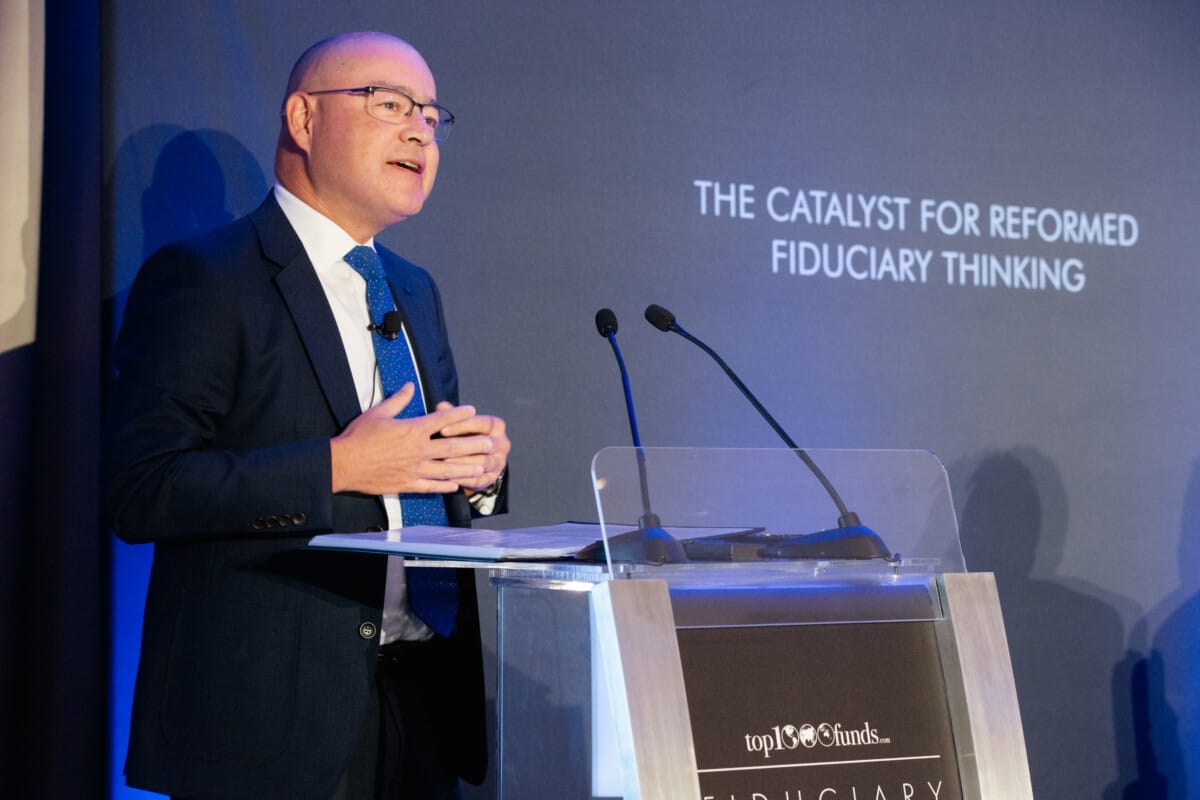

Investors in the Asia-Pacific region must be better prepared for the impact of President Trump’s “national securitisation of everything” strategy, which is blending defence and commercial imperatives, according to Michael Shearer, senior counsellor for Asia-Pacific at Veracity Worldwide.
Shearer – speaking at the Top1000funds.com Fiduciary Investors Symposium before President Trump this week unveiled hefty tariffs across dozens of trade partners which sent markets plummeting – said the current pace of geopolitical change was unprecedented.
A key shift was the US government designating an ever-widening array of issues, assets and industries as strategic to national security.
“What happens when commercial imperatives take a back seat to strategic ones?” he asked at the symposium in Singapore.
“How do we assess business cases and investment propositions when the targets are not purely commercial in nature, and then as the lines between commercial technologies and services and defence blur, are we comfortable and equipped to be investing in defence?”
Investors must now navigate greater regulatory complexity and enforcement risk, as the country that ultimately owns and controls a business matters as much as where it is located, he said.
His comments proved prescient as companies with complex global supply chains, such as Apple, Nike and Adidas, were heavily sold off after President Trump unveiled tariffs of at least 10 per cent starting April 5.
Shearer referred to this rising challenge facing investors, with one global asset owner holding investments across three key impacted verticals: energy transition, emerging technologies, and critical minerals.
“If you’re looking, for example, at a long-range investment into, say, a data centre, there are real issues to consider now when it comes to who is used to put in place the undersea cables for data and for power.”
Shearer recommended asset owners recalibrate their mindset to include a greater awareness of geopolitical implications and understand the pain points in their portfolios.
This included systematically mapping out the impact of new policies and tariffs (broken down by location and ultimate ownership) in an environment of heightened political risk.
“We’re aware of some investment firms running China exposure checks for every deal they’re doing, regardless of jurisdiction or asset to make sure that the suppliers, customers, or the very sector they’re investing in, doesn’t make them vulnerable to sanctions or censure.”
Shearer pointed towards two major potential risks in the years ahead.
One was the high chance of an earthquake in Tokyo sometime in the next 30 years, which would be catastrophic for supply chains. The other risk is Taiwan where tensions have been escalating with China, although Shearer said Trump is currently more focused on resolving the Ukraine-Russia war.







Leave a Comment
You must be logged in to post a comment.
Login