
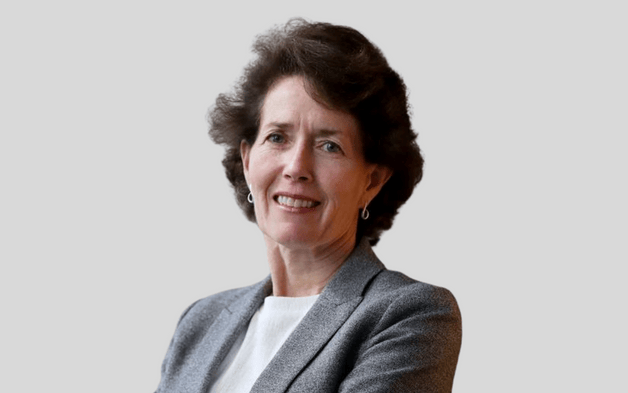

The world’s emergence from the pandemic offers an opportunity for the investment industry to embark on transformational, rather than just incremental, change. In an impassioned call for a different type of investment, Carol Geremia, president, MFS Investment Management, urged FIS Maastricht delegates to help create a new investment model.
Today’s post pandemic world is a good junction for the investment industry to self-reflect. Investors are now taking five times more risk to get the same return as they were thirty years ago. It’s one of the reasons why the industry is now so vast – that increase in risk requires additional oversight and care allocating capital and ensuring diversification, she said. “No wonder money management has grown so much.”
The explosion in the number of asset allocators over the last 25 years creates an opportunity for asset managers to use their influence positively to create a new model. “The only way to generate returns going forward is to create a system that works,” said Geremia who joined MFS in 1984, where she has spent her entire career to date.
Just moving capital around
Now is the time to examine the structural issues that come with taking risk; explore the limitations of passive capital and argue the case of ESG to be embedded in the investment process. “Do we just move capital around, or do we invest it,” she asked delegates.
The world has moved from shareholder primacy to stakeholder capitalism which requires a different way of operating. “We want companies to focus on stakeholder capital, but they won’t do that unless we operate differently. We are now able to ensure the companies we own take stakeholder capital seriously.” She urged investors to align their operations with purpose, embrace three dimensional investment that integrates risk, return and impact and allocate capital responsibly. “Trust matters; it’s what we sell,” she said.
Extended time horizon
A crucial component in building a better system involves extending investment time horizons. Many organizations have embedded short-term incentives within their organizations: although they espouse long-term horizons, in reality an overwhelming focus on three year performance records means they typically hold a single stock on average for just a few years. This means capital is not being committed for long enough to have any impact on the transition. “The only way to manage risk is to extend time horizons,” she said.
Investors need to re-think how they measure performance. If investors are going to engage with companies and try and influence the transition, it requires committing capital for longer, rethinking the ideal time to hold equity. If companies don’t change, active investors can withdraw capital. In this way, companies will have to compete for finance based on their sustainability credentials.
Extending investment time horizons requires difficult conversations and inclusive leadership. Leaders need to challenge incentives, get out of their comfort zones and build alliances with new stakeholders. This includes building new relationships with regulators. “I have never spoken to regulators as much as I do today,” she said.
Rather than argue hard with regulators to protect their own business, she urged delegates to explain to regulators how they planned to change their behaviour to better serve the people they represent. Regulators don’t want to hear that it is hard for investors; they want to hear new ideas and how to change the model, she said. She urged investors to stop “whining” about regulation but welcome it. “The cost of inaction is catastrophic and a challenge to our survival.”
Limitations to passive capital
Geremia also noted the increasing limitation of passive capital to influence net zero targets and push sustainability. Increasingly, investors will need to know what they own and who they are lending to. “Bad” companies or companies that are not on a sustainable trajectory, should struggle to access capital. “Sustainability applies to every company in the world. Should all companies get money all the time? I’d say ‘no’.”
Geremia concluded that this approach isn’t about putting companies out of business. However, investors should talk to companies about where, and how, they are making money and insist they are not short term when it comes to measuring results. Investors should demand honest conversations and data drawn from a full market cycle, she concluded.








Leave a Comment
You must be logged in to post a comment.
Login