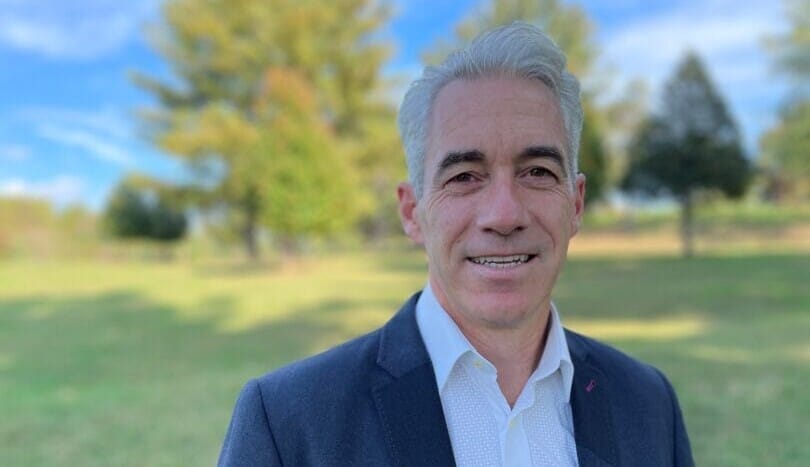

CalPERS’ plan to generate alpha from climate investments

CalPERS’ sustainable investment strategy is predicated on a belief it can generate outperformance by investing in climate solutions – with $100 billion to be allocated by 2030. Peter Cashion, managing investment director for sustainable investments tells Amanda White why, and how, it looks for climate alpha opportunities.

CalPERS has been energetic in the implementation of its new climate action plan, developed under the leadership of Peter Cashion last November. Among other things, the plan includes deploying $100 billion to climate solutions by 2030 – just over 20 per cent of CalPERS’ $469 billion AUM – with the aim of both generating alpha and reducing the carbon intensity of the portfolio.

When the plan was devised, the fund already had $47 billion in climate solutions and the team under Cashion is hard at work to more than double that commitment, with nine new private investments made in recent weeks.

Reporting to the CIO – now Stephen Gilmore, who started at the fund this week – Cashion and his team have worked each asset class to develop a sustainable investment plan towards 2030.

“It’s not a fixed number for each asset class, but a range,” Cashion told Top1000funds.com in an interview.

“We see investment opportunities across the spectrum with the most tangible in infrastructure, private and public equities.”

Sponsored Content

Already CalPERS has worked with FTSE to develop a customised climate transition index, that evaluates the risks and opportunities of the global energy transition, and it has committed $5 billion in its public equity investments to this scalable alternative to a market-cap index.

It has also announced its first wave of private investment, with $1.1 billion in private equity and infrastructure committed across nine deals, and a further $3.6 billion across 19 deals in advanced pipeline.

Investments to date include supply chain optimisation, an energy company, a lithium-ion producer, electric boats, wind turbines and fossil-fuel-free logistics.

“In a number of opportunities we are seeing more in private equity, particularly in co-investment where we are very active,” Cashion says, adding that while infrastructure deals are fewer in number, they are much bigger in scale.

Infrastructure deals make up about $900 million of the recently committed $1.1 billion, so it’s a big portion of committed investment already.

“We will see opportunities in private credit and fixed income, but they haven’t matured or transpired as much yet as they have on the equities side,” Cashion says.

“The equity coming in is good, but to have the leverage to generate returns you need debt, so that’s why we see impending opportunity in fixed income and private credit, and we are actively having calls with fund managers.”

Cashion says one of the key differentiators for CalPERS’ climate plan is it is driven by the notion it can generate alpha and outperform by investing in climate.

He explains there are a number of reasons the fund sees investing in climate as a thematic that can generate outsized performance.

First is the size and scale of the transition opportunity set that is not only large but growing. It has also identified the theme of resource efficiency with companies more attuned to using less energy experiencing lower costs and so higher valuations. And the inclusion of both physical and transition climate risks as an area of focus means in both portfolio and security selection risk management is more robust.

“Taking in the combination of those three factors it’s a recipe for higher performance, particularly over time as these effects roll out,” he says.

While the fund hasn’t put a precise number or expectation on the alpha that it can generate from these investments, it has clear tracking of climate solution investment performance and will benchmark that against the asset class benchmark.

The nine recent investments were a combination of flagship funds and dedicated climate funds, and Cashion, who was previously the global head of climate finance and chief investment officer in the financial institutions group at the World Bank’s International Finance Corporation (IFC), says “we welcome both”.

“An investment through the flagship fund is indicative this is not a niche do-gooder pursuit, this is generally good business,” he says.

“But we also want to identify the exclusive climate-focused funds in private equity, infrastructure or private credit.”

CalPERS also plans to coinvest in climate solutions alongside the asset classes.

“This is not a carve out for sustainable investment, but we will jointly implement it with the asset classes,” he says.

“Once my team is built out we will have a joint process with one of my team sitting alongside the asset classes and I will jointly approve it. This is a more scalable model and with the urgency of the transition needed and the opportunity set it is better to play at scale.”

In fact, it’s the opportunity CalPERS presents to invest at scale that attracted Cashion personally from a 30-year career at the IFC to make the move to CalPERS.

“I made the move because I saw the potential and the scale. We are doing something big and new at scale,” he said adding that CalPERS is looking to recruit a further 10 people to the sustainable investing team, effectively doubling the size.

And while the team has made some quick progress since setting the strategy in November, Cashion is cognisant it won’t be a straight line.

“We have an additional $53 billion in incremental investment to make, we can’t just divide that by 6.5 years [to get to 2030] and that’s what we do each year,” he says. “The pace of the opportunity set may be uneven and that could be an obstacle.”

As a result of its climate investment ambition, and the $100 billion commitment, the fund has set an emissions reduction target for 2030.

It had already committed to a net zero 2050 target but one of the advantages of the new sustainable investment strategy work is to define a 2030 target of 50 per cent.

The emissions intensity of every portfolio at CalPERS has been mapped by the internal team taking into account any asset allocation shifts.

“An interesting component of that is the $100 billion investment,” Cashion says.

“Without that we wouldn’t reduce by 50 per cent. The $100 billion is driven by the fact we think we’ll make more money that way, but it also reduces emissions.”

The investment universe for climate solutions at CalPERS has been grouped into three buckets: mitigation, adaptation and transition. Cashion says he is aware that transition investments may come through buying into higher emitters, such as steel, that will mean an uptick on the emissions footprint of the portfolio.

“We are comfortable with that because we don’t just want to impact our own portfolio but the broader economy. We want to lean into these,” he says.

Another objective of the focus on climate investments is also to build more resilience into the portfolio and the fund will recruit specialists across both public and private markets to fully integrate ESG analysis into the portfolio.

Climate scenarios will also be incorporated into the fund’s capital market assumptions and asset-liability management process with climate scenario stress testing included in the top-down portfolio view.

“This is still an evolving science and we are developing that muscle from the top down and also within specific asset classes and sectors so we will look at the firm, asset and macro total fund exposure level,” Cashion says.

Key to that will also be more analysis and expectation of fund managers’ ESG integration capabilities and the internal sustainable investment team will give providers recommendations to work towards.

Peter Cashion will speak at the Fiduciary Investors Symposium at Stanford University from September 17-19. For more information click here.

Leave a Comment

Finland’s Elo: Larger equity allocations promise new media scrutiny

Finland’s Elo: Larger equity allocations promise new media scrutiny

As Finland's pension funds prepare to increase their equity allocations to unprecedented levels compared to global peers, they must also navigate a new and unfamiliar risk. Elo's chief investment officer Jonna Ryhänen explains the fund's investment approach going forward and how it will manage stakeholder and media scrutiny as they react to swinging volatility and returns.

Sort content by

Why NYC pensions CIO hasn’t drunk the ‘TPA Kool-Aid’

Three decades of investing have given Monte Tarbox sharp eyes for recognising risk and opportunities, and he’s putting it to use as the new permanent chief investment officer of the $306 billion NYC Bureau of Asset Management. In an interview with Top1000funds.com, Tarbox outlines his vision for the fund, why he’s bullish on infrastructure but “nervous” on PE, and why he hasn’t drunk the TPA “Kool-Aid”.

How CPP is evolving risk management for a faster, more interconnected world

In an environment where multiple risks are emerging and their effects are compounding on the portfolio, CPP Investments' chief risk officer Priti Singh says the $572 billion fund is rethinking risk management from the ground up, shifting from reaction to preparation and embedding risk thinking earlier in investment decisions. She speaks to Amanda White about the fund's risk approach.

URS bets on nuclear to power AI and lower emissions

Next-generation nuclear energy, and the money pouring into it, will truly change the world, according to CIO of Utah Retirement System John Skjervem. It’s a lonely position as the CIO of a public pension fund but one Utah is embracing as it builds out early-stage investments in nuclear energy as part of its alternative energy portfolio. He speaks to Sarah Rundell in an exclusive interview about how investing in transformational energy technologies can be part of prudent investment management.

Managing volatility and inflation: Constant rebalancing shores up UK’s lifeboat fund

A keen focus on rebalancing, and best in class systems, allows the UK’s £31.2 billion Pension Protection Fund to effectively implement a dynamic hedging strategy for one of the UK's biggest LDI portfolios. Sarah Rundell reports.

Velliv reset: More Danish funds lean into low cost DC model

In Denmark’s fiercely competitive commercial pension industry, Velliv was quick to take action with a root-and-branch overhaul of its pension provision when it experienced a drop in returns in the first half of 2024. It sacked its active equity managers, scaling up internal active strategies and low-cost, index-based investments instead, and stopped allocating to its $4.3 billion alternatives allocation. Thor Schultz Christensen, deputy chief investment officer at Velliv, unpacks the change.

Ohio sounds warning bells on PE liquidity logjam

Farouki Majeed, chief investment officer of the $23 billion Ohio School Employees Retirement System, has highlighted worrying signs in private equity that resulted from a backlog of exits, including industry murmurs that some GPs are having to borrow money to operate their business because LP fees are drying up. In an interview with Top1000funds.com, Majeed unpacks why its 12 per cent PE allocation is shielded from the rout.



