
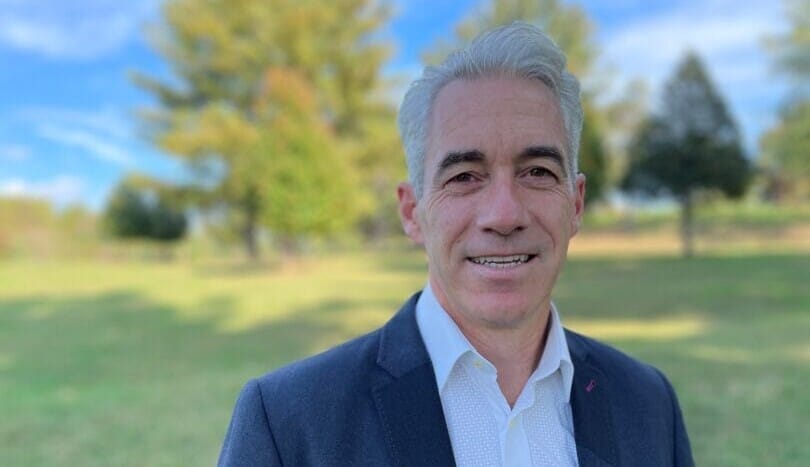

CalPERS’ sustainable investment strategy is predicated on a belief it can generate outperformance by investing in climate solutions – with $100 billion to be allocated by 2030. Peter Cashion, managing investment director for sustainable investments tells Amanda White why, and how, it looks for climate alpha opportunities.
CalPERS has been energetic in the implementation of its new climate action plan, developed under the leadership of Peter Cashion last November. Among other things, the plan includes deploying $100 billion to climate solutions by 2030 – just over 20 per cent of CalPERS’ $469 billion AUM – with the aim of both generating alpha and reducing the carbon intensity of the portfolio.
When the plan was devised, the fund already had $47 billion in climate solutions and the team under Cashion is hard at work to more than double that commitment, with nine new private investments made in recent weeks.
Reporting to the CIO – now Stephen Gilmore, who started at the fund this week – Cashion and his team have worked each asset class to develop a sustainable investment plan towards 2030.
“It’s not a fixed number for each asset class, but a range,” Cashion told Top1000funds.com in an interview.
“We see investment opportunities across the spectrum with the most tangible in infrastructure, private and public equities.”
Already CalPERS has worked with FTSE to develop a customised climate transition index, that evaluates the risks and opportunities of the global energy transition, and it has committed $5 billion in its public equity investments to this scalable alternative to a market-cap index.
It has also announced its first wave of private investment, with $1.1 billion in private equity and infrastructure committed across nine deals, and a further $3.6 billion across 19 deals in advanced pipeline.
Investments to date include supply chain optimisation, an energy company, a lithium-ion producer, electric boats, wind turbines and fossil-fuel-free logistics.
“In a number of opportunities we are seeing more in private equity, particularly in co-investment where we are very active,” Cashion says, adding that while infrastructure deals are fewer in number, they are much bigger in scale.
Infrastructure deals make up about $900 million of the recently committed $1.1 billion, so it’s a big portion of committed investment already.
“We will see opportunities in private credit and fixed income, but they haven’t matured or transpired as much yet as they have on the equities side,” Cashion says.
“The equity coming in is good, but to have the leverage to generate returns you need debt, so that’s why we see impending opportunity in fixed income and private credit, and we are actively having calls with fund managers.”
Cashion says one of the key differentiators for CalPERS’ climate plan is it is driven by the notion it can generate alpha and outperform by investing in climate.
He explains there are a number of reasons the fund sees investing in climate as a thematic that can generate outsized performance.
First is the size and scale of the transition opportunity set that is not only large but growing. It has also identified the theme of resource efficiency with companies more attuned to using less energy experiencing lower costs and so higher valuations. And the inclusion of both physical and transition climate risks as an area of focus means in both portfolio and security selection risk management is more robust.
“Taking in the combination of those three factors it’s a recipe for higher performance, particularly over time as these effects roll out,” he says.
While the fund hasn’t put a precise number or expectation on the alpha that it can generate from these investments, it has clear tracking of climate solution investment performance and will benchmark that against the asset class benchmark.
The nine recent investments were a combination of flagship funds and dedicated climate funds, and Cashion, who was previously the global head of climate finance and chief investment officer in the financial institutions group at the World Bank’s International Finance Corporation (IFC), says “we welcome both”.
“An investment through the flagship fund is indicative this is not a niche do-gooder pursuit, this is generally good business,” he says.
“But we also want to identify the exclusive climate-focused funds in private equity, infrastructure or private credit.”
CalPERS also plans to coinvest in climate solutions alongside the asset classes.
“This is not a carve out for sustainable investment, but we will jointly implement it with the asset classes,” he says.
“Once my team is built out we will have a joint process with one of my team sitting alongside the asset classes and I will jointly approve it. This is a more scalable model and with the urgency of the transition needed and the opportunity set it is better to play at scale.”
In fact, it’s the opportunity CalPERS presents to invest at scale that attracted Cashion personally from a 30-year career at the IFC to make the move to CalPERS.
“I made the move because I saw the potential and the scale. We are doing something big and new at scale,” he said adding that CalPERS is looking to recruit a further 10 people to the sustainable investing team, effectively doubling the size.
And while the team has made some quick progress since setting the strategy in November, Cashion is cognisant it won’t be a straight line.
“We have an additional $53 billion in incremental investment to make, we can’t just divide that by 6.5 years [to get to 2030] and that’s what we do each year,” he says. “The pace of the opportunity set may be uneven and that could be an obstacle.”
As a result of its climate investment ambition, and the $100 billion commitment, the fund has set an emissions reduction target for 2030.
It had already committed to a net zero 2050 target but one of the advantages of the new sustainable investment strategy work is to define a 2030 target of 50 per cent.
The emissions intensity of every portfolio at CalPERS has been mapped by the internal team taking into account any asset allocation shifts.
“An interesting component of that is the $100 billion investment,” Cashion says.
“Without that we wouldn’t reduce by 50 per cent. The $100 billion is driven by the fact we think we’ll make more money that way, but it also reduces emissions.”
The investment universe for climate solutions at CalPERS has been grouped into three buckets: mitigation, adaptation and transition. Cashion says he is aware that transition investments may come through buying into higher emitters, such as steel, that will mean an uptick on the emissions footprint of the portfolio.
“We are comfortable with that because we don’t just want to impact our own portfolio but the broader economy. We want to lean into these,” he says.
Another objective of the focus on climate investments is also to build more resilience into the portfolio and the fund will recruit specialists across both public and private markets to fully integrate ESG analysis into the portfolio.
Climate scenarios will also be incorporated into the fund’s capital market assumptions and asset-liability management process with climate scenario stress testing included in the top-down portfolio view.
“This is still an evolving science and we are developing that muscle from the top down and also within specific asset classes and sectors so we will look at the firm, asset and macro total fund exposure level,” Cashion says.
Key to that will also be more analysis and expectation of fund managers’ ESG integration capabilities and the internal sustainable investment team will give providers recommendations to work towards.
Peter Cashion will speak at the Fiduciary Investors Symposium at Stanford University from September 17-19. For more information click here.








Leave a Comment
You must be logged in to post a comment.
Login