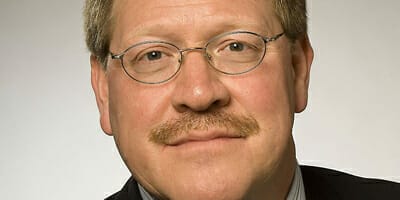
Eijffinger’s decade of financial repression

Financial repression will define the economic landscape for at least another decade, according to professor of financial economics at Tilburg University, Sylvester Eijffinger, which has serious implications for institutional investors.

Eijffinger, who also is also a visiting professor at Harvard, sits on the monetary experts panel of the European Union and is an adviser to the International Monetary Fund, says negative interest rates are the major issue of our time.

Negative real interest rates are here to stay, a realisation that has huge implications for investors.

“Governments have to de-leverage risk in times of low growth and they are not prepared to increase taxes; they have to do it with financial repression,” he says. “As an investor, be prepared. You have to realise that low interest rates are here to stay at the short-end and possibly at the long-end of the yield curve. This has huge implications for investments.”

By way of example, he says the European Central Bank’s policy rate stands at 0.5 per cent, while the eurozone’s annual inflation rate is 2.5 per cent. The Bank of England keeps its policy rate at only 0.5 per cent, despite an inflation rate that hovers above 2 per cent. And, in the United States, where inflation exceeds 2 per cent, the Federal Reserve’s benchmark federal funds rate remains at an historic low of 0 to 0.25 per cent.

This will be the financial and economic environment of the immediate future.

Sponsored Content

He says negative interest rates, which he describes as a kind of wealth tax, are necessary for governments to de-risk, but they come at the expense of savers.

“People who save should be aware that governments need to do this for at least a decade,” he says.

Eijffinger will give a keynote address at the Fiduciary Investors Symposium, an event that brings together institutional investors to examine the power and responsibility of fiduciary investment.

The event, which is convened by Conexus Financial, the publisher of conexust1f.flywheelstaging.com, will be held in Amsterdam from October 20 to 22, 2013. www.fiduciaryinvestor.com

Read an article by Eijffinger on the subject here.



Leave a Comment

Sort content by

Montagnon defines investor engagement

There is scope for European legislation directing asset owners who issue mandates to service providers in Europe to say that they have “thought through” what they want their asset managers to engage with companies on, ICGN conference delegates heard. Peter Montagnon, senior investment adviser of corporate governance at the UK Financial Reporting Council, says there

Code of conduct for proxy voting industry

The European Securities and Markets Authority (ESMA) has developed a set of high level principles with the aim of encouraging the proxy voting industry to develop its own code of conduct. Speaking at the ICGN conference in Milan, the head of the investment and reporting division at ESMA, Laurent Degabriel, said it will set a

Breakfast with AQR’s Cliff Asness

Having a breakfast meeting with Cliff Asness is a wake-up call. He will let you know if you’re late – something he holds in very little regard. He admits he has to constantly remind himself that just because he’s 20 minutes early to everything that others are not automatically then 20 minutes late. Asness is

Tackling sustainability in emerging markets

Emerging market investing and sustainable investing easily rank as two of the most substantiated of the many investment trends of the past decade. However, the two styles of investing are far from natural bedfellows. Christian Ragnartz, as chief investment officer of the $17-billion-plus Swedish pension fund AP7 – which has 13 per cent of its

Ownership: a forgotten art?

While the responsible investment field has come a long way, the majority of investors are still treating it as an overlay, rather than truly integrating it into investment decision-making. This is not an ideal situation for the investment industry, not to mention society at large, but it presents an opportunity for those that do integrate

Maverick Series video: Gonski part I

In the first of a new series of video interviews featuring thought leaders in global institutional investment, chair of the $80 billion Australian Future Fund, David Gonski, outlines his views on governance. mrec4inarticleinline Sponsored Content scnative1 scnative2 scnative3

Previous




