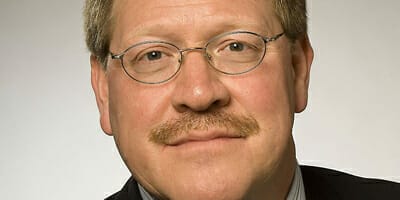
Eijffinger’s decade of financial repression

Financial repression will define the economic landscape for at least another decade, according to professor of financial economics at Tilburg University, Sylvester Eijffinger, which has serious implications for institutional investors.

Eijffinger, who also is also a visiting professor at Harvard, sits on the monetary experts panel of the European Union and is an adviser to the International Monetary Fund, says negative interest rates are the major issue of our time.

Negative real interest rates are here to stay, a realisation that has huge implications for investors.

“Governments have to de-leverage risk in times of low growth and they are not prepared to increase taxes; they have to do it with financial repression,” he says. “As an investor, be prepared. You have to realise that low interest rates are here to stay at the short-end and possibly at the long-end of the yield curve. This has huge implications for investments.”

By way of example, he says the European Central Bank’s policy rate stands at 0.5 per cent, while the eurozone’s annual inflation rate is 2.5 per cent. The Bank of England keeps its policy rate at only 0.5 per cent, despite an inflation rate that hovers above 2 per cent. And, in the United States, where inflation exceeds 2 per cent, the Federal Reserve’s benchmark federal funds rate remains at an historic low of 0 to 0.25 per cent.

This will be the financial and economic environment of the immediate future.

Sponsored Content

He says negative interest rates, which he describes as a kind of wealth tax, are necessary for governments to de-risk, but they come at the expense of savers.

“People who save should be aware that governments need to do this for at least a decade,” he says.

Eijffinger will give a keynote address at the Fiduciary Investors Symposium, an event that brings together institutional investors to examine the power and responsibility of fiduciary investment.

The event, which is convened by Conexus Financial, the publisher of conexust1f.flywheelstaging.com, will be held in Amsterdam from October 20 to 22, 2013. www.fiduciaryinvestor.com

Read an article by Eijffinger on the subject here.



Leave a Comment

Sort content by

ATP reunites alpha and beta after 6 years

Alpha and beta rely to a large extent on exposures to systematic risk factors, so goes the “2013 thinking” of ATP in reversing the decision to separate alpha and beta in its investment portfolio six years ago. ATP has separate hedging and investment portfolios, with the hedging portfolio significantly larger at around DKK 670 billion

State Street’s Probyn into 2013

The current equity rally is not predicated on a shift in economic performance, according to chief economist at State Street, Chris Probyn, who says it would be reasonable to say the market may “pause for thought”. Probyn says the move from fixed income to equities has been fostered by some of the “economic areas for

CalPERS’ sustainability initiative drives investment beliefs

Launched this week, CalPERS’ Sustainable Investment Research Initiative (SIRI) will drive the development the $250-billion fund’s first set of investment beliefs. While difficult to believe a fund of its size, reach and history could invest without a set of investment beliefs, it is encouraging to see that sustainability will be a core part of that

Finnish pension reform a lesson for all

The findings from the first review of the Finnish pension system, commissioned by the Finnish Centre for Pensions, were handed down by Nicholas Barr from the London School of Economics and Keith Ambachtsheer from the Rotman International Centre for Pension Management last month. Although Helsinki in January is far from a party Ambachtsheer and Barr

European investors stay on the offensive

2012 was a year of battles for European pension funds. An ongoing war was waged against a severe regulatory challenge from the European Commission in the shape of Solvency II-style legislation. Aside from the uncertain struggle of that campaign, major European investors gained plenty of credit from standing up to corporate boards in the “shareholder

Swiss investors on the hunt for alternatives

A company pension fund might not be the first place you would think of applying for a mortgage. According to Matthias Weber, a partner at Zurich consultancy ifund services, the issuance of mortgages by investors is likely to deepen as Swiss pension funds continue on their quest to find good alternative assets. Weber has just

Previous




