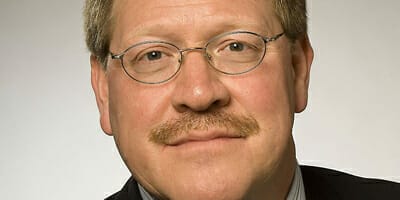
Eijffinger’s decade of financial repression

Financial repression will define the economic landscape for at least another decade, according to professor of financial economics at Tilburg University, Sylvester Eijffinger, which has serious implications for institutional investors.

Eijffinger, who also is also a visiting professor at Harvard, sits on the monetary experts panel of the European Union and is an adviser to the International Monetary Fund, says negative interest rates are the major issue of our time.

Negative real interest rates are here to stay, a realisation that has huge implications for investors.

“Governments have to de-leverage risk in times of low growth and they are not prepared to increase taxes; they have to do it with financial repression,” he says. “As an investor, be prepared. You have to realise that low interest rates are here to stay at the short-end and possibly at the long-end of the yield curve. This has huge implications for investments.”

By way of example, he says the European Central Bank’s policy rate stands at 0.5 per cent, while the eurozone’s annual inflation rate is 2.5 per cent. The Bank of England keeps its policy rate at only 0.5 per cent, despite an inflation rate that hovers above 2 per cent. And, in the United States, where inflation exceeds 2 per cent, the Federal Reserve’s benchmark federal funds rate remains at an historic low of 0 to 0.25 per cent.

This will be the financial and economic environment of the immediate future.

Sponsored Content

He says negative interest rates, which he describes as a kind of wealth tax, are necessary for governments to de-risk, but they come at the expense of savers.

“People who save should be aware that governments need to do this for at least a decade,” he says.

Eijffinger will give a keynote address at the Fiduciary Investors Symposium, an event that brings together institutional investors to examine the power and responsibility of fiduciary investment.

The event, which is convened by Conexus Financial, the publisher of conexust1f.flywheelstaging.com, will be held in Amsterdam from October 20 to 22, 2013. www.fiduciaryinvestor.com

Read an article by Eijffinger on the subject here.



Leave a Comment

Sort content by

Real estate the object of desire for UK funds

United Kingdom pension funds will increase their real estate allocations as bond and equity investments continue to disappoint, according to new research by property consultancy Jones Lang Lasalle. The funds typically hold around 5 per cent of their assets in real estate, but the recent findings predict the pendulum will swing in favour of much

CFA Institute survey reveals ethical vacuum leads to lack of trust

An absence of appropriate ethical culture at financial services firms has been the biggest contributor to the lack of trust in the finance industry, according to a global survey of CFA Institute members, which attracted more than 6000 responses. Matt Orsagh, director of capital markets policy at CFA Institute, says to restore integrity in global

EDHEC: a bridge to practical portfolio construction

The new chairman of EDHEC-Risk Institute’s international advisory board, chief investment strategist at Swedish pension fund AP2, Tomas Franzen, says institutional investors should embrace academia and be open to applying research in the implementation of practical portfolio construction. He says that while investing is part art and part science, it is important to employ science

Fund “heads in sand” on climate risk

An Australian superannuation fund with A$6.6 billion ($6.9 billion) under management has achieved number-one ranking in a global survey of how the world’s top 1000 retirement funds, insurance companies and sovereign wealth funds are responding to climate risk. Sydney-based Local Government Super (LGS) has received the top ranking in the inaugural Climate Index of the

BFP to boost UK economy

In a policy to galvanise pension fund assets to help boost its ailing economy, the UK government wants funds to invest in small and medium-sized businesses. As part of its Business Finance Partnership (BFP), it has named four asset managers to run specialist funds backed by pooled government and private capital. The funds will invest

European distressed debt: investors divided by volatility

Last month conexust1f.flywheelstaging.com hosted a thinktank with a group of influential Australian investors to discuss the opportunities in European distressed debt. Participants included the Australian Government’s $80 billion sovereign wealth Future Fund, the $68 billion QIC, and leading asset consultants, with guest speaker sir David Cooksey, former board member of the Bank of England, chairman

Previous




