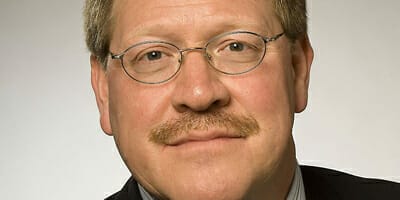
Eijffinger’s decade of financial repression

Financial repression will define the economic landscape for at least another decade, according to professor of financial economics at Tilburg University, Sylvester Eijffinger, which has serious implications for institutional investors.

Eijffinger, who also is also a visiting professor at Harvard, sits on the monetary experts panel of the European Union and is an adviser to the International Monetary Fund, says negative interest rates are the major issue of our time.

Negative real interest rates are here to stay, a realisation that has huge implications for investors.

“Governments have to de-leverage risk in times of low growth and they are not prepared to increase taxes; they have to do it with financial repression,” he says. “As an investor, be prepared. You have to realise that low interest rates are here to stay at the short-end and possibly at the long-end of the yield curve. This has huge implications for investments.”

By way of example, he says the European Central Bank’s policy rate stands at 0.5 per cent, while the eurozone’s annual inflation rate is 2.5 per cent. The Bank of England keeps its policy rate at only 0.5 per cent, despite an inflation rate that hovers above 2 per cent. And, in the United States, where inflation exceeds 2 per cent, the Federal Reserve’s benchmark federal funds rate remains at an historic low of 0 to 0.25 per cent.

This will be the financial and economic environment of the immediate future.

Sponsored Content

He says negative interest rates, which he describes as a kind of wealth tax, are necessary for governments to de-risk, but they come at the expense of savers.

“People who save should be aware that governments need to do this for at least a decade,” he says.

Eijffinger will give a keynote address at the Fiduciary Investors Symposium, an event that brings together institutional investors to examine the power and responsibility of fiduciary investment.

The event, which is convened by Conexus Financial, the publisher of conexust1f.flywheelstaging.com, will be held in Amsterdam from October 20 to 22, 2013. www.fiduciaryinvestor.com

Read an article by Eijffinger on the subject here.



Leave a Comment

Sort content by

Investors must collaborate to innovate

Institutional investors are sheltered by competition, which in some instances can be beneficial, but it also means they are shielded from competitive forces that drive innovation. A new paper by Gordon Clark and Ashby Monk, looks at why the current model of either insourcing or outsourcing investment management doesn’t allow for innovation, and the models

Mercer’s plan for integrating ESG

How to implement ESG into portfolio construction and implementation is an ongoing challenge for asset owners. Mercer has come up with a number of strategies including the best way to use ESG ratings, active ownership, and tailored strategies that play to sustainability themes, including its own unlisted investment solution. Amanda White spoke to Jane Ambachtsheer,

PRI governance review to look at differential rights

The PRI has received many queries following the move by six Danish funds to abdicate as signatories over governance concerns. The association is holding a governance review that among other things will discuss the prospect of differential rights among signatories.   When six Danish funds, with a combined $300 billion, decided to leave the PRI

A trustee guide to factor investing

This research by academics at Tilburg University and the VU University Amsterdam, looks at the hurdles of implementing factor investing. It translates those into a checklist for implementing factor investing. The research, conducted for Robeco, finds that three approaches to factor investing are emerging and conducts case studies to examine how these approaches are implemented

Blackrock looks favourably on equities

Blackrock has a favourable view on equities, relative to bonds, but within fixed income it advocates an unconstrained approach. Amanda White spoke to chief investment strategist, Russ Koesterich.   Equities look cheap relative to bonds or cash, says chief investment strategist for Blackrock and iShares chief global investment strategist, Russ Koesterich, with the manager recommending

Howard Marks on alpha and making money

“It used to be easier to make money,” Oaktree Capital Management founder and chairman, Howard Marks muses as he discusses meeting the demands and goals of his clients in 2014. Marks is an avid communicator, and has been writing memos to clients for 24 years. The result is his book “The Most Important Thing”, which

Previous




