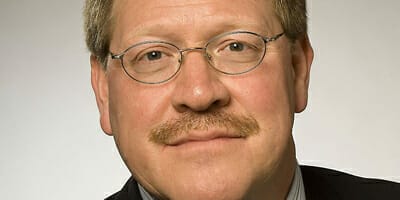
Eijffinger’s decade of financial repression

Financial repression will define the economic landscape for at least another decade, according to professor of financial economics at Tilburg University, Sylvester Eijffinger, which has serious implications for institutional investors.

Eijffinger, who also is also a visiting professor at Harvard, sits on the monetary experts panel of the European Union and is an adviser to the International Monetary Fund, says negative interest rates are the major issue of our time.

Negative real interest rates are here to stay, a realisation that has huge implications for investors.

“Governments have to de-leverage risk in times of low growth and they are not prepared to increase taxes; they have to do it with financial repression,” he says. “As an investor, be prepared. You have to realise that low interest rates are here to stay at the short-end and possibly at the long-end of the yield curve. This has huge implications for investments.”

By way of example, he says the European Central Bank’s policy rate stands at 0.5 per cent, while the eurozone’s annual inflation rate is 2.5 per cent. The Bank of England keeps its policy rate at only 0.5 per cent, despite an inflation rate that hovers above 2 per cent. And, in the United States, where inflation exceeds 2 per cent, the Federal Reserve’s benchmark federal funds rate remains at an historic low of 0 to 0.25 per cent.

This will be the financial and economic environment of the immediate future.

Sponsored Content

He says negative interest rates, which he describes as a kind of wealth tax, are necessary for governments to de-risk, but they come at the expense of savers.

“People who save should be aware that governments need to do this for at least a decade,” he says.

Eijffinger will give a keynote address at the Fiduciary Investors Symposium, an event that brings together institutional investors to examine the power and responsibility of fiduciary investment.

The event, which is convened by Conexus Financial, the publisher of conexust1f.flywheelstaging.com, will be held in Amsterdam from October 20 to 22, 2013. www.fiduciaryinvestor.com

Read an article by Eijffinger on the subject here.



Leave a Comment

Sort content by

The Intersection of Energy, the Environment and the Economy

Cary Krosinsky, vice president of Trucost and co-editor and author of Sustainable Investing: The Art of Long Term Performance, recently presented at an Audubon-hosted event alongside Libby Cheney of Shell. Here he writes for conexust1f.flywheelstaging.com drawing on his presentation about the intersection of energy, the environment and the economy, and the implications for asset owners.

Investors seek liquidity in hedge fund managers: Preqin

Transparency, liquidity and risk management have replaced the performance record of a fund as the key consideration of hedge fund investors, according to a recent survey of 50 global institutional investors by Preqin, which also found half of those surveyed intend to maintain their current exposure to hedge funds in the next year. mrec4inarticleinline Sponsored

LACERS prioritises local companies

The Los Angeles City Employees’ Retirement System (LACERS) will give preference to Los Angeles-based companies in its alternative investment allocations, providing all else is considered equal in terms of performance, strategy, personnel, and philosophy. mrec4inarticleinline Sponsored Content scnative1 scnative2 scnative3

Alaska continues self assessment with special meeting

The Alaska Permanent Fund Corporation Board of Trustees has called a special meeting for October 15, to discuss among other things the performance of the executive director and the fund’s securities lending agenda. mrec4inarticleinline Sponsored Content scnative1 scnative2 scnative3

Russell Investment Manager Outlook

The market is no longer undervalued, according to the views of more than 200 funds managers in the September Russell Investment Manager Survey, which among other things found that 54 per cent of managers believe the US equity market is now fairly valued. mrec4inarticleinline Sponsored Content scnative1 scnative2 scnative3

Cost vs value: US funds suffer fee creep

The 2009 cost of doing business survey by the Callan Investments Institute found that fees paid by US funds have been increasing on the back of higher allocations to more expensive asset classes and lower allocations to passive investment. Amanda White spoke with Callan’s executive vice president and director of capital market and alternatives research,

Previous




