
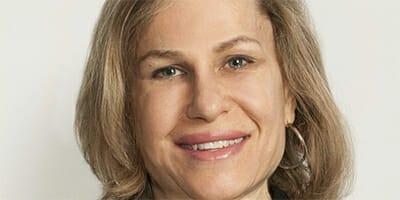

A week-long Board Effectiveness Program with peers from around the globe, including those from Canada’s HOOPP and Denmark’s ATP, has given AIMCo board member, Andrea Rosen, a new perspective on best practice.
In a business environment where most people are working harder, multi-skilling, facing lower-than-necessary resourcing, staffing and margins, a week-long course could be viewed as indulgent.
But the value of networking with global peers, discussing and implementing governance best practice, was not lost on AIMCo board member, Andrea Rosen.
Specifically, Rosen says the chance to spend time with board members of funds such as the established and prevailing HOOPP and ATP gave her a chance to expand her viewpoint.
“What was revealed to me is that HOOPP had an incredibly good track record of returns, so it was worth understanding how that happened and what they did to get that,” she says.
“I also sat next to an ATP person who said seven years ago their CEO set a mission of being the best in class in performance and service. In both of these funds it came down to structure, strategy and vision.”
Rosen, who is an experienced board member, serving on the boards of ManuLife Financial, Emera, Hiscox as well as the $70-billion AIMCO since inception five years ago, says the program provided “more data points to think about”.
Do things differently
What became evident through the intensive, highly interactive strategic program, Rosen says, is the importance of understanding how the funds got to where they are.
“For example, did they get the results because they spent $80 million on an attribution system to facilitate those sophisticated investments? There were some similarities between them in how they achieved their success. It was a good wake-up call for us and our management – that we have to go beyond the truism of good governance,” she says, which includes paying staff competitively.
“It showed the importance of understanding the nuances like what does the destination look like, how do we get there, and what are the signs to get there. It’s the setting of expectations.”
In addition the fact these funds have achieved their stellar results through out-of-the-box thinking and implementation, such as the use of derivatives, demonstrated that a fund doesn’t have to emulate other funds, and it is possible to do things differently.
“We are a bit myopic in the Canadian market that we talk about CPPIB and OTPP almost exclusively,” she says. “At this event it enabled me to get a better understanding of HOOPP’s success – they don’t get the same type of press as OTPP and CPPIB. As a board member of AIMCo, it intrigued me to look at more obscure cases of pension fund-management success.”
Specifically, she says the program examined the best-in-class attributes, examples of the specifics of success and how funds achieved them.
A higher level of responsibility
The program, which is a joint venture between the Rotman School of Management Executive Programs and ICPM and called the Rotman-ICPM Board Effectiveness Program for Pension Funds and Other Long-Horizon Investment Institutions, runs over four and a half days. In past programs it has been attended by board members from 20 funds from 10 countries.
Keith Ambachtsheer, the academic director of the program, says the program focuses less on facts and elementary board discussion, and more on the higher level responsibilities of board members to provide oversight of what is essentially a complex financial institution.
The course, held at the University of Toronto covers a history of organisation governance, rethinking fiduciary duty, a case study on boardroom dynamics, guiding and assessing investment beliefs and organisation design, a case study on OTPP, risk measurement and management, board challenges and solutions.
According to Rosen, the funds that have been successful have shown that if the mission is compelling enough, as in the case of HOOPP and ATP, it will attract the right people.
“It is management’s role to set the strategy and ours to test it,” she says. “We were doing it anyway but this program has provided us with more data points to test it. It is not good governance to put education solely in the hands of management; that is only one view. The board also needs to be responsible for education.”
AIMCo manages about $70 billion for 26 clients.








Leave a Comment
You must be logged in to post a comment.
Login