
Chicken, beef or vegetables: assessing the real environmental impact of AI

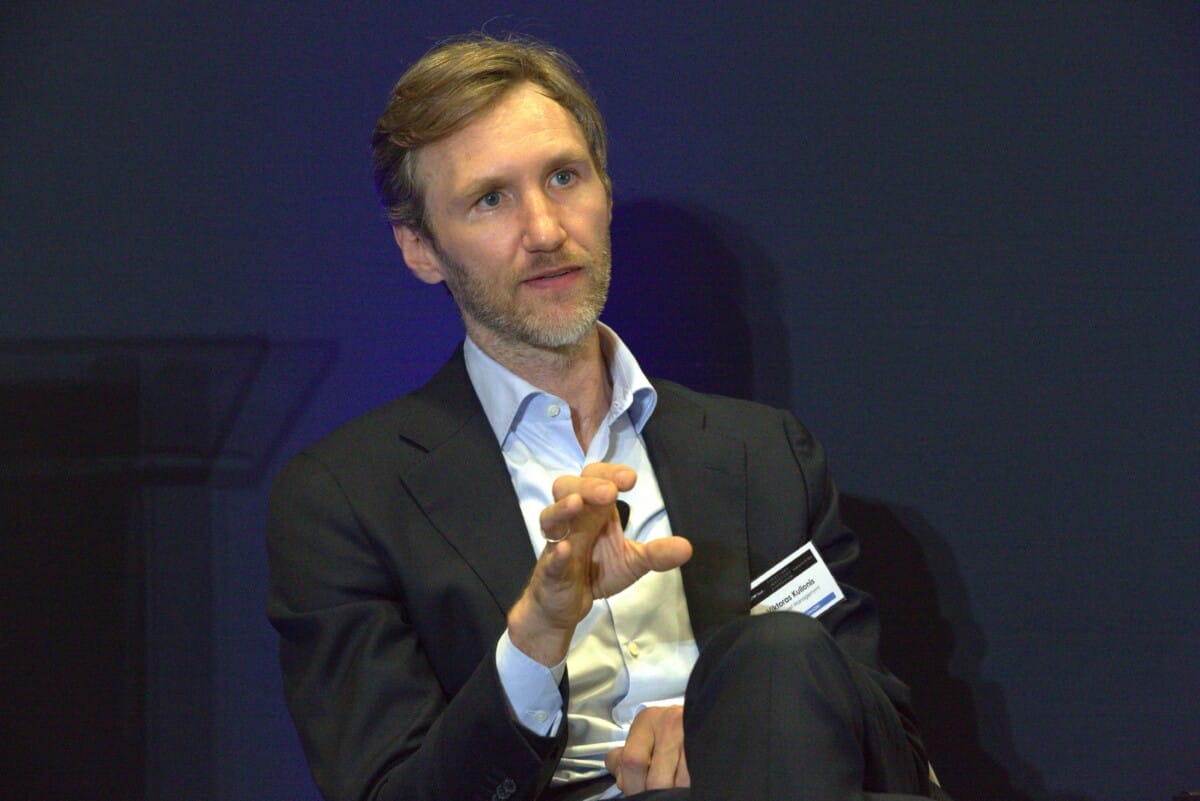
Viktoras Kulionas, investment manager and senior environmental economist at Pictet Asset Management.

Viktoras Kulionas, investment manager and senior environmental economist at Pictet Asset Management.

Producing 50 grams of protein in the form of beef produces about the same amount of carbon dioxide – roughly 19 kilograms – as 617,000 Gemini AI queries. Producing 50g of protein in the form of chicken produces an equivalent amount of CO2 to about 95,000 AI queries. And producing 50g of protein in the form of peas produces the equivalent of about 6700 queries.

The point of the analysis, presented at the Fiduciary Investors Symposium by Viktoras Kulionas, an investment manager and senior environmental economist at Pictet Asset Management, was not to spark a dietary rethink but to put AI’s environmental impact into perspective.

Kulionis said a comprehensive life cycle assessment of AI must weigh both its footprint – the impact of building and running AI systems – and its handprint, the potential positive effects of AI in cutting other industries’ emissions.

The power consumption of AI, for example, is routinely described as “obscene” or “shocking”. Some estimates suggest that if every Google search became an AI chatbot interaction, the company would consume as much electricity as Ireland. The capital investment needed to support that volume of AI interactions is estimated at $100 billion, making such a shift unlikely.

Nevertheless, such analyses “usually give an impression that AI will have a substantially negative environmental impact because it uses a lot of energy and water and also emits a lot of greenhouse gas emissions,” Kulionis told FIS.

“However, when you start to look at these numbers in a bit more detail, you start to see a different picture, a picture that is a bit more positive.”

Sponsored Content

Kulionis said the take-up of AI and AI-enabled processes can be seen as a continuation of a decoupling of GDP growth and energy consumption dating back to around 1860 and the introduction of the steam engine.

“During that period, what happened is that energy use was growing in parallel with GDP. Those two were very, very closely linked together,” he said.

“Then that relationship started to change during the Second Industrial Revolution. What happened then was that GDP continued to grow. Energy use continued to grow, but… GDP grew faster than energy use.

“That relationship changed once again around 1970s with the introduction of semiconductors, and during that time what happened is that there were even weaker links between energy use and GDP – GDP continues to grow, but energy use levels out. It still increased, but it didn’t increase as much as before.”

We are now entering potentially a fourth industrial revolution, Kulionis said, where GDP growth and energy consumption will decouple even further, and “AI is that kind of catalyst that can bring us those big changes”.

“And the question is, what will be the impact of AI? Will it have this positive impact on energy use, where it will lead to increasing energy use; or will it have this negative impact on energy use, where it will help us to reduce energy use, because it helps to achieve certain efficiencies?”

“AI is only part of – is a subset of – that entire data centre energy usage, and it’s relatively difficult to estimate,” Kulionis said.

“Different literature sources suggest that today it’s between 15 to 25 per cent, so here I assume that it is 25 per cent and if we do the numbers, then AI-related energy use would account for about 0.09 per cent of total final energy consumption globally. So it’s not a huge number, it’s not small number, but it’s not also as dramatic as some of the headlines suggest.”

Kulionis said energy demand from data centres will undoubtedly continue to increase but “it will not be the key driver for energy demand growth” – there are other categories such as electrification of industry, air conditioning and electric vehicles that will contribute significantly more to that growth in energy demand.

The handprint of AI can be very significant, Kulionis said. For example, the aviation industry is responsible for about 3 per cent of global climate change through aeroplane emissions and through contrails that can trap heat and prevent it from escaping the atmosphere.

“If you change the flight path of your plane, you can reduce these contrails,” Kulionis said. An analysis of flight paths suggested that “about 54 per cent of these contrails could be reduced, if you slightly modify that route”.

“You would be able to reduce that climate change impact by about 0.57 per cent and… this application alone, if it would be successful, would be more than enough to offset entire data centre emissions,” he said.

“So it’s quite substantial, and that’s only one application.”

The key insight, Kulionis said, is that “AI has a footprint, but in a grand scale of things, that footprint remains modest and not large”.

“It’s also likely to remain small because of grid decarbonisation,” he said.

“But there are also some things that are important to keep in mind and monitor, and one of those things is water usage, especially water usage in water-stressed regions.

“And if we put everything together the key message or insight that we get here is that the downside associated with AI, the downside on the environment, seems to be limited, but the potential upside can be huge because of all these positive impacts.”

Be part of the conversation next year – register now for the Fiduciary Investors Symposium Stanford 2026. Asset owners only. 

Our next event is at the University of Oxford, November 4-6 2025. Register today – asset owners only. 

Leave a Comment

Condoleezza Rice: Globalisation’s borderless era is coming undone

Condoleezza Rice: Globalisation’s borderless era is coming undone

Condoleezza Rice, the 66th US Secretary of State and current director of Stanford University’s Hoover Institution, said the new world order will have several characteristics of which there are already signs: more protectionist trade policies, a redistribution of security burdens, and louder voices for those marginalised in globalisation. 

Sort content by

Investors unpack regime-based portfolio thinking 

Funds are operating in an extraordinary environment, with Scott Chan, chief investment officer of CalSTRS, saying he has never witnessed so many “large shifts stacked on top of the other” in his investment career. Amid the change, investors are increasingly shifting to a scenario and regime-based asset allocation.  

AI investors face post-Moore’s Law reality

Mark Horowitz, a leading computer scientist and electrical engineer at Stanford University, has declared that Moore’s Law is “basically over”, which will have significant ramifications for artificial intelligence investors who are counting on more computing power to feed into more complex models.  

Public-private partnerships key to fixing US infrastructure

The size of the current infrastructure investment gap and the speed at which it is widening mean there is both a desire and a need for more public-private partnerships to unlock funding. Investors say that collaboration with local governments and raising public awareness of private investment benefits are crucial. 

Federal backing vital for US innovation: Stanford president 

Stanford president Jonathan Levin said the university’s top priority is maintaining the partnership with the federal government while safeguarding its operational freedom, as the institution balances financial reliance on Washington and political scrutiny from the Trump administration. 

Debt beats equity in data centre boom as scarce capital lifts credit yields

Asset owners continue to weigh up the shifting risk-return attributes of the booming data centre sector including deal structures, refinancing, energy requirements, and the future of AI.

Why CalPERS doesn’t want to miss the climate revolution

If CalPERS had put more money into the Silicon Valley companies in its own backyard earlier it might be fully funded by now, jokes its sustainable investment head. But it won’t miss the same opportunities in climate investing.