
How AI will propel quant 2.0

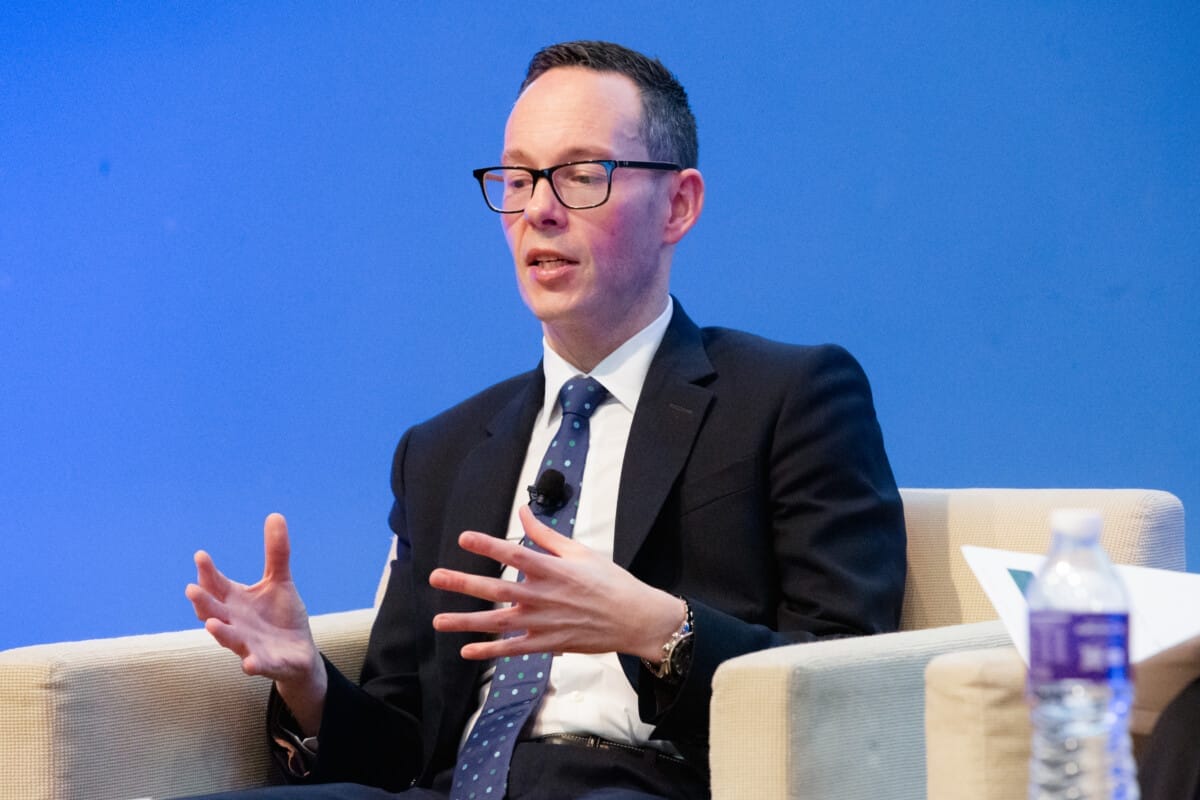
David Wright. Photo: Jack Smith

Data analysis driven by machine learning is generating as much as 50 per cent of alpha in certain equities strategies managed by Pictet Asset Management, according to its head of quantitative investment David Wright. 

At the Top1000funds.com Fiduciary Investors Symposium, Wright said AI will not only provide drastic efficiency gain for traditional stock pickers but also will be a defining part of “quant 2.0”. 

“The arrival of machine learning in the quant space is not a revolution. It’s a part of a much longer evolution in the requirement for more data, more technology, and more computing speed,” he told the symposium in Singapore.  

“It was the early 2010s when machine learning was first looked at by quants, predominantly as a way of analysing new types of data or text documents with natural language processing. 

“This was done in response to the crisis that happened in the quant industry at the underperformance of a lot of traditional risk premia. 

“Today, quants are using a variety of different machine learning strategies to support our investment processes.” 

Sponsored Content

Wright said Pictet has been running AI-driven long/short and long-only strategies for several years, which currently manage $2 billion. They have a machine learning component to make short-term stock forecasts. Its process consists of data preparation – such as determining what data points to use and defining the target – then model training and prediction.  

He explained that the so-called “conditioning” element of AI-driven quant, which analyses and acts upon the interaction of different non-linear data points, is what sets it apart.  

“[It’s] almost rules-based, like don’t follow an analyst upgrade at this point because the stock is heavily shorted and it’s near to its reporting period,” he said. 

“That conditioning piece is what you don’t get from a traditional quant model. 

“That’s probably generating 50 per cent of the alpha that we’ve seen, that’s consistently between long-only and long/short, and we see it pretty consistently quarter-on-quarter as well.” 

[click to enlarge]
Machine learning is also helping to overcome another key quant-investing challenge in the trade-off between a model’s complexity and its accuracy. Wright highlighted that traditionally, overtly simple or complex quant models both run the risk of reduced accuracy, as they either have too little information to make an accurate prediction or become over-fitted for the ultimate investment process. 

“With linear models, what we spend a lot of our time doing is trying to work out where the bottom of that U [shape] is,” he said. 

“Now machine learning offers the potential that we don’t have to spend the time looking for that optimal point.” 

Staying ahead of the game

However, Wright said in response to a question from the audience that it is very difficult to “build a moat” in AI-driven quant investing.  

“I don’t think we have a data source that no one else has. I don’t think we start with an algorithm that no one else could use. I don’t think we have an implementation that no one else could use,” he said.  

“In the same way quant has always been, if you’ve got to a point that there are people following you, you’ve got to make sure when they get to where you are, you’re not there anymore. 

“You continue to add more data, continue to refine your algorithms, continue to refine your implementation. 

“I think it’s trying to make every single part of the process as effective as possible, but don’t be naive and think [in] any one single part of it, no one else could do well.” 

This also provides considerations for asset owners in their manager selection process if they are thinking of tapping into AI-driven quant strategies.  

When this happens, Wright said they are in search of five key things: pure alpha stripped of any common factor effects; active returns that are independent of market regime; strategies customisable according to their needs such as risk level or ESG; strategies that are implementable in different ways; and data transparency. 

Different manager models have different pathways: for example, what type of learning does it use? Is it supervised learning? What are they forecasting? Are they going to be economically driven or data driven?  

Wright encouraged asset owners to understand exactly what they want from the strategies.  

“A lot of the decisions that you make as humans start to send you off in different directions,” he said. 

 “It gives me a lot of comfort that even if you take the same starting point, you’re not going to get to the same place as a lot of your competitors.” 

Leave a Comment

The world in flux and Trump’s role in a new equilibrium

The world in flux and Trump’s role in a new equilibrium

The second Trump administration has so far brought a lot of things: market shocks, volatile trade policies, and turbulent foreign relationships. But beyond the chaos, renowned geopolitics expert Stephen Kotkin says Trump has an unwitting role to help the world rebalance and reach a “new equilibrium” in the global order.

Sort content by

Why the energy transition won’t die with Trump 2.0

Despite the uptick in anti-ESG sentiment that’s come with Donald Trump’s return to the White House, large institutional investors are certain that innovations in transition technology will continue and that the broader world has not changed course on the journey to decarbonisation.  

How Asia-Pacific investors can navigate Trump’s America first plan

President Trump is dramatically reshaping geopolitics, creating new risks and opportunities for investors across the Asia-Pacific.

How new technologies are changing the game in private markets

With the ability to uncover hard-to-find information and enable more frequent trading in traditionally illiquid asset classes, new technologies like artificial intelligence and tokenisation could be the biggest disruption most private markets investors will see in their lifetime. 

How capital markets became a weapon of choice in great power conflict

Capital markets continue to be a key battlefield of power between Beijing and Washington, and whether the yuan has a serious chance of taking over the dollar as the international currency is the next big question for the world economic order. 

Investors brace for life after the US dollar 

A world where the US dollar is no longer the reserve currency seems increasingly likely by the day, and institutional investors are wary that it could fundamentally change the way they construct portfolios. 

Future of Asia now ‘a more difficult story’ as multilateralism crumbles

The global environment in which small Asian economies have thrived over the past seven decades is being dismantled as the US retreats as an advocate of multilateralism, globalisation and internationalism, warned leading geopolitics academic and economist Danny Quah.