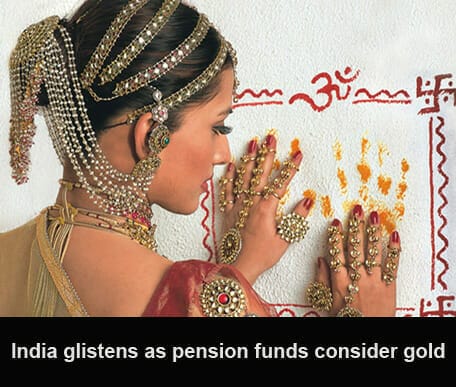
Indian festivities glisten as pension funds consider gold

Uncertainty about whether inflation or deflation is the greater threat in the US and Europe, coupled with record prices for – and individual investor buying of – gold, have prompted an unusual level of interest in the yellow metal by pension funds.

Historically, pension funds and other institutional investors have generally shunned the gold market, for various reasons. Gold produces no income, costs money to store and is subject to supply fluctuations when governments enter the market. However, gold is a very good hedge against inflation.

Exposure to gold by pension funds in recent years has generally been through commodities funds. According to US broker Morgan Gold, a typical allocation of 3 per cent to commodities will contain about 0.15 percentage points of gold.

CalSTRS, the second-largest fund in the US, has recently followed the slightly larger CalPERS with an allocation to commodities including gold, according to Morgan Gold.

The broker says some UK funds have even shown an interest in making direct gold investments.

Gold exchange traded funds (ETFs) tracked by the World Gold Council had a record total holdings of 2,070 tonnes (worth $87 billion) at the end of September.

Sponsored Content

Gold is now in its 10th straight year of gains, sitting at the near record price of $1,415 an ounce early this week.

But demand has been falling since the global crisis started to bite in 2008 and the price rises drove people away from buying gold jewellery.

Now, according to the World Gold Council, the drop in demand has slowed and the world’s biggest buyer of gold, India, is set for a resurgence despite the record price for gold.

The council expects the current festive season in India to reverse the small decline in demand evident through the first half of this year.


Leave a Comment

Sort content by

Schapiro considers action on pay to play

The US Securities and Exchange Commission (SEC) is currently considering pay-to-play activities and will report back on any proposed action in the next few weeks, according to its chairman Mary Schapiro, speaking via video at the annual International Corporate Governance Network conference this week. mrec4inarticleinline Sponsored Content scnative1 scnative2 scnative3

Hermes chief calls for mandate overhaul

Pension funds should demand an overhaul in the product offerings of funds managers and change the terms of mandates to incorporate environmental, social and governance issues in portfolios, according to Colin Melvin, chief executive of Hermes Equity Ownership Services, who pointed to a number of funds in the UK, including the owner of Hermes, BT

How to allocate if the world has changed forever

The financial crisis has challenged pension funds to rethink standard asset allocation models, but as Jonathan Armitage, head of US equities at Schroders observes, a lot of investors are questioning whether they need to react. mrec4inarticleinline Sponsored Content scnative1 scnative2 scnative3

Crisis fails to derail support for ESG

A new report commissioned by the International Finance Corporation (IFC), a member of the World Bank Group, has found environmental, social and governance investment criteria in emerging markets are being embraced by most of the asset management community despite the economic crisis. mrec4inarticleinline Sponsored Content scnative1 scnative2 scnative3

USS, ABP and PGGM collaborate on real estate

Three of Europe’s largest institutional investors have teamed up to investigate the way environmental issues are assessed and managed by real estate companies. mrec4inarticleinline Sponsored Content scnative1 scnative2 scnative3

Shareholder influence under question: ICGN conference

The ability to appoint and dismiss company board directors is the most important shareholder right according to an overwhelming majority of delegates at the International Corporate Governance Network (ICGN) annual conference, who were more cautious on whether shareholders could actually influence corporate governance once they had the right to vote. mrec4inarticleinline Sponsored Content scnative1 scnative2

Previous



