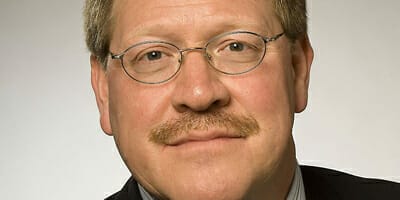
Eijffinger’s decade of financial repression

Financial repression will define the economic landscape for at least another decade, according to professor of financial economics at Tilburg University, Sylvester Eijffinger, which has serious implications for institutional investors.

Eijffinger, who also is also a visiting professor at Harvard, sits on the monetary experts panel of the European Union and is an adviser to the International Monetary Fund, says negative interest rates are the major issue of our time.

Negative real interest rates are here to stay, a realisation that has huge implications for investors.

“Governments have to de-leverage risk in times of low growth and they are not prepared to increase taxes; they have to do it with financial repression,” he says. “As an investor, be prepared. You have to realise that low interest rates are here to stay at the short-end and possibly at the long-end of the yield curve. This has huge implications for investments.”

By way of example, he says the European Central Bank’s policy rate stands at 0.5 per cent, while the eurozone’s annual inflation rate is 2.5 per cent. The Bank of England keeps its policy rate at only 0.5 per cent, despite an inflation rate that hovers above 2 per cent. And, in the United States, where inflation exceeds 2 per cent, the Federal Reserve’s benchmark federal funds rate remains at an historic low of 0 to 0.25 per cent.

This will be the financial and economic environment of the immediate future.

Sponsored Content

He says negative interest rates, which he describes as a kind of wealth tax, are necessary for governments to de-risk, but they come at the expense of savers.

“People who save should be aware that governments need to do this for at least a decade,” he says.

Eijffinger will give a keynote address at the Fiduciary Investors Symposium, an event that brings together institutional investors to examine the power and responsibility of fiduciary investment.

The event, which is convened by Conexus Financial, the publisher of conexust1f.flywheelstaging.com, will be held in Amsterdam from October 20 to 22, 2013. www.fiduciaryinvestor.com

Read an article by Eijffinger on the subject here.



Leave a Comment

Sort content by

Pensionomics,
a money-go-round

As debate rages in the US about the generous retirement benefits and high cost of state and local defined benefit (DB) schemes, new research sheds light on the role these funds play in stimulating the economy and creating jobs. Pensionomics 2012: Measuring the Economic Impact of DB Pension Expenditures looks at the effect of DB

Total cost shakedown at CalPERS

Up to 8.9 basis points will be slashed from the total cost of managing the CalPERS’ investment portfolio in the next three years, under a new investment resource strategy which could also see internal administration costs increase by $6.5 million next year, and internal staff accountable for internal versus external management allocations. The internal investment

ESG almost an afterthought

Only 26 of 4300 companies surveyed by Governance Metrics International (GMI) have a specific clause that measures executive compensation against a sustainability metric, and institutional investors play a pivotal role in transforming this behaviour. Kimberly Gladman, director of research and risk analytics at the governance research company GMI, says investors should set the expectations that

Broader engagement at UNPRI

The United Nations Principles of Responsible Investment (UNPRI) will expand its focus beyond the micro focus of ESG implementation for its signatories to include thought-leadership research and public and policy debate, writes Amanda White. James Gifford, executive director at UNPRI, said the new strategy came out of its board meeting last week in Australia and

Are hedge fund investors getting what they paid for?

Alternative hedge fund beta allows investors to access the returns generated by hedge funds without the pressures of finding alpha, says Fama family professor of finance at the University of Chicago Booth School of Business, Tobias Moskowitz. Moskowitz says there are three components to hedge fund returns: unique alpha, traditional market beta, and “something else”,

Fund collaboration first step to joint investment

European pension fund service providers PGGM and PKA have agreed on an innovative knowledge exchange that eventually aims to look for joint investment opportunities as well as improving the way the funds conduct risk management and the benchmarking of investments, costs and socially responsible investing.mrec4inarticleinline Sponsored Content scnative1 scnative2 scnative3

Previous




