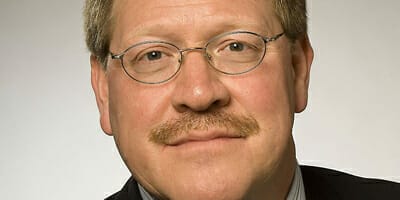
Eijffinger’s decade of financial repression

Financial repression will define the economic landscape for at least another decade, according to professor of financial economics at Tilburg University, Sylvester Eijffinger, which has serious implications for institutional investors.

Eijffinger, who also is also a visiting professor at Harvard, sits on the monetary experts panel of the European Union and is an adviser to the International Monetary Fund, says negative interest rates are the major issue of our time.

Negative real interest rates are here to stay, a realisation that has huge implications for investors.

“Governments have to de-leverage risk in times of low growth and they are not prepared to increase taxes; they have to do it with financial repression,” he says. “As an investor, be prepared. You have to realise that low interest rates are here to stay at the short-end and possibly at the long-end of the yield curve. This has huge implications for investments.”

By way of example, he says the European Central Bank’s policy rate stands at 0.5 per cent, while the eurozone’s annual inflation rate is 2.5 per cent. The Bank of England keeps its policy rate at only 0.5 per cent, despite an inflation rate that hovers above 2 per cent. And, in the United States, where inflation exceeds 2 per cent, the Federal Reserve’s benchmark federal funds rate remains at an historic low of 0 to 0.25 per cent.

This will be the financial and economic environment of the immediate future.

Sponsored Content

He says negative interest rates, which he describes as a kind of wealth tax, are necessary for governments to de-risk, but they come at the expense of savers.

“People who save should be aware that governments need to do this for at least a decade,” he says.

Eijffinger will give a keynote address at the Fiduciary Investors Symposium, an event that brings together institutional investors to examine the power and responsibility of fiduciary investment.

The event, which is convened by Conexus Financial, the publisher of conexust1f.flywheelstaging.com, will be held in Amsterdam from October 20 to 22, 2013. www.fiduciaryinvestor.com

Read an article by Eijffinger on the subject here.



Leave a Comment

Sort content by

Top1000funds.com audience using social media for business

Thank you to all our readers who responded to the Top1000funds.com Audience Behaviour Survey. The survey’s overall aim was to allow us to better tailor our portfolio of products and events to you our readers. Some of the interesting findings included that our typical reader is aged between 41 and 50 and earns between $96,000

Global property lures investors

Property investors should look beyond the current languid growth in developed market economies and position their portfolios for a recovery in the world economy in 2013 and 2014, Mark Roberts the global head of RREEF Real Estate says. Roberts, who also chairs the National Council of Real Estate Investment Fiduciaries (NCREIF), points to initial yield

Why Global Investment Matters

The recent rally on global markets does not mean that the risk environment has abated Towers Watson’s global head of investment Carl Hess has warned. Speaking from New York prior to the launch of the consultant’s report Global Investment Matters, Hess says that while the risk of the imminent collapse of financial markets has lessened,

Extracting value from managers

Three funds find effective ways to get better value from staff, co-investment and private markets. The Danish ATP, Australian Sunsuper and the Teachers Retirement System of Texas are among the funds looking at innovative ways to extract value and interact with the managers of their private equity allocations. Institutional investors are increasingly seeking new ways

Limited partners hold fee-bargaining power

In a harsh capital-raising climate, ATP Private Equity Partners and TRS have different startegies on how to drive hard bargains on private equity fees. Institutional investors are gaining concessions on private equity management fees, with a near-record number of funds on the road seeking funds resulting in a shift in bargaining power to limited partners.

Infrastructure – fewer fees, please

Public pension funds make up almost a quarter of the world’s 100 largest institutional investors in infrastructure and, while still favouring unlisted funds, they are increasingly investing directly and pushing back on management fees, research reveals. The research by global alternatives research firm, Preqin, shows a record number of funds on the road seeking a

Previous




