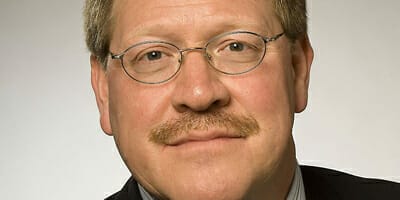
Eijffinger’s decade of financial repression

Financial repression will define the economic landscape for at least another decade, according to professor of financial economics at Tilburg University, Sylvester Eijffinger, which has serious implications for institutional investors.

Eijffinger, who also is also a visiting professor at Harvard, sits on the monetary experts panel of the European Union and is an adviser to the International Monetary Fund, says negative interest rates are the major issue of our time.

Negative real interest rates are here to stay, a realisation that has huge implications for investors.

“Governments have to de-leverage risk in times of low growth and they are not prepared to increase taxes; they have to do it with financial repression,” he says. “As an investor, be prepared. You have to realise that low interest rates are here to stay at the short-end and possibly at the long-end of the yield curve. This has huge implications for investments.”

By way of example, he says the European Central Bank’s policy rate stands at 0.5 per cent, while the eurozone’s annual inflation rate is 2.5 per cent. The Bank of England keeps its policy rate at only 0.5 per cent, despite an inflation rate that hovers above 2 per cent. And, in the United States, where inflation exceeds 2 per cent, the Federal Reserve’s benchmark federal funds rate remains at an historic low of 0 to 0.25 per cent.

This will be the financial and economic environment of the immediate future.

Sponsored Content

He says negative interest rates, which he describes as a kind of wealth tax, are necessary for governments to de-risk, but they come at the expense of savers.

“People who save should be aware that governments need to do this for at least a decade,” he says.

Eijffinger will give a keynote address at the Fiduciary Investors Symposium, an event that brings together institutional investors to examine the power and responsibility of fiduciary investment.

The event, which is convened by Conexus Financial, the publisher of conexust1f.flywheelstaging.com, will be held in Amsterdam from October 20 to 22, 2013. www.fiduciaryinvestor.com

Read an article by Eijffinger on the subject here.



Leave a Comment

Sort content by

Kay calls for philosophical shift

In an interview with conexust1f.flywheelstaging.com, John Kay, economist and author of the UK government-commissioned enquiry into long termism and the UK equity markets, has said it is “fanciful to imagine large number of trustees will have the skills and knowledge to have long-term relationships with corporates”. Kay says the key players in the UK equity

UK equity allocation falls

Equity allocation by UK pension schemes continues to fall, but the assets are being re-allocated into “everything else except gilts”, according to Mercer chief investment officer, Andrew Kirton. Last year equities allocations by UK pension funds fell by 5 per cent, according to Mercer, as they attempt to deal with the enormous amount of pension

CalSTRS considers
asset risk factors

The $152.5-billion Californian State Teachers Retirement System (CalSTRS) is undertaking an asset-allocation review that will consider the underlying risk factors of assets for the first time. Chris Ailman, chief investment officer of CalSTRS, says the fund is in the middle of an asset-allocation study, which would likely take six months, and would take a different

Natixis champions
Asian alternatives

In a bid to achieve long-term returns without incurring the risk of today’s choppy markets, Asia’s biggest institutional investors are increasingly opting for alternatives in their asset allocation. The majority of respondents in a survey of 120 Asian institutional investors no longer deem long-held industry norms – such as lengthy holding periods or conventional 60/40

PIP in to infrastructure

A swathe of UK pension funds is poised to increase its exposure to infrastructure. In a small start, which enthusiasts believe will quickly grow, the Pension Infrastructure Platform (PIP) will launch as a fund in January 2013, targeting £2 billion ($3.24 billion) worth of projects with the backing of around 10 UK pension funds. The

Complexity: thinking ahead

Complexity is, well complex. And as trite as that sounds, it’s something investors, even professional investors, don’t understand well enough, according to Tim Hodgson, head of the Thinking Ahead Group at Towers Watson. The Thinking Ahead Group (TAG), as has been reported here before, gets paid to think – a gig conexust1f.flywheelstaging.com is envious of.

Previous




