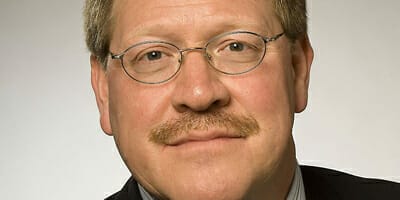
Eijffinger’s decade of financial repression

Financial repression will define the economic landscape for at least another decade, according to professor of financial economics at Tilburg University, Sylvester Eijffinger, which has serious implications for institutional investors.

Eijffinger, who also is also a visiting professor at Harvard, sits on the monetary experts panel of the European Union and is an adviser to the International Monetary Fund, says negative interest rates are the major issue of our time.

Negative real interest rates are here to stay, a realisation that has huge implications for investors.

“Governments have to de-leverage risk in times of low growth and they are not prepared to increase taxes; they have to do it with financial repression,” he says. “As an investor, be prepared. You have to realise that low interest rates are here to stay at the short-end and possibly at the long-end of the yield curve. This has huge implications for investments.”

By way of example, he says the European Central Bank’s policy rate stands at 0.5 per cent, while the eurozone’s annual inflation rate is 2.5 per cent. The Bank of England keeps its policy rate at only 0.5 per cent, despite an inflation rate that hovers above 2 per cent. And, in the United States, where inflation exceeds 2 per cent, the Federal Reserve’s benchmark federal funds rate remains at an historic low of 0 to 0.25 per cent.

This will be the financial and economic environment of the immediate future.

Sponsored Content

He says negative interest rates, which he describes as a kind of wealth tax, are necessary for governments to de-risk, but they come at the expense of savers.

“People who save should be aware that governments need to do this for at least a decade,” he says.

Eijffinger will give a keynote address at the Fiduciary Investors Symposium, an event that brings together institutional investors to examine the power and responsibility of fiduciary investment.

The event, which is convened by Conexus Financial, the publisher of conexust1f.flywheelstaging.com, will be held in Amsterdam from October 20 to 22, 2013. www.fiduciaryinvestor.com

Read an article by Eijffinger on the subject here.



Leave a Comment

Sort content by

Brussels ‘cooking up real estate shock’

The European Union is threatening to drive pension funds out of real estate investments, experts warn. That could be one of the undesirable results of plans to put pension funds under new risk regulations akin to the Solvency II requirements for the continent’s insurers. What most concerns John Forbes, a PriceWaterhouseCoopers real estate expert, is

Size and scalability up, fees down

The world’s largest asset managers should be using the advantages of their size and scalability to adjust their fee structures, according to Craig Baker, the global head of manager research at Towers Watson, which just released this year’s Pensions & Investments/Towers Watson World 500. “The advantage of large managers is [that] they could structure their

300 Club roots for stewardship over salesmanship

The 300 Club is a rare group that combines long-term thinking and asset management provision. Taking on an industry that is evolving from client-driven to product-driven, the 300 Club is proposing a fundamental mindset shift from short-term salesmanship to long-term stewardship. In this paper, chief investment officer of Kempen Capital Management in the Netherlands, Lars

Aligning asset owners and managers

Delegation is a fundamental obstacle to the alignment of asset-owner and asset-manager goals. However, Sebastien Pouget, professor of finance at the University of Toulouse, believes a combination of customised performance benchmarks and a dual short and long-term fee incentive can help overcome the problems of the principal/agent relationship. Pouget, who spoke at the recent United

Danish pension is gold

Denmark has blitzed the pension-system competition, being awarded the first Mercer Global Pension Index A grading. In the process, it has relegated the Dutch and Australian systems to second and third places, respectively, after four years. Mercer senior partner and report author, David Knox, says the reasons for awarding Denmark the top grade were clear.

Taking the future into account

At the International Centre for Pension Management’s biannual meeting in London, Jack Gray and Generation’s David Blood had a tête à tête on sustainability. An academic at the Paul Woolley Centre for Capital Market Dysfunctionality at the University of Technology Sydney, Gray has written a paper, Misadventures of an Irresponsible Investor, that at its core

Previous




