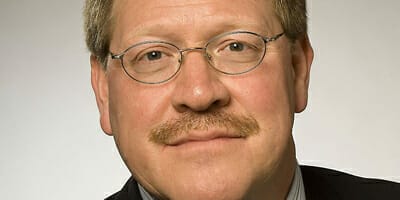
Eijffinger’s decade of financial repression

Financial repression will define the economic landscape for at least another decade, according to professor of financial economics at Tilburg University, Sylvester Eijffinger, which has serious implications for institutional investors.

Eijffinger, who also is also a visiting professor at Harvard, sits on the monetary experts panel of the European Union and is an adviser to the International Monetary Fund, says negative interest rates are the major issue of our time.

Negative real interest rates are here to stay, a realisation that has huge implications for investors.

“Governments have to de-leverage risk in times of low growth and they are not prepared to increase taxes; they have to do it with financial repression,” he says. “As an investor, be prepared. You have to realise that low interest rates are here to stay at the short-end and possibly at the long-end of the yield curve. This has huge implications for investments.”

By way of example, he says the European Central Bank’s policy rate stands at 0.5 per cent, while the eurozone’s annual inflation rate is 2.5 per cent. The Bank of England keeps its policy rate at only 0.5 per cent, despite an inflation rate that hovers above 2 per cent. And, in the United States, where inflation exceeds 2 per cent, the Federal Reserve’s benchmark federal funds rate remains at an historic low of 0 to 0.25 per cent.

This will be the financial and economic environment of the immediate future.

Sponsored Content

He says negative interest rates, which he describes as a kind of wealth tax, are necessary for governments to de-risk, but they come at the expense of savers.

“People who save should be aware that governments need to do this for at least a decade,” he says.

Eijffinger will give a keynote address at the Fiduciary Investors Symposium, an event that brings together institutional investors to examine the power and responsibility of fiduciary investment.

The event, which is convened by Conexus Financial, the publisher of conexust1f.flywheelstaging.com, will be held in Amsterdam from October 20 to 22, 2013. www.fiduciaryinvestor.com

Read an article by Eijffinger on the subject here.



Leave a Comment

Sort content by

The changing nature of fixed income

As the fixed income asset class undergoes rapid change and the opportunity set expands, unconstrained bond funds have become popular. But as this article examines, with that expanded opportunity set comes new considerations including a wider risk/return spectrum among managers.   Trends in the global investment universe tend to come around every six months or

McKinsey’s tips on sustainability integration

More companies are recognising sustainability as a core business issue, but according to McKinsey and Company they are still failing to capture its full value, in particular struggling with incorporating it into organisational processes such as performance management. A McKinsey global survey, garnering responses from 3,344 executives from the full range of regions, company size

Long term investing and infrastructure

There has been some ambiguity about what being a long-term investor means. For Australia’s Future Fund it means focusing on a few key aspects of our investments: understanding value, the ability to make and implement portfolio decisions and manager alignment. In this speech at the ASFA Global Investment Forum on infrastructure and long-term investment, Raphael

Where does the next generation of fund managers come from?

According to Malcolm Gladwell’s Outliers, at least 10,000 hours of practice is needed to be a success at your chosen profession. This means that a fund manager will hit their strides around age 40. But the London Business School is giving its students a leg up in that quest to find success. They have real-life

The meaning of fiduciary duty

The UK Law Commission has delivered its final report on how the law of fiduciary duties applies to investment intermediaries and an evaluation of whether the law works in the interests of the ultimate beneficiaries. The project was commissioned by the Department for Business, Innovation and Skills (BIS) and the Department for Work and Pensions

New leadership prompts strategy review at ICPM

A decade since the formation of the Rotman International Centre for Pension Management is a good time to review the organisation’s raison d’etre. Amanda White spoke to ICPM chair, Barbara Zvan, chief investment risk officer of Ontario Teachers’ Pension Plan, and the outgoing and incoming executive directors, Keith Ambachtsheer and Rob Bauer.   “There is

Previous




