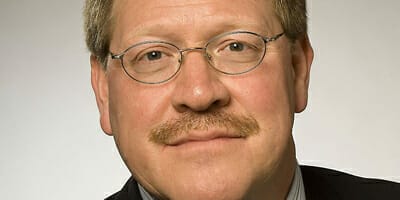
Eijffinger’s decade of financial repression

Financial repression will define the economic landscape for at least another decade, according to professor of financial economics at Tilburg University, Sylvester Eijffinger, which has serious implications for institutional investors.

Eijffinger, who also is also a visiting professor at Harvard, sits on the monetary experts panel of the European Union and is an adviser to the International Monetary Fund, says negative interest rates are the major issue of our time.

Negative real interest rates are here to stay, a realisation that has huge implications for investors.

“Governments have to de-leverage risk in times of low growth and they are not prepared to increase taxes; they have to do it with financial repression,” he says. “As an investor, be prepared. You have to realise that low interest rates are here to stay at the short-end and possibly at the long-end of the yield curve. This has huge implications for investments.”

By way of example, he says the European Central Bank’s policy rate stands at 0.5 per cent, while the eurozone’s annual inflation rate is 2.5 per cent. The Bank of England keeps its policy rate at only 0.5 per cent, despite an inflation rate that hovers above 2 per cent. And, in the United States, where inflation exceeds 2 per cent, the Federal Reserve’s benchmark federal funds rate remains at an historic low of 0 to 0.25 per cent.

This will be the financial and economic environment of the immediate future.

Sponsored Content

He says negative interest rates, which he describes as a kind of wealth tax, are necessary for governments to de-risk, but they come at the expense of savers.

“People who save should be aware that governments need to do this for at least a decade,” he says.

Eijffinger will give a keynote address at the Fiduciary Investors Symposium, an event that brings together institutional investors to examine the power and responsibility of fiduciary investment.

The event, which is convened by Conexus Financial, the publisher of conexust1f.flywheelstaging.com, will be held in Amsterdam from October 20 to 22, 2013. www.fiduciaryinvestor.com

Read an article by Eijffinger on the subject here.



Leave a Comment

Sort content by

Real credit the only opportunity in the new regime: Watson Wyatt

Investors must recognise that the economic world has changed and not expect normal asset price reversion in the future, says Carl Hess, Watson Wyatt’s global head of investment consulting. mrec4inarticleinline Sponsored Content scnative1 scnative2 scnative3

Swedish AP funds exclude 10 companies due to ethical breaches

Sweden’s first four buffer funds, with combined assets of SEK 690.6 billion (US$83 billion) have demonstrated a lack of tolerance for companies that continue to breach ethical guidelines despite the funds’ governance efforts to bring about change, excluding 10 companies from their investment universe. mrec4inarticleinline Sponsored Content scnative1 scnative2 scnative3

…while ICGN urges IASC to prioritise investors’ views in accounting

The International Corporate Governance Network (ICGN), with members from 47 countries responsible for global assets of US$15 trillion, has urged the International Accounting Standards Committee (IASC) to prioritise investors, not auditors, as the key stakeholders in the setting of global financial reporting standards. mrec4inarticleinline Sponsored Content scnative1 scnative2 scnative3

Modern Portfolio Theory still holds up Harry Markowitz says so.

In an exclusive interview, Amanda White, editor of top1000funds.com, talks to the modern portfolio theorist about markets, portfolio rebalancing, Madoff and more. mrec4inarticleinline Sponsored Content scnative1 scnative2 scnative3

Economic recovery will bring inflation back from the dead: Partners Group

Government efforts to defend economies from the global downturn – primarily official interest rate cuts and spending packages – could make inflation a significant threat to investors’ portfolios once the crisis has run its course, according to Urs Wietlisbach, executive vice chairman of Partners Group, a CHF24 billion (US$21 billion) alternatives manager. mrec4inarticleinline Sponsored Content

Should hedge funds delay taking performance fees?

The US$173 billion California Public Employees’ Retirement System (CalPERS) is restructuring the relationships it has with its hedge fund managers and calling for fees to be based on long-term rather than short-term performance. CalPERS said performance fees should be judged on a long-term basis, and mechanisms such as delayed realisations and clawbacks can better align

Previous




