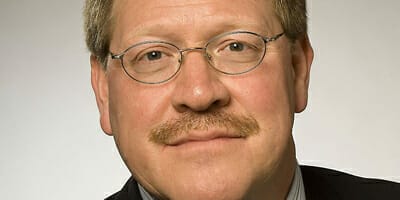
Eijffinger’s decade of financial repression

Financial repression will define the economic landscape for at least another decade, according to professor of financial economics at Tilburg University, Sylvester Eijffinger, which has serious implications for institutional investors.

Eijffinger, who also is also a visiting professor at Harvard, sits on the monetary experts panel of the European Union and is an adviser to the International Monetary Fund, says negative interest rates are the major issue of our time.

Negative real interest rates are here to stay, a realisation that has huge implications for investors.

“Governments have to de-leverage risk in times of low growth and they are not prepared to increase taxes; they have to do it with financial repression,” he says. “As an investor, be prepared. You have to realise that low interest rates are here to stay at the short-end and possibly at the long-end of the yield curve. This has huge implications for investments.”

By way of example, he says the European Central Bank’s policy rate stands at 0.5 per cent, while the eurozone’s annual inflation rate is 2.5 per cent. The Bank of England keeps its policy rate at only 0.5 per cent, despite an inflation rate that hovers above 2 per cent. And, in the United States, where inflation exceeds 2 per cent, the Federal Reserve’s benchmark federal funds rate remains at an historic low of 0 to 0.25 per cent.

This will be the financial and economic environment of the immediate future.

Sponsored Content

He says negative interest rates, which he describes as a kind of wealth tax, are necessary for governments to de-risk, but they come at the expense of savers.

“People who save should be aware that governments need to do this for at least a decade,” he says.

Eijffinger will give a keynote address at the Fiduciary Investors Symposium, an event that brings together institutional investors to examine the power and responsibility of fiduciary investment.

The event, which is convened by Conexus Financial, the publisher of conexust1f.flywheelstaging.com, will be held in Amsterdam from October 20 to 22, 2013. www.fiduciaryinvestor.com

Read an article by Eijffinger on the subject here.



Leave a Comment

Sort content by

Global search activity down, but US pension funds hire and fire

US pension funds increased their manager search activity in 2008 on the back of large losses in equity markets, while funds in the UK, Europe and Australia ditched searches to concentrate on strategy issues. mrec4inarticleinline Sponsored Content scnative1 scnative2 scnative3

ICGN appoints Rosen to ex dir as Simpson departs to CalPERS

The International Corporate Governance Council (ICGN) has appointed Carl Rosen, head of corporate governance at the Second Swedish National Pension Fund (AP2), as its new executive director replacing Anne Simpson who will join CalPERS as senior portfolio manager for corporate governance this month. mrec4inarticleinline Sponsored Content scnative1 scnative2 scnative3

Australian Future Fund piles into debt

The $A51.2 billion ($37.9 billion) Australian Future Fund has quintupled its allocation to debt in the past year, significantly upweighting its exposure to debt securities in the last quarter to 21.9 per cent of the fund. mrec4inarticleinline Sponsored Content scnative1 scnative2 scnative3

Governance review to facilitate speedy decisions at SWFs

Sovereign wealth funds are prioritising a review of their internal risk management frameworks and better communication with their stakeholders regarding expectations of financial markets, according to Patricia Pascuzzo, global head of national funds consulting at Mercer. mrec4inarticleinline Sponsored Content scnative1 scnative2 scnative3

The marginal investor: thoughts from the edge

What’s in a Name (or an Acronym)? GFC is in the lexicon. It’s not in mine. I refuse to add to the surplus of investment TLAs in  circulation. I refuse because naming induces a dangerously comforting sense that we’ve understood or even controlled that named. Hurricanes sound less malevolent, friendly almost, when called Kylie or

The stochastic advantage: volatility creates opportunity

Robert Garvy, chief executive officer of Florida-based INTECH Investment Management, talks to Kristen Paech about the benefits of mathematical investing, and the blurring of the line between passive and active investing. mrec4inarticleinline Sponsored Content scnative1 scnative2 scnative3

Previous




