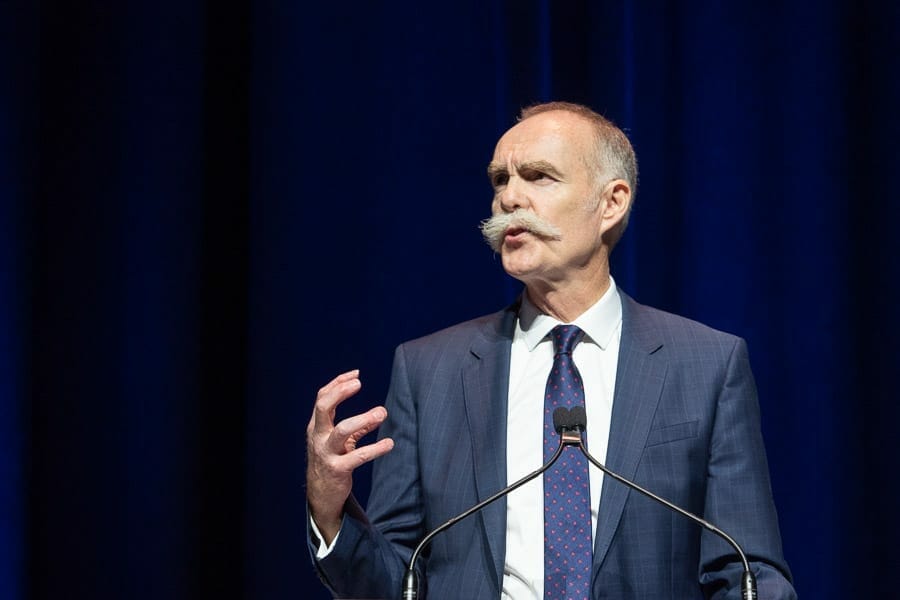

Australia’s funds can do better

Ian Silk

Ian Silk, chief executive of the Australia’s largest pension fund, the A$130 billion ($91 billion) AustralianSuper, has thrown down a challenge for industry funds, the profit for members sector of the industry.

He said if the superannuation industry is really performing optimally for members there should not be any consistently underperforming funds.

“If those running consistently under-performing funds don’t do the right thing, APRA must,” he said.

“The real test will be whether we act in members’ interests every single time, not some or most of the time, but each and every time we make a decision, including when that might not be in the best interests of our fund, or even ourselves.

“We should welcome the extra scrutiny that comes with our current position of industry leadership.

“Each of us and our funds should make a genuine commitment to take our funds from their current position to elite performance for members.”

Sponsored Content

In focusing on delivering what members want, Silk said that funds will need to ensure they have sufficient resources, the right skill mix, the ability to invest in capabilities and to plan and act for the future.

“We have all, and I don’t think there are any exceptions, behaved in ways that will not cut it in the future,” he said.

Specifically Silk challenged those funds whose membership has been declining, or have consistently had below median performance to ask if they can do better.

“Have you really considered whether your fund’s members are best served by the status quo continuing?”

“Have you instructed your financial advisers that when they believe that one of your fund’s members would be better off in another fund, that they should tell the member that, and facilitate the transfer to the other fund? Do you vigorously pursue non-payment or under-payment of superannuation contributions on behalf of members?”

Silk acknowledged that the industry fund sector is now larger than the retail sector, and the gap is growing. In addition he said the Productivity Commission explicitly, and the Royal Commission implicitly, concluded that the industry fund sector is superior to the retail sector. But he said this meant industry funds needed to step up, not be complacent.

“What does this new-found mantle of industry leadership mean, he asked. “Member and community expectations are going to be higher, regulators are going to be more aggressive, political focus will be more intense and the media scrutiny will be sharper. And all of this in the context of a more challenging investment environment,” he said. “We shouldn’t complain about greater scrutiny. When it’s applied in good faith we should accept that it comes with the responsibility of looking after the retirement savings of millions of Australians, and of becoming a more important source of capital for the domestic economy.”

The fact that industry funds emerged largely uncriticised from the Royal Commission process is “no cause for triumphalism”, he said.

“That the profit-for-member sector was not found to have committed widespread misconduct, or behaved in a way that failed to meet community expectations, should be a base level expectation of profit-for-member funds. There is no basis for complacency or hubris whatsoever.”

Silk urged the delegates to think bigger than simply whether profit for member funds were better than retail funds.

“Our challenge is more fundamental,” he said. “It’s to be the best we can be for existing members, and the many that are currently choosing to move to industry funds. This weighty responsibility means both a big difference in mindset, and ultimately our actions.”

Silk pointed to three factors that he said make it incumbent on  the industry to operate the system in the public interest and the interests of members.

“The Parliament has established a super system which involves the implementation of public policy through the outsourcing to the super industry itself, a super system that is compulsory, and a super system that receives significant tax concessions,” he said.

“Because of these factors the obligation on us to operate the system to the highest ethical and performance standards is greater than exists in most industries,” he said.

A post Royal Commission and Productivity Report environment, combined with projected lower returns for the next decade than the past decade, creates a challenging future environment for the Australian superannuation industry, he said.

“The effect of each of these new factors means a more challenging environment in the future, which will be compounded by a reduction in the positive tailwinds that have boosted the performance of many profit-for-member funds,” he said.

This, he said, will require a different and bolder mindset focused on the best interest of members.

Silk gave the keynote address on day one of CMSF, an event that is in its 29th year.

In opening the conference, chief executive of AIST, Eva Sheerlinck urged delegates to “never lose sight of the core of who we are: proud stewards of others hard-earned savings”.

Asset Owner:AustralianSuper

Leave a Comment

La Caisse’s oil exit pays off as renewables portfolio pulls ahead of fossil fuels

La Caisse’s oil exit pays off as renewables portfolio pulls ahead of fossil fuels

Divesting from the oil sector has been a boon for La Caisse’s performance, as the Canadian pension giant says its energy investments have earned billions in value-add compared to the benchmark since the inception of its climate strategy. Head of sustainability Bertrand Millot unpacks the fund’s approach in an interview with Top1000funds.com.

Sort content by

NZ investors act on terror attack

New Zealand’s largest investors are urging Facebook, Google and Twitter to take more responsibility for what is published on their platforms, following the live-streaming and sharing on social media of last week’s Christchurch terror attacks. They are calling on other global investors to act with them.

Geopolitics: portfolio implications

For most investors recognising whether geopolitical tensions are a short term blip, or a long-term systemic shift is key to understanding how those risks inform investment decisions. Amanda White spoke to investors about the impact of geopolitical risk on their portfolios.

Geopolitics: risk or opportunity?

The challenge around geopolitical risk is determining how sustained or long-lasting any particular risk is. Angela Rodell, CEO of Alaska Permanent sees opportunity in having a view of the world.

Factors are useless without the research

Product providers cite all manner of factors behind the performance of their products but unless those factors adhere to what academics have replicated and standardised, it’s folly for investors to expect persistent returns from them.

Tough times greet new CalPERS CIO

Ben Meng isn’t easing into his role. The new CIO of CalPERS faces three new board members, a stressed private equity program and executive turnover, all under the pressure of a 70 per cent funded status and a maturing membership at the $340 billion fund.

Homogenous behaviour imperils markets

Global markets are more interconnected than ever. That provides many benefits but it also has its drawbacks. Chief among those is the potential for investors to move in lockstep when driven by fear or euphoria, creating feedback loops that can result in crashes.

Previous




