


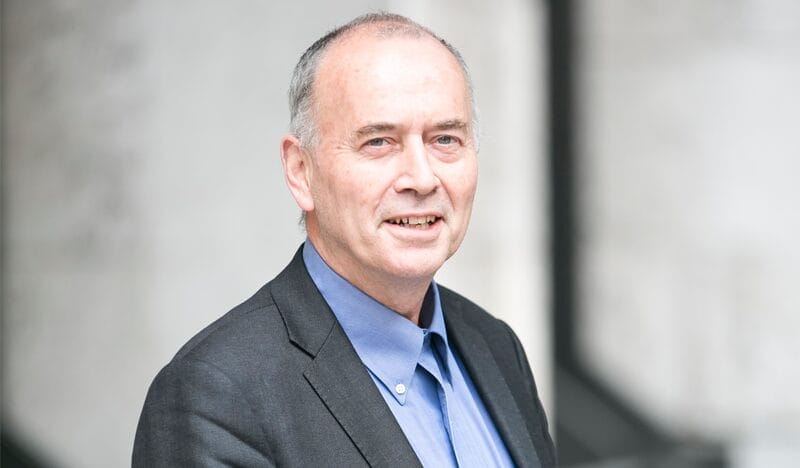
The idea that the ESG movement is impeding a successful response to the climate emergency sounds like a paradox. But John Skjervem, CIO at $43.2 billion Utah Retirement Systems (URS), believes today’s seemingly unanimous embrace of ESG investment and ESG groupthink is actually jeopardizing real transition solutions.
Divestment doesn’t work, he says, and Scope 3 reporting regulations portend a legal and bureaucratic morass that will stymie both economic growth and the pace of meaningful emissions reduction. Moreover, current (and, he says, largely narrative-based) ESG initiatives threaten pension plans’ long-term financial security and, in turn, their capacity to finance energy transition technologies.
“Now completely politicized, ESG is a waste of time,” says Skjervem, a self-confessed ESG apostate, speaking in a rare interview since he joined URS in November 2021 to work alongside State Treasurer Marlo Oaks, a prominent ESG critic.
Amongst the climate change cacophony, calls for divestment worry him most. Take one of URS’s best performing allocations: a 5 per cent strategic commitment to energy, mining, and infrastructure, most of which resides in direct oil and gas investments URS has made in the wake of other institutional investors’ exodus from fossil fuels.
Direct relationships with management teams and operating groups have allowed URS to make cost-saving investments and escape the co-mingled fund structures in which general partners add value and then quickly exit. Now URS can match investment duration with its long-term return and asset allocation objectives.
“We’ll hold these hydrocarbon assets for a decade or more,” he says, flying in the face of calls on pension funds to divest fossil fuels. “We earn great returns while also doing our part to maintain America’s access to cheap, reliable power and fortify its geopolitical position through domestic energy independence.”
Just as important, the unashamedly “fabulously successful” portfolio (boosted by the sharp appreciation in energy prices) has helped fund multiple investments in renewables and several separate commitments to “moon-shot” energy technologies like fusion. “From a place of humility, not ideology, we are deliberately allocating across a mosaic of energy investments because we don’t know exactly how the transition will evolve and play out,” says Skjervem.
He also points out the integral role natural gas plays in weaning economic activity off coal and providing backup power to the intermittent supply profile of wind and solar. “The reality is, we need aggressive investment in oil and gas to provide cheap reliable energy so plans like ours can remain fully funded and provide the risk capital needed to invest in transition technologies like renewables, modular fission, hydrogen and fusion.” He continues, “the energy transition is not an ‘either/or’ proposition, it’s a ‘both/and’ proposition.”
Fossil fuel divestment doesn’t only cause investors to miss out on returns – of which last year was a particularly good example – and plough more money into emerging climate solutions. Divestment is also disingenuous.
In an increasingly pervasive argument, Skjervem says divestment doesn’t work because selling hydrocarbon assets just means they’ll likely end up in the hands of other, less altruistic investors who are less knowledgeable and less concerned about sustainability. “Engine No.1 would not have prevailed if CalSTRS had divested,” he says, referring to the proxy battle investors forced on US oil giant Exxon.
Divestment is also flawed because if successful, it would raise the cost of capital for fossil fuel companies, resulting in fewer projects and less long-term capital investment, he continues.
“Constraining supply raises prices, and higher energy prices are essentially a tax borne mostly by the poor and working class who generally cannot work from home and for whom purchasing an EV is entirely cost prohibitive,” he says, warming to his theme. “Living in the Bay Area during summer power outages, the cause of which was at least partly the State of California decommissioning some natural gas-fired powered plants, I anecdotally observed the immediate activation of diesel-powered generators in affluent areas while poor neighborhoods suffered through extended heatwaves without any air conditioning. The hypocrisy is appalling.”
“At URS we know the energy transition is an imperative, but we also refuse to make investments or promote policies like divestment that shift transition costs disproportionally to the poorest members of society, undermine the economic progress of our state, and compromise the geopolitical security of the US,” he surmises.
Perhaps the aspect of divestment that frustrates him most is that the climate emergency looms ever closer, but clamours for hydrocarbon divestment only squander valuable time, throwing sand in the gears of efforts to find real solutions. “Proponents of divestment are wasting time and diverting valuable resources from serious people making equally serious investments across the energy transition spectrum. This misguided activism is just getting in the way.”
Governance, Governance, Governance
Skjervem, who was CIO at Oregon State Treasury between 2012 and 2020, cites the URS governance model as support for his team’s bold fossil fuel investments. Specifically, the URS board addresses investment matters in executive session which limits the “political grandstanding and virtue signalling” Skjervem says is commonplace at many US public plan board meetings.
The URS model has not only enabled staff to quietly profit from fossil fuel investments while many other public funds bow to divestment pressures. Skjervem says it also shields the entire programme from politics and “non-fiduciary” influences, allowing the team to focus exclusively on hunting for the best risk-adjusted returns without interruption or interference.
“Why do endowments outperform?” he asks. “Because they are opaque. You can’t dial into or attend Stanford’s or Yale’s investment committee meetings.”
Take the URS venture capital allocation for example, a particularly attractive element of the programme’s portfolio construction. Skjervem attributes the celebrated allocation and its impressive manager roster (on par with top endowments and mostly unprecedented among public funds) to the fund’s governance structure which allows VCs to pitch in privacy, protect their IP and stay under the media radar.
Together with enduring Board support (which often wanes at larger funds due to the negligible performance impact of typically small VC investments), he says the URS model has a distinct competitive advantage. “Allowing public comment and opinion on potential investment opportunities is not conducive to attracting high quality VC partners, but in our construct, general partners can be confident they’ll be insulated from the counter-productive elements that quickly emerge with public participation and transparency.”
The seven-member URS board, comprised of five professional investors and two participant representatives, sets asset allocation policy, the actuarial rate of return and employers’ legally compelled contribution rates. The only politician on the Board is the state treasurer, and all implementation and manager selection decisions are delegated to URS investment staff.
URS has an internal audit team that monitors investment process compliance as well as external auditors who review its financials and file reports with the Retirement and Independent Entities Committee of the Utah State Legislature, thereby ensuring multiple layers of accountability.
Skjervem believes this combination of delegated investment authority and multi-level fiduciary oversight is the programme’s “secret sauce” and manifests as excellence in both portfolio construction and team culture, which has enabled the easiest transition to a new role of his career.
So far, he hasn’t had to “put out fires”, “push boulders uphill” or any other metaphor for difficult and complex change management. In fact, he says the most important aspect of his job is keeping a steady hand on the tiller, a thinly veiled tribute to previous CIO Bruce Cundick who over a two decade span assembled “a terrifically dedicated and talented staff who have expertly capitalized on the program’s structural advantages to create a truly world-class investment portfolio.”
Smaller Managers
Nor could he find anything to change in the 15 per cent allocation URS has to hedge funds, a large commitment for a fund its size. This corner of the portfolio, where he particularly enjoys getting under the hood, has proved truly unique. Steeling for change when he took the helm, the hedge fund allocation has, in fact, produced the holy grail of low correlation and statistically significant alpha despite challenging markets.
It has also withstood rigorous empirical analysis and stress testing. “If I think back to the hedge fund portfolios I’ve been responsible for in previous roles, I wouldn’t have had the same success URS has enjoyed.” He attributes this success to Board support (as with the VC allocation) and a carefully cultivated list of around 30 smaller managers.
Rather than invest with the usual suspects, URS positions itself as the largest LP in the relationship rather than one of many. Other contributing factors he cites include ensuring the allocation is well-resourced internally and invested globally rather than with a US bias.
He was similarly circumspect regarding URS’s 12 per cent private equity allocation, especially coming from Oregon. That pioneering investor has a private equity portfolio that dates from 1981 and a pacing model that requires annual commitments of $3.5 billion allocated among the biggest PE firms. He quickly learnt that different principles govern the URS allocation.
Once again, URS plays to its strengths in terms of preferential access, and favours partnerships with smaller, lesser-known managers, made possible by bitesize annual commitments totalling around $1 billion. “There are many benefits to being smaller,” he says.
As the conversation draws to a close, he returns to his conviction that ESG is now hindering the energy transition, diverting valuable resources and time from the important task at hand. “We’re trying to figure out who’s doing it right in terms of both commercial viability and environmental sustainability, and if you’re not doing that, you are part of the problem.”
For all his talk of not changing anything, and the portfolio only needing a minor tweak here or there if at all, Skjervem is putting his mark on URS.







Leave a Comment
You must be logged in to post a comment.
Login