
Europe rearms, defence returns surge, asset owners rethink exposure

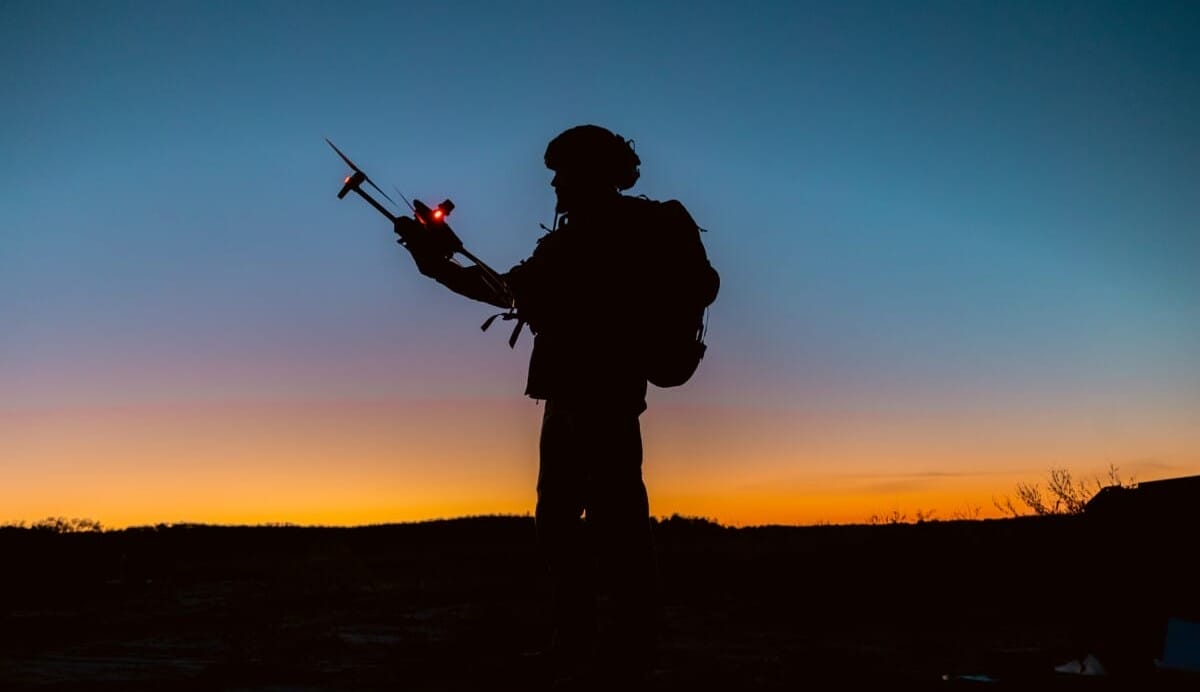
A soldier using a drone for scouting during a military operation.

Defence was once treated by many asset owners as a near-automatic exclusion but the sector’s resurgence since Russia’s full-scale invasion of Ukraine in 2022 has exposed a blunt reality for fiduciaries: the harder the screen, the greater the risk of missing returns.

Defence companies are only about 2.5 per cent of the MSCI World index, yet performance has been hard to ignore. The MSCI Aerospace & Defence index surged 49.25 per cent in the year to November 28, 2025 as the Russia-Ukraine war and a less reliable US ally prompted a surge in investment across the sector.

“There’s a slow acceptance – an openness now for everyone to allow them back in your portfolio,” says Aston Chan, chief investment officer, head of investment solutions at sustainability investment solutions and data provider Impact Cubed, which has been advising asset owners on the issue.

“It’s no longer Europe versus Russia. It has become Europe versus Russia without having the US as a reliable partner.”

Yet investing in the sector is anything but straightforward. Depending on cultural norms, geography and interpretations of fiduciary duty, one asset owner may frame defence investments as protecting democracy, while another sees it as a reputational risk amid accusations of profiteering from war.

Nordic investors embrace ‘total defence’ and revisit exclusions

Asset owners closest to the Russia conflict have been amongst the quickest to change their approach to investing in the defence sector. Their longstanding proximity to the Russian border has created the Nordic concept of “total defence” or “comprehensive security”.

Sponsored Content

It refers to a whole-of-society resilience mindset across military defence, civil preparedness, supply chains, cyber, information security and critical infrastructure.

Earlier this year, the €65.7 billion ($77.1 billion) Ilmarinen Mutual Pension – based in Finland which shares a 1300-plus kilometre border with Russia – incorporated this approach in revised principles for responsible investment.

“When the illegal invasion of Russia to Ukraine happened in 2022 we saw this geopolitical change and started to analyse what it means,” Karoliina Lindroos, head of responsible investments, Ilmarinen Mutual Pension, said at the Fiduciary Investors Symposium at the University of Oxford.

Its previous policy excluded many “dual use” companies that didn’t operate purely in the defence sector. For example, Finnish satellite-imagery company ICEYE initially began commercialising synthetic aperture radar (SAR) imagery to monitor hazardous Arctic conditions, but in 2022 began providing Ukraine with access to its capabilities.

Funds with a hard-line exclusion on defence can miss out on a key source of innovation outside of the much-heralded tech sector and with it, potentially higher returns as new technology diffuses across the economy.

“We thought that this type of binary policy may not serve us as well as it served us in the past, and we need more nuance. But at the same time, we needed to find the balance… could we get exposure to defence sector companies but at the same time, how do we consider the human rights risks that are inherently present in this sector?”

The fund now has a more flexible approach – with enhanced oversight – including the ability to invest in companies that manufacture “controversial weapons” if they are headquartered in NATO countries. The €66.7 billion ($78.3 billion) Finnish pension fund Varma also made a similar change regarding potential investments in controversial weapons.

It is one of the most common changes and largely focused on companies involved in the nuclear sector, according to Impact Cubed’s Chan, as opposed to companies making weapons banned under common international treaties such as anti-personnel landmines, cluster munitions, chemical weapons or biological weapons.

“In my experience, it’s largely cultural,” Chan says.

“A number of asset owners in France have excluded alcohol, but not nuclear weapons, and that’s saying something in a place that produces great wine. The French asset owners as a group never have – and in my opinion probably never will – consider nuclear controversial. Germany does. So depending on when my train crosses the border, the mandate changes.”

Israel–Palestine pushes screens in the opposite direction

But even as the Russia-Ukraine conflict has opened the door for a more inclusive approach to defence companies, the Israel-Palestine conflict has placed pressure in the opposite direction, with more investors taking a hard-line.

The Israel-Palestine conflict was a key driver behind the Avon Pension Fund’s recent re-evaluation of its defence sector investments – a hotbed issue among its members who tend to work at local unitary councils, universities, academies, town and parish councils, housing associations and charities.

Committee members of the £6 billion ($8 billion) local government scheme voted 8 to 2 in favour of the approach after a months-long member consultation led to a formal member survey. The result was lineball, with 42 per cent sup­por­ting divestment, 47 per cent favouring remaining invested, and 11 per cent unsure.

After the meeting, councillor Toby Simon – who also serves as chair of the Avon Pension Fund Committee – said committee members recognised it was a difficult and sensitive issue.

“The fund takes all member views seriously and, in reaching a decision, the committee has balanced those views with its wider fiduciary duty, legal advice, financial considerations, and the wider regulatory context with the evolution of pooling,” he said of the decision by the fund, which is one of ten within the Brunel Pension Partnership.

The Israel-Palestine conflict similarly prompted a defence sector review by the Sydney University of its endowment’s investments following campus protests related to the Middle East conflict. Unlike the Avon Pension Fund, Sydney University announced in November 2025 that it would divest from the sector in principle.

Norway’s NOK 878 billion ($87 billion) Kommunal Landspensjonskasse (KLP) – which serves employees at local municipalities and workers at health enterprises – in June excluded US industrials group Oshkosh Corporation and Germany’s ThyssenKrupp for selling weapons including armoured personnel carriers, warships and submarines to the Israeli military.

Karolina Malisauskaite, analyst – responsible investments, at Norway’s KLP said the exclusion was made under its existing criteria which prevents investments in companies that sell weapons to countries in conflict where there is a high risk of the end user violating international humanitarian law.

“In June, a UN special group of experts that were working came up with a press release listing companies that were involved in selling weapons to Israel, and there was documented evidence that those weapons were used in Gaza,” she said at the Fiduciary Investors Symposium at the University of Oxford.

“They came out saying companies selling weapons to Israel are risking being complicit in the war crimes and human rights violations.”

It raises another key risk for investors in the sector: defence companies largely have one customer – government – and they cannot control how any state ultimately deploys its weapons. When those systems are implicated in a conflict zone, the reputational fallout can quickly rebound on the fund.

When returns meet responsibility: the case for defence in a democracy

While the humanitarian aspect of war, and the close relationship that defence companies play, cannot be underestimated. the fiduciary rationale to invest in the high-performing defence sector is a drive underpinned by legislation in many countries.

“The main thing for the last 15 years is that nothing has performed better than tech,” Chan says. “But now, in the last year, I would say that the only thing that’s performed comparably or even better than tech in some places, is defence stocks.

“So if you were sitting on an investment committee in Europe and said, ‘We’re not touching the best performing assets,’ that’s an increasingly difficult position to defend, and opens you up to tough questions around societal resilience and fiduciary responsibility.”

In addition, aerospace and defence shares typically exhibit low correlation with the broader business cycle, meaning their exclusion would marginally increase overall equity risk, according to a paper prepared by the Avon Pension Fund. Unlike fossil fuel producers, defence companies do not face the same long-term risk of assets becoming “stranded” as economies decarbonise.

An increasing number of European asset owners are pairing this investment case with a broader social purpose. Some argue ESG can only be underpinned by democracy itself – and investments in the defence sector as part of protecting it.

Danish pension funds AkademikerPension, PensionDanmark and AP Pension joined forces in December 2025 to back ETNA, a newly formed defence-focused private markets fund. They framed the move as an act of social responsibility in the current security climate and an opportunity to deliver strong long-term returns for members.

Rikke Berg Jacobsen, head of ESG at AkademikerPension, said the decision followed an earlier softening of its approach to companies associated with European nuclear weapons programs (although ETNA cannot invest in nuclear weapons).

“We consider it our societal responsibility to provide capital support for the rebuilding of Danish and European defence,” she told Top1000funds.

“We can fulfil this responsibility in several ways. For example, we can invest in the large publicly listed dual-use and defence companies (the policy change created greater scope for doing so), we can support the Danish defence directly through public–private partnerships and we can invest in smaller, non-listed defence and resilience companies.

“It is in relation to the latter that ETNA is focused and given the rapid technological development within the defence sector, we actually believe this is where our members’ capital can have the greatest impact per krone invested.”

ETNA will focus on buyout and growth equity investments in European SMEs that contribute to strengthening Europe’s defence capabilities and resilience. Several other fund managers have explored launching defence-focused funds, particularly in defence-related infrastructure which does not attract as much risk of reputational damage for asset owners.

The investment opportunities are only likely to increase after NATO’s recent commitment to invest 5 per cent of Gross Domestic Product (GDP) annually on core defence requirements and defence- and security-related spending by 2035.

But as NATO members rearm and private capital is invited in, asset owners will be judged not just on whether they invest, but on how: the conditions they set, the transparency they demand, and the boundaries they are willing to defend – to members, regulators and themselves.

Leave a Comment

NZ Super cuts benchmark return expectation on US valuation concerns

NZ Super cuts benchmark return expectation on US valuation concerns

A view that the US stock market is overvalued and equity risk premia will be lower over the long term has driven New Zealand Super to lower the return expectations for its reference portfolio following its recent five-yearly review of the benchmark. Co-chief investment officer Brad Dunstan also flags underweight commodity exposure as an area to address and explains why the fund remains sceptical of illiquidity premia despite seeing a growing case for private markets.

Sort content by

Complexity to clarity: How AP4’s tech overhaul slashed risk and costs

A new investment management platform at Swedish buffer fund AP4 has taken almost ten years to come to fruition. Increased efficiency, lower costs and risk make it worth the wait, says head of risk and operations Nicklas Wikström.

Aware Super mulls return to infra funds; builds AI-driven data edge

Aware Super is considering a return to infrastructure funds after years of favouring direct investments. The infrastructure allocation currently stands at $15 billion and the fund sees benefits to access a “broader set of offerings” and opportunity sets via fund commitments to GPs, its head of infrastructure Mark Hector says.

Treasurer Steiner on Oregon’s private equity future

Top1000funds.com editor Amanda White speaks to Oregon State Treasurer, Elizabeth Steiner, about the future role and expectations of private equity, how a maturing of the asset class puts pressure on returns, and the private/ public asset mix in the fund’s four-yearly asset allocation review which has just begun.

Why asset owners should not outsource innovation

Asset owners have traditionally counted on external asset managers to pursue bold innovations rather than stretching their limited internal resources to do so. But leading Stanford academic Ashby Monk has warned in a new paper that this long-standing model is distilling short-term thinking in pension management.

HOOPP: Light covenants in private credit are a growing source of concern

The boom in private credit has been accompanied by a spike in lighter covenants, reducing protection and guardrails for lenders says Jennifer Shum, senior managing director, structured and private credit at HOOPP, and warns of mounting risks in private credit.

West Yorkshire prepares to up the pressure on Shell and BP

A new approach to holding the major oil companies to account will see the West Yorkshire Pension Fund, together with a cohort of other UK and European pension funds, demand BP and Shell explain their business plans in a world of declining demand for fossil fuels.

Previous



