
Asset owners eye tech’s new foundation for investing

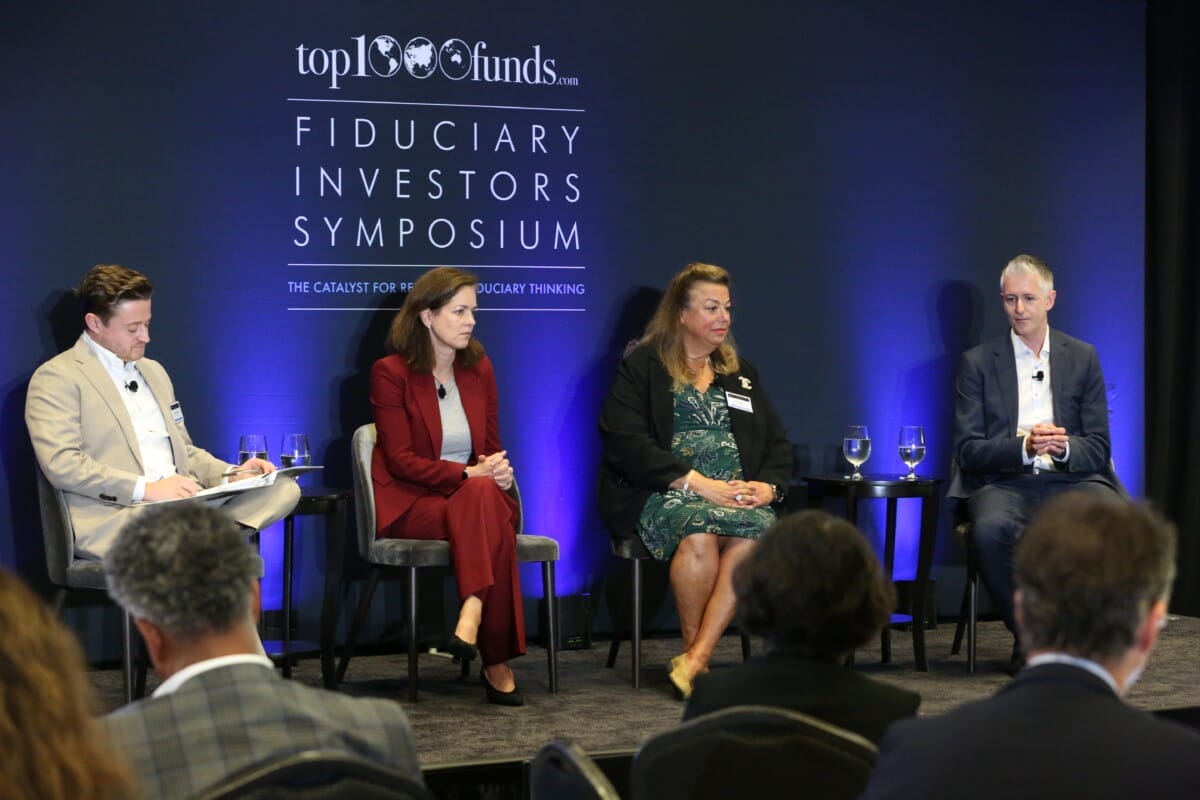
Marg Franklin, Sandy Kaul and Chris Drew.

Marg Franklin, Sandy Kaul and Chris Drew.

Institutional investing is on the cusp of a structural reset as advances in blockchain-based technologies rewire the market plumbing that underpins asset ownership.

This next generation of infrastructure will operate continuously with near-instant settlement across traditional and newly tokenized assets, according to Franklin Templeton executive vice president and head of innovation Sandy Kaul.

“By 2030, every market and every asset settles instantly,” she told the Top1000Funds Fiduciary Investors Symposium at Stanford University, adding that portfolios will become highly customised “portfolios of one” tailored to each institution’s goals, liabilities and cashflow needs.

Kaul pointed to the recent passing of the US GENIUS Act, which marked the United States’ first major legislative step towards regulating stablecoins, as “the starting gun on a complete transformation” towards a wallet-based system that will replace today’s account-based system.

“This is a huge threat to banks – this stablecoin act – and this is just the beginning. But it has created a parallel economic system now and that parallel economic system is going to recreate everything that we have in the current system.

“There is going to be cash sweeps between stablecoins and tokenised money market funds so that you can manage your cash in the wallet-based system. There are going to be new investment options where I can now create liquidity around illiquid investments that I hold in my portfolio by tokenising interests and shares in them.”

Sponsored Content

Rest Super head of portfolio construction, external equities, Chris Drew, said the Australian pension fund held about 1 per cent of its global equity portfolio in US dollar denominated cash with a custodian.

“We’re looking at can we replace that custodial-held cash with a tokenised money market fund? And there’s our use case where we can get far superior yields. We get instant settlement and we get the added benefits of the intraday yield that you get… we said, ‘here’s a problem to solve. Let’s go and look at a number of ways we can do that’. That led us to tokenisation.”

Kaul said the technology underpinning its tokenised money market fund allowed investors to receive a proportionate share of interest for the exact time they were invested.

“If you owned a tokenised money market fund for three hours of the five hour or the eight hour trading session, you will get that proportionate share of the day’s interest, and we are paying that interest out every single calendar day of the year.”

But such a radical change to the market’s underlying infrastructure also challenges existing governance approaches.

CFA Institute CEO and president Marg Franklin said the tokenisation of assets will change their characteristics and also drive returns. Many asset owners will need to consider these interconnections, particularly on illiquid assets such as infrastructure.

“You have to determine, is your valuation methodology accurate, what does it look like, and then how does that impact your performance measurement and what you’re reporting to beneficiaries or to your board?

“The responsibility for due diligence, and the sort of accuracy of your due diligence is going to increase, and the complexity of that due diligence is going to increase.”

Drew said tokenising real world assets would create a new operating environment – one that Australian regulation had yet to catch up to.

“You’ve  got to completely re-imagine how you think about your investment structure and that’s what we’re grappling with.”

Separately, Drew said the fund was also now increasingly using AI as part of its investment decision making process including to more accurately and quickly distil information and action items from manager meetings; to perform deep research and identify market thematics; as well as data analytics.

For example, AI can predict index rebalances or produce insights about shifting correlations in near real-time.

“Everyone talks about the Mag Seven. We would argue there is no Mag Seven… at some point in time, there’s a Mag Three, at some point in time, there’s a Mag Five. These correlations move around through time, and so that’s information for us as well – how exposed you want to be to these correlated groups of stocks.”

Be part of the conversation next year – register now for the Fiduciary Investors Symposium Stanford 2026. Asset owners only.

Our next event is at the University of Oxford, November 4-6 2025. Register today – asset owners only.

Asset Owner:REST Super

Leave a Comment

Condoleezza Rice: Globalisation’s borderless era is coming undone

Condoleezza Rice: Globalisation’s borderless era is coming undone

Condoleezza Rice, the 66th US Secretary of State and current director of Stanford University’s Hoover Institution, said the new world order will have several characteristics of which there are already signs: more protectionist trade policies, a redistribution of security burdens, and louder voices for those marginalised in globalisation. 

Sort content by

AI beyond the black box

The artificial intelligence revolution is taking place against a backdrop of rising fiscal deficits and a realignment of the geopolitical order. Applying cutting-edge AI technology to navigate markets is helping asset managers such as Bridgewater make sense of a shifting landscape.

FIS Stanford 2025: Photo gallery

mrec4inarticleinline Sponsored Content scnative1 scnative2 scnative3

Chicken, beef or vegetables: assessing the real environmental impact of AI

The inexorable rise of AI is increasing energy demand around the globe, but the technology itself is also enabling greater efficiencies. Assessing its real impact requires an understanding of both its “footprint” and its “handprint”, and its impact may not be as dire as we’ve been led to believe.

Khosla warns of disrupted decade before AI boom brings abundance

AI will deliver a five-year burst of productivity and cost cutting before a deflationary decade reshapes the global economy, according to legendary venture capitalist Vinod Khosla.

Managing fat tails and risks in the face of contradictory signals

Global investors face the difficult task of setting asset allocation in an environment where the global macro-economic backdrop suggests chaos and downside risk but markets continue to perform strongly.

Risk takers vs scalers: Investors split on where to access innovation

Investors are still split on whether it’s better to hunt for innovative companies in the public or private markets. But the biggest consideration for investing in new technologies might have more to do with liquidity.