

Artificial intelligence continues to make inroads into the investment operations of major asset owners, but most are proceeding with a high degree of caution and setting clear boundaries around what the technology is and is not permitted to do, while resisting the temptation to allow AI to dictate organisational change.
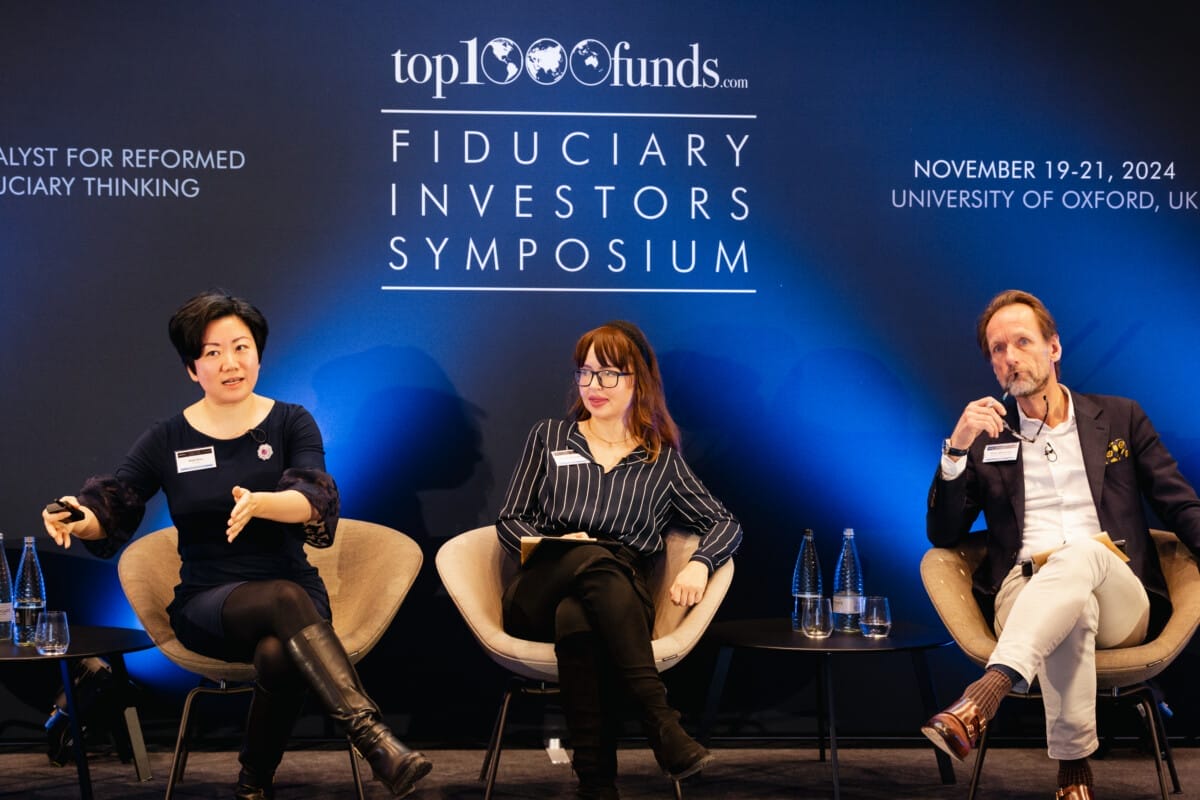
Global head of digitalisation and innovation at the €577 billion ($606 billion) APG Asset Management Peter Strikwerda told the Top1000funds.com Fiduciary Investors Symposium at the University of Oxford that the opportunity for AI is “large throughout the whole investment chain”.
“The reason for that is quite simple,” he said. “AI, as is, is good at processing data; is good at processing unstructured data, especially; is good at efficiency gains. We don’t make chairs or tables, we work with data, being investors.
“That is a good starting point to look at all the opportunities. The challenges are, even so, big. Outside of technical ones, there are cultural and organisational ones…and what is in between, I think what is paramount is don’t take a technology push perspective here.”
Strikwerda said the big hyperscalers are investing tens of billions of dollars a quarter and pushing the use of the technology on users whether they want or need it or not.
“[It] is going to be pushed forward, but never use it as a tech-push in your organisation,” he said.
“We can build the smartest hammer that you have, but if you need to put a screw in, I mean, where are you at?
“That’s the AI stepping in and taking over. But the other side of that equation is look at your business challenges and then see how to smartly apply it. And some, I think, great examples are in, for example, responsible investing, where we have a lot of data challenges, on data quality and data availability; on standards; on ethics; anything. So I think AI has a great role there and we have some great examples already there on the sustainable development investments.”
Investment risk and data manager for the DKR230 billion (32.4 billion) Industriens Pension Fund, Julia Sommer-Legaard, told the symposium the fund has started using AI to support asset allocation decisions, but does not leave the technology to make decisions unsupervised or unchecked.
“We have always had a model for [asset allocation], but now, using AI, we could actually develop a much more complex model,” Sommer-Legaard said.
“We have basically fed PDFs and articles to chat GPT and to Copilot and made it write the code. What can be dangerous about this is if you don’t know coding yourself, you wouldn’t know if it actually did it right. The strategists in my firm and myself, we have a lot of coding experience, so that’s how we make sure that the coding is actually right.
“Then, understanding the mathematics, of course, too. Also developing an internal model. We wouldn’t have the resources for that, being two people, so it has helped a lot in that sense.”
Sommer-Legaard said it is critical for asset owners to combine the outputs from AI with human knowledge and experience.
“We are not just trusting a model and trusting the mathematics, we are combining it with human knowledge from the portfolio managers,” she said.
“You can never use an AI model just by itself. You need like, the 20 last per cent from human interaction and human knowledge.”
Sommer-Legaard said asset owners must also be able to fulfill their fiduciary responsibilities as investors and be able to explain or demonstrate how AI has produced the results or the investment inputs that it has.
“Investment managers, our CIO, everyone needs to understand this is not just a black box,” she said.
“We understand what’s happening, so that’s one of the issues. But since it’s leaning towards our normal model, then it hasn’t been that big an issue. But it could be an issue when we want to use it for other things.”
Robeco deputy CIO and head of quant investing and research team Weili Zhoulso touched on fiduciary responsibilities and the challenges that are created by using AI to make decisions or generate investment proceed inputs from vast oceans of data. Zou said that every two years the volume of new data created is equal to the sum of all data created in human history to that point.
“The amount and dimensionality of the data that is available is amazing,” Zhou said.
“It’s not only the stock price movement, volatility, it’s what the CEO is saying, what news and policymakers are doing, what’s the sentiment from a client and leaving a review on eBay, on Amazon; all these information actually are relevant, sometimes, for the decision making of investment.
“This is a blessing and curse at the same time, because do you have the power to process it? Can you see what is noise and what’s relevant and what’s irrelevant? And that also requests you to have a very strong infrastructure.”
Zhou says the output of an AI model is one thing, but investors need to look well beneath the surface.
“Is your AI industrialised, is your AI auditable, is your AI result-repeatable?” she said.
“If you’re sued…are you able to prove where [decisions] come from and what recommendations were made?
“That’s putting on a lot of requests on the whole infrastructure and the governance around it.”
At the end of the day investing remains largely a human-based activity, even though it is increasingly being augmented by AI. APG’s Strikwerda said that must always remain the case.
“If we trust technology [blindly] and stop thinking, we’re in deep trouble,” he said.







Leave a Comment
You must be logged in to post a comment.
Login