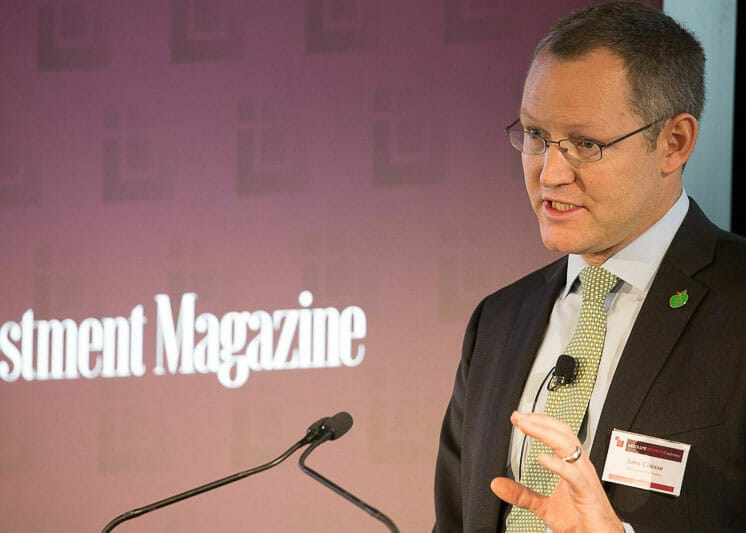

Strive for elegance on fees: consultant

Hedge funds need to be more flexible with fee arrangements and respond to investor demands for fee alignment, says Albourne chief executive John Claisse, who pointed to the ‘1 or 30’ fee structure the consultant helped develop with Teacher Retirement System of Texas (TRS) as an example.

“When it is working, there is an elegance,” Claisse says. “You are tapping entirely into your share of alpha, and paying for skill.”

As Jonathan Koerner explains in the case study on the $140 billion Texas Teachers, the 1 or 30 structure always pays a 1 per cent management fee or a performance fee of 30 per cent of alpha, whichever is greater. However, following periods when the 1 per cent management fee exceeded 30 per cent of alpha, an investor pays less to bring its share of alpha back to 70 per cent.

Essentially, when alpha is not sufficient to cover the 1 per cent management fee, that fee is paid as an advance on future performance fees.

“What we’re hearing from asset owners is that 1 or 30 revolutionises the conversation,” Claisse says. “It simplifies the focus to [put it] on alpha, and there is an elegance to that. Credit to TRS, they are not just doing it for their own benefit. Ultimately, it stabilises the business model of the manager, which is good for every investor.”

He says some large sovereign wealth funds are asking all their managers to consider these structures.

Sponsored Content

Furthering this, Albourne has conducted a survey, which 350 funds have completed. It found that more than 40 per cent have adopted a 1 or 30-style fee structure or are considering it.

Claisse says the beta hurdle and performance fee share are negotiable.

“This is not a one-size-fits-all,” he explains. “There are a lot of different types of fee structures for different strategies, but the important thing is they are all focused on the alignment of fees. It’s not the level but the shape of fees that’s most important.”

Fees are fraught

There has been increasing pressure on fee structures from investors, partly because of the sheer volume of fees they pay, but also because there are now genuine alternatives.

Claisse explains that in 2015, (based on a review of more than 600 funds managing more than $1 trillion in assets), hedge funds generated $51 billion in revenue. The investor share of this was only $23 billion, or about 45 per cent, while $16 billion, 31 per cent, went to management fees, and $12 billion went to performance fees.

“That just doesn’t work,” he says.

Claisse, who has been at Albourne for 20 years and, along with its two founders, makes up the executive committee, says the most important trend in the hedge fund space is the activist investor, which is moving the industry forward.

“End investors have the ability to make the hedge fund industry a pool of investable assets that’s attractive as they can be,” he says. “Hedge funds are an efficient business model for deploying risk capital, but they need to evolve to adapt to the current environment and survive. Hedge funds need to change and investors have the opportunity to effect change.”

There has been meaningful progress in fees, he says, but investors can still have a greater impact.

Albourne has been an advocate for fee transparency. In 2013, it launched the feemometer tool for investors. It has also helped managers produce Open Protocol, an industry standard for reporting risk exposures, in effort to empower investors in their negotiations with managers.

Claisse wants to eliminate the ‘angry dollar’ – investors who are unhappy because they are paying for beta or a manager kept a performance fee following a drawdown. The consultant continues to work on fee structure and has an initiative focused on fee disclosure called The Matrix, which includes the scoring of a manager’s fee transparency and flexibility.

“This allows investors to get a more accurate understanding of what they are paying, relative to the alternatives,” he says. “This information can be complex and challenging to obtain.”

Claisse says investors should be asking where they stand relative to other clients.

“Do [the managers] charge 2 and 20 to everyone and have no flexibility, or do other clients get better deals?” he asks.

Leave a Comment

Nest favours institutional-first managers as retail exodus pressures private credit

Nest favours institutional-first managers as retail exodus pressures private credit

Nest, the largest workplace pension in the UK, says that private credit managers who prioritise institutional clients will be more favourably viewed. The £61 billion ($82 billion) fund has awarded a £450 million ($605 million) US direct lending mandate to Crescent Capital this month, citing the manager's institutional-client-first approach as a key attraction.

Sort content by

The bright and dark sides of PE

Analysis of institutional investor private equity allocations shows the differences in implementation styles and related costs are a key driver of a wide dispersion in private equity results. Researchers at CEM Benchmarking show that costs matter, a lot, in PE.

Coronavirus: market impacts

The coronavirus has triggered a market correction, bringing the S&P 500 off its all-time high. But as always an analysis of fundamentals, and the relationship between price and value, is essential for allocating capital. So could this be a time to buy?

Oregon PE revamp shakes off GFC legacy

Oregon Investment Council has committed to investing $3 billion a year in private equity, with the smooth pacing strategy part a response to the fund’s overweight position to poor performing vintages as a result of its allocations before and after the GFC. The investor is also focusing on manager relationships with a focus on accessing new relationships and upsizing the best existing ones; and a new strategy that sees no provider in charge of more than 5 per cent of the portfolio.

India’s NIIF gathers steam

India’s new sovereign development fund has raised a further £1.3 billion, on top of the government's $3 billion, to finance domestic infrastructure and growth. Key to its success is the unique investor-owned structure, similar to Australia's IFM Investors, and generous co-investment terms.

The future is quant

The pace of technological change and advances in machine learning and quantitative methods will result in a “shake out” in investment management according to Campbell Harvey, Professor of Finance at Duke University.

Future Fund sticks with hedge funds

Australia’s A$168 billion Future Fund is looking to add more money to its A$22.6 billion hedge fund program where it can find managers with spare capacity, to help protect the portfolio against a sell-off in the equity market.

Previous



