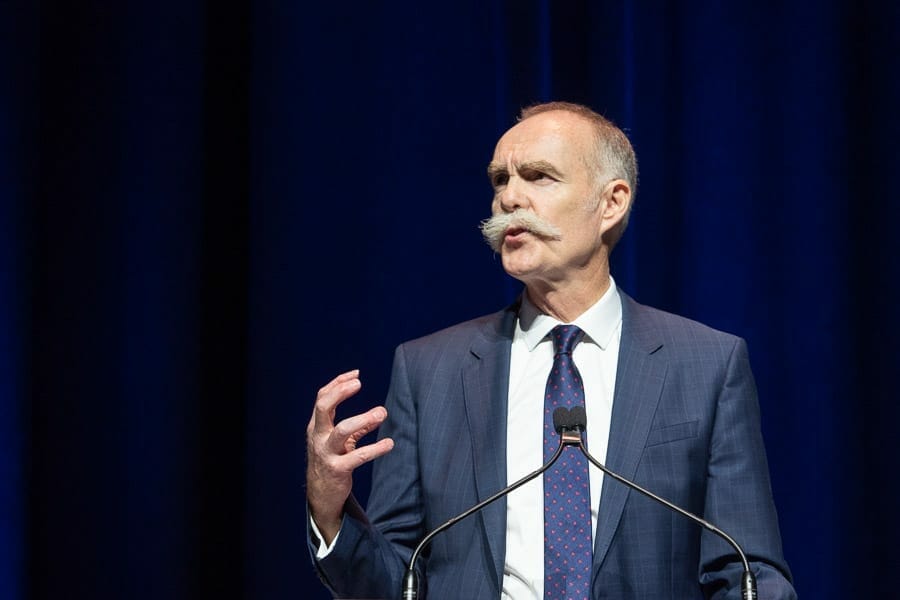

AustralianSuper expands offshore

Ian Silk

AustralianSuper chief executive Ian Silk aims to capitalise on foreign opportunities by having more people on the ground in major markets to identify and execute deals earlier, thus avoiding the prospect of a bidding war for prized assets.

Australia’s largest superannuation fund plans to open offices in New York and Asia and beef up its London operation as part of a strategy to invest in, and directly manage, more offshore assets, Silk said.

The superannuation fund, projected to reach A$300 billion in assets in five years, is forecast to increase its allocation to overseas investments from about half to about 60 per cent by 2024.

AustralianSuper’s overseas ambitions are partly driven by watching rival funds snare key assets through having a greater presence in major markets, according to the superannuation fund boss.

“The best opportunities are often ones that don’t go through a big public process or auction which drive up prices to some very lofty levels,” he argued.

“We want to carry out transactions that don’t occur in the public gaze and don’t have the sort of competitive tension that auctions spark.”

Sponsored Content

Silk believes building relationships and understanding a vendor’s particular circumstances makes it easier to cut a deal that suits two parties.

Silk also conceded that running foreign transactions out of Australia is not sustainable.

“We are approached on investments because we have a big pool of capital but if we are on the ground in these markets, we think we will be aware of opportunities earlier,” he noted.

Importantly, with A$160 billion in assets under management, the fund now has the scale to make this cost effective.

“The next wave of change is going to be a much greater allocation offshore and a much greater direct investment,” Silk said.

TheAustralianSuper chief called this a “very significant shift” in the way the fund invests.

About 62 per cent of the fund’s assets are managed by external parties and the rest is managed internally.

The fund has received around A$16 billion of new inflows this financial year, which was up about 90 per cent on last year. The bulk of this has come from retail offerings from the country’s big four banks, and financial services provider AMP, who have lost customers due to the revelation of bad practices during the Hayne Royal Commission at the end of 2018.

Silk says he is “staggered” to see that inflows from retail funds is continuing.

“We thought there’d be a short-term blip during the currency of the royal commission when the publicity was at its keenest,” he noted.

“But its continued and we have had certain months this year which have outstripped many months last year so it shows no signs of dropping off.

“Presumably it will at some point but there are but no signs yet.”

Silk said the fund’s goal was not growth for its own sake, and the new money had to drive better performance for members.

Critically, he argued, unless the inflows are actually driving enhanced performance, then AustralianSuper should be shutting the door on new members and new money.

“If the money was coming in and we couldn’t invest it well and continue to deliver good performance we would be acting entirely contrary to what a for member fund is all about.”

Asset Owner:AustralianSuper

Leave a Comment

Long term lens shields Colorado from private credit jitters

Long term lens shields Colorado from private credit jitters

As concerns in private credit mount, Colorado PERA CIO and COO Amy McGarrity says the pension fund isn’t seeing any strains in its growing allocation to the asset class, arguing that long-term investors are shielded from the risks because they can lock up their capital to weather market cycles.

Sort content by

Sovereign Wealth Funds look to risk

The International Forum of Sovereign Wealth Funds held its second annual meeting in Sydney last week. conexust1f.flywheelstaging.com reports on the meeting’s outtakes – including asset allocation and risk management implications. mrec4inarticleinline Sponsored Content scnative1 scnative2 scnative3

Mercer’s new approach to asset allocation for multi-manager funds

Mercer has revamped the asset allocation of its largest group of funds and in the process refined the way it classifies types of investments into ‘growth’ and ‘defensive’. The multi-manager has also signaled an evolution towards a ‘risk premia-based’ approach to asset allocation in the future. Greg Bright reports. mrec4inarticleinline Sponsored Content scnative1 scnative2 scnative3

New Jersey leads flight from equities

The New Jersey Division of Investment, which manages the $67.3 billion in state pension funds and was the best-performing US fund last year, has made some dramatic changes to its asset allocation in line with its objective of relying less on public equities for returns.

Flexible in-house thinking pays dividends for Canada’s HOOPP

A strategic shift into equities during 2009 and the completion of a multi-year strategy to bring all assets in house, has resulted in the Healthcare of Ontario Pension Plan (HOOPP) returning 15.18 per cent return for 2009, positioning it as one of very few pension funds around the globe to be fully funded. mrec4inarticleinline Sponsored

Abu Dhabi sovereign fund coughs up: first ever review published

With uncharacteristic fanfare, the big Abu Dhabi sovereign wealth fund has provided the first insight into its workings, illustrating an international outlook and an appetite for a sophisticated asset allocation strategy. The fund published its first ever “annual review” this week. mrec4inarticleinline Sponsored Content scnative1 scnative2 scnative3

Passive tilt for Massachusetts state fund

The $42 billion Massachusetts Pension Reserves Investment Management (PRIM) will move half of its developed non-US equity portfolio and 25 per cent of its emerging market equity portfolio into passive strategies and has begun a search for a single manager for each asset class with a commencement date of May. mrec4inarticleinline Sponsored Content scnative1 scnative2

Previous



