
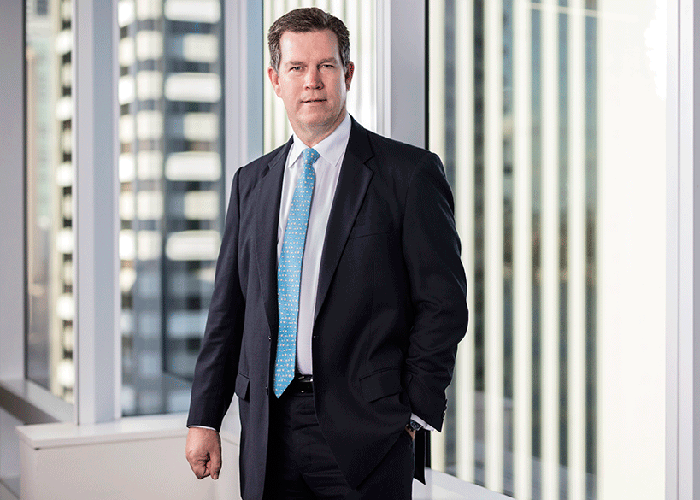

Karl Morris, the chair of the board at the A$94 billion ($72 billion) Australian fund QSuper reflects on recent changes at the fund including going public offer and launching an insurance arm. The long-time Australian Liberal Party powerbroker also speaks in defence of the representative trustee board model.
Investment Magazine: QSuper opened to new members as a public offer fund on July 1, 2017. Are you pleased by the response so far? How does becoming a public offer fund change the conversation for the board?
Karl Morris: The response to date has exceeded expectations, we have been quite overwhelmed. The majority of new members are friends and family of existing members, and we are happy to be able to welcome so many of them. We’re also seeing past members who, having experienced other funds, have now chosen to return to QSuper. Becoming a public offer fund hasn’t shifted our focus. Members will always remain our key focus and we will continue to innovate and enhance the award-winning, tailored products and services we are renowned for.
IM: With advice, investment management, and insurance capabilities in-house, QSuper is one of the most ‘vertically integrated’ non-profit funds in Australia. How do you manage the governance risks that come with this advantage?
KM: Having so many of our capabilities in-house ensures that the teams are working together across the organisation and it provides great opportunity to share ideas and leverage expertise. Our Lifetime product, which is our default investment option, was made possible through the internal investment, product and advice teams working together to bring the idea to fruition. Internalising teams has required some changes to governance processes, but these changes have not been prohibitive and have positively contributed to member outcomes. These changes have ensured that appropriate delegations inform responsibilities around each function. They’ve also ensured clarity of purpose and role, along with setting in place strong due diligence processes.
IM: QSuper has posted some of the strongest investment returns in Australia in recent years while having a very different investment strategy to its peers. How did the board get comfortable with the ‘peer-aware but not peer-anchored’ approach?
KM: Having great clarity of a central purpose is very powerful. At QSuper the focus has been, and will always be, on achieving the best outcomes for members. The QSuper board holds this view strongly and we spend a lot of time considering the diverse nature of our membership, their needs and expectations and tailoring products and services to them. Anchoring our investment philosophy and strategy to peers would be contrary to this. Whilst we know that this may mean we look very different in fund comparison tables, positively and negatively, we believe that this is the right approach. Ultimately, we are targeting a smoother path to their retirement, with returns comparable to those of traditional balanced funds.
IM: Are mergers part of the growth strategy for QSuper?
KM: As one of the largest funds in the country, we already have benefits of scale that we leverage at every opportunity. Whilst mergers are not a priority at the moment, we are open to considering opportunities as they arise. The primary test for us is that any merger would have to be of benefit to our existing members.
IM: Are there any important ways in which chairing a superannuation fund is different to your previous experience chairing stockbroking firm Ord Minnett?
KM: There are a number of differences to being on the ‘buy side’ from the ‘sell side’. A stockbroking firm has shareholders who want a return on equity, whilst at QSuper we have the ‘sole purpose test’ and ‘best interest of members’ to guide how we best provide for members’ retirement. The board appointment processes are also very different and the nuances between directors representing shareholders to trustees representing members requires a slightly different fiduciary lens. There is typically a lower level of engagement from superannuation fund members, with many investing through the default offering. To make decisions for hundreds of thousands of members is a huge responsibility. I believe that QSuper took a big step forward when we separated our default investment option into eight smaller options, grouping members by age and account balance, and recognising that one size does not fit all when setting investment strategies for such a vastly diverse group of members.
IM: How have your views about what makes a good chair changed over the last decade?
KM: A good chair continually makes sure board members are collegiate and respectful of one another, whilst acknowledging that sometimes there may be different opinions. The key to getting a board to get big decisions right, is making the decisions in a considered and consensus way. In my career, I have had the opportunity to report to boards, be a director on boards, and chair various boards, so I’ve experienced both the good and bad from various angles. To be a good chair requires a keen interest in the business area, the desire to work collaboratively with a broad range of people, and the ability to see the big picture and identify priorities. I think that the role of boards is much more challenging today than a decade ago, and the chair’s role has also grown significantly in scope and complexity over this time. These days, organisational strategy needs to be more flexible, risk management is much more prominent, and the level of governance appropriately high.
IM: What is your top piece of advice to investment specialists for improving their communications with super fund trustees?
KM: Make sure there are no surprises. It’s an obvious statement, but critically important to developing trust and collaboration. Continually update trustees so that they are attune and open in their thinking to cyclical and structural changes to economies and markets. I think it’s important that investment specialists communicate frankly with super fund trustees to ensure the full range of potential outcomes is understood. There are good and bad investments, and there are bull and bear markets. Boards need to be aware of both the upside and the downside of this and how this translates into the experience for members.
IM: What is the most valuable professional development or training you have done that has helped you be a better chair?
KM: The Australian Institute of Company Directors course was very good but, in reality, director development is more experiential. I have learnt a lot from ‘good and bad’ chairs. One important thing I have learnt is that all directors must be equal in information and remuneration. And whilst not strictly professional development, the activity that resonates with me most regarding my fiduciary duty is attending QSuper member events and talking directly to our members.
IM: You are an independent chair governing a representative board. Do you feel that board composition model works well for QSuper? What are the pros and cons?
KM: I think the results speak for themselves. QSuper has long been fortunate to have trustee representatives from both the employer and member organisations who have truly championed the ‘best interest of members’ philosophy. The pros of a representative board are the direct channels of engagement with the employer and member organisations, while the cons are the relatively limited ‘pool’ of people available within these organisations from which to choose candidates. A board that operates as a high-performance team requires a group of people with diverse and complementary abilities. Ultimately, where the trustee directors come from (employer, member or independent), is less important than the knowledge and experience they bring and the commitment they demonstrate in their role as a fiduciary.








Leave a Comment
You must be logged in to post a comment.
Login