
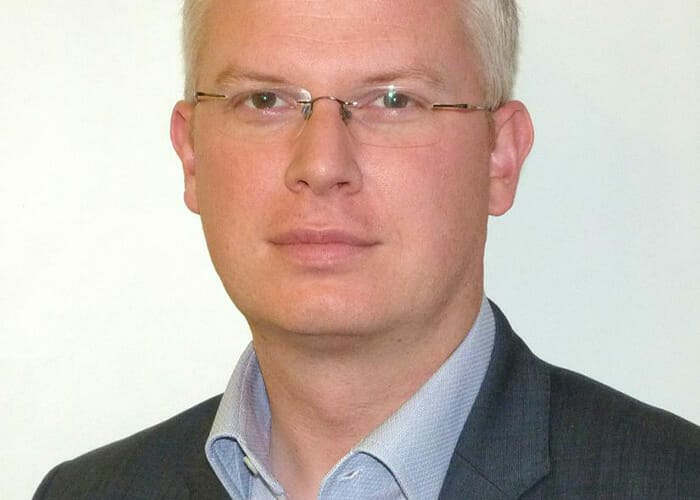

Howard Brindle, the chief operating officer at Universities Superannuation Scheme Investment Management is one of the most experienced investment operations executives in the pension industry. Before joining the £57 billion fund ($69.3 billion), which runs about two-thirds of its assets in-house, he was head of JP Morgan’s European Transfer Agency Product and chief administration officer for Lehman Brothers Asset Management Europe. He talks about business transformation and the importance of talent.
Top1000funds.com: What is the most critical operations factor for dealing with growth?
HB: In my experience, it’s the strength and experience of your people. You need strong, experienced senior staff who understand how investment businesses work. Attracting good quality people involves a number of things, not just remuneration; developing a positive culture is important, certainly in terms of retention, and is something we focus on a lot at USS. Having strong senior staff also helps, as good people tend to hire good people.
Of course, being at one of the biggest and most innovative pension schemes in the country helps, too. Working in a pension fund is an incredibly attractive alternative to hedge funds and big banks. We provide all the complexity, challenge, variety and pace of those environments, but with less artificial client-related deadlines, and without the internal bureaucracy of a large organisation. As a result, we are able to attract and retain top-quality talent, and can give them as much responsibility as they are able to handle.
What are the critical systems and processes superannuation funds should have in place if they are to bring assets in-house?
The benchmarking is clear: when a certain scale is reached – I would say greater than £5 billion per asset class, maybe £10 billion for equities – the cost advantage means that in-house teams perform better. I’d caveat that by saying you should in-house only assets for which you have scale and only when you are confident you will be invested in them for the long term.
For a defined benefit scheme, or any multi-asset fund, the starting point is an investment book of record, with a consolidated record of all assets, linked to a risk system. Asset allocation decisions are the biggest investment decisions a scheme makes. For single-asset, defined contribution funds, an investment book of record is not as relevant.
Is it essential to have good performance analysis tools? Should trading be done in-house and if so what systems should be used?
For managing the actual underlying assets, portfolio management is the most critical system. Performance reporting, accounting, valuation, collateral management – they can all be outsourced effectively. But a portfolio management system is key. Historically, these were different per asset class, but now there are solutions (for example, Bloomberg AIM, BlackRock Aladdin) that can cover most asset classes from a single system, and can also support processes from front to back. Having a simple core system architecture is a huge benefit.
Trade execution can be outsourced, although not as easily. However, we’ve not felt the need to do so, [thanks to] more electronic trading venues, more seamless integration of execution venues with core portfolio management systems, and appropriately skilled portfolio managers.
To get the most out of our core systems, we use a highly skilled in-house development team that enables us to support any new business initiatives, such as integrating new teams, new external managers, new analytic systems, new reporting and so on.
What type of staff do you need to manage and monitor systems?
You need people who are skilled and experienced in investment operations and IT. Find them, employ them and look after them.
How should you reward in-house investment staff, and how do you make them accountable?
The starting point needs to be the philosophy. What are you willing to pay for above-market performance? With scale, the cost-benefit to the scheme will be there, but the compensation philosophy, the governance and the sponsors need to be aligned.
Investment performance has a significant impact on overall funding levels, so it is arguably in the best interests of our sponsors and members for us to offer largely performance-related packages that attract and retain good-quality staff who can continue to achieve fantastic results on their behalf.
Being a captive asset manager has tremendous benefits if you can take the long view. We measure and reward staff based on performance over a five-year horizon using a formulaic underpinning to compensation, but it cannot be based just on the numbers. We always apply a discretionary overlay to ensure pay is fair and proportional to individual contribution and performance.
How can pension funds work better with their custodians and other providers to get more transparency around their data? What is the best way to use the data that you do have; i.e., how do you interpret data for efficiency and better decision-making?
Larger, more complex funds, like USS, can no longer rely on custodians to provide all the data. If you trade exchange-traded derivatives or over-the-counter derivatives, these may not be cleared through your custodian. Custodian data is also based on confirmed trade data and can be slightly out of date as a result. We reconcile our records to our custodians every day on T+1, but we also reconcile to external manager records, to the clearing houses and valuation agents. This puts a burden on the in-house operation, but means we are not reliant on a single partner, and operate using multiple custodians and clearers.
What is a reasonable budget for technology? How could operating budgets be best allocated and managed?
USS has taught me that it’s better to have quality over quantity, and that you shouldn’t underestimate how much you can deliver if you give good people, who understand the business and technology, the right tools and support. We support a £57 billion fund; about 69 per cent of assets are managed in-house, with more than 100 portfolios and more than 1000 transactions a month. We have an IT team of 10 people and an operations team also of 10 people. Our investment book of record is internally developed, all our system integration is managed in-house and we are able to respond quickly and efficiently to new demands. We’re quite unique in the UK, which, together with our size and scale, drives our innovative, cost-effective, in-house approach.








Leave a Comment
You must be logged in to post a comment.
Login