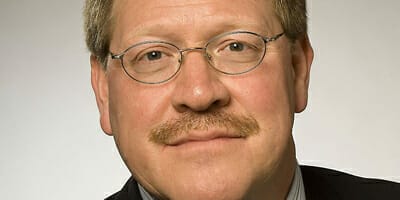
Eijffinger’s decade of financial repression

Financial repression will define the economic landscape for at least another decade, according to professor of financial economics at Tilburg University, Sylvester Eijffinger, which has serious implications for institutional investors.

Eijffinger, who also is also a visiting professor at Harvard, sits on the monetary experts panel of the European Union and is an adviser to the International Monetary Fund, says negative interest rates are the major issue of our time.

Negative real interest rates are here to stay, a realisation that has huge implications for investors.

“Governments have to de-leverage risk in times of low growth and they are not prepared to increase taxes; they have to do it with financial repression,” he says. “As an investor, be prepared. You have to realise that low interest rates are here to stay at the short-end and possibly at the long-end of the yield curve. This has huge implications for investments.”

By way of example, he says the European Central Bank’s policy rate stands at 0.5 per cent, while the eurozone’s annual inflation rate is 2.5 per cent. The Bank of England keeps its policy rate at only 0.5 per cent, despite an inflation rate that hovers above 2 per cent. And, in the United States, where inflation exceeds 2 per cent, the Federal Reserve’s benchmark federal funds rate remains at an historic low of 0 to 0.25 per cent.

This will be the financial and economic environment of the immediate future.

Sponsored Content

He says negative interest rates, which he describes as a kind of wealth tax, are necessary for governments to de-risk, but they come at the expense of savers.

“People who save should be aware that governments need to do this for at least a decade,” he says.

Eijffinger will give a keynote address at the Fiduciary Investors Symposium, an event that brings together institutional investors to examine the power and responsibility of fiduciary investment.

The event, which is convened by Conexus Financial, the publisher of conexust1f.flywheelstaging.com, will be held in Amsterdam from October 20 to 22, 2013. www.fiduciaryinvestor.com

Read an article by Eijffinger on the subject here.



Leave a Comment

Sort content by

CalSTRS positions for global volatility with allocation changes

The volatility in global markets has prompted the $154 billion CalSTRS to an underweight global equities position, moving assets into cash, its chief investment officer, Chris Ailman, said.mrec4inarticleinline Sponsored Content scnative1 scnative2 scnative3

China growth ‘unsustainable’ cautions expert

China experts are predicting the country’s growth will slow in the medium- to long-term as the government undertakes the difficult task of rebalancing the economy away from its dependence on investment and exports.mrec4inarticleinline Sponsored Content scnative1 scnative2 scnative3

Germans ‘deeply unhappy’ warns academic

The asset allocation of corporate pension plans should be driven by corporate finance not asset management according to Bernd Scherer, affiliate professor of finance at EDHEC Business School, and instructor of an upcoming seminar on portfolio construction and risk budgeting in Singapore. mrec4inarticleinline Sponsored Content scnative1 scnative2 scnative3

Human gorillas chest-thump in US testosterone territory

There’s been a little bit of chest beating of the gorilla type in the US, on both the political and finance sides of the fence. I can’t help thinking the testosterone levels are getting a little out of control and some of the behaviour has been more about protecting territory rather than acting in the best interests of the electorate, clients, beneficiaries, or neighbours.

Quantum co-founder bullish on commodities

As stock markets continued to be volatile and bears abounded, Jim Rogers, the co-founder with George Soros of the Quantum hedge fund, was one of few bullish voices. Rogers said that commodities will defy a stuttering world economy and depressed financial markets to enjoy a 20-year bull run.mrec4inarticleinline Sponsored Content scnative1 scnative2 scnative3

US asset managers trail European counterparts in ESG

Less than a quarter of US asset managers are using ESG risk analysis to inform their investment decisions, and European managers are considerably out-performing their American and global counterparts in integrating sustainability considerations, a report from MSCI ESG Research has revealed.mrec4inarticleinline Sponsored Content scnative1 scnative2 scnative3

Previous




