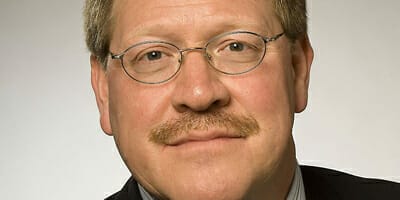
Eijffinger’s decade of financial repression

Financial repression will define the economic landscape for at least another decade, according to professor of financial economics at Tilburg University, Sylvester Eijffinger, which has serious implications for institutional investors.

Eijffinger, who also is also a visiting professor at Harvard, sits on the monetary experts panel of the European Union and is an adviser to the International Monetary Fund, says negative interest rates are the major issue of our time.

Negative real interest rates are here to stay, a realisation that has huge implications for investors.

“Governments have to de-leverage risk in times of low growth and they are not prepared to increase taxes; they have to do it with financial repression,” he says. “As an investor, be prepared. You have to realise that low interest rates are here to stay at the short-end and possibly at the long-end of the yield curve. This has huge implications for investments.”

By way of example, he says the European Central Bank’s policy rate stands at 0.5 per cent, while the eurozone’s annual inflation rate is 2.5 per cent. The Bank of England keeps its policy rate at only 0.5 per cent, despite an inflation rate that hovers above 2 per cent. And, in the United States, where inflation exceeds 2 per cent, the Federal Reserve’s benchmark federal funds rate remains at an historic low of 0 to 0.25 per cent.

This will be the financial and economic environment of the immediate future.

Sponsored Content

He says negative interest rates, which he describes as a kind of wealth tax, are necessary for governments to de-risk, but they come at the expense of savers.

“People who save should be aware that governments need to do this for at least a decade,” he says.

Eijffinger will give a keynote address at the Fiduciary Investors Symposium, an event that brings together institutional investors to examine the power and responsibility of fiduciary investment.

The event, which is convened by Conexus Financial, the publisher of conexust1f.flywheelstaging.com, will be held in Amsterdam from October 20 to 22, 2013. www.fiduciaryinvestor.com

Read an article by Eijffinger on the subject here.



Leave a Comment

Sort content by

The Netherlands’ UWV battles to regain funding

The funding crisis that hit pension funds across the world may be easing – in common with the five-year long economic crisis – but restoring healthy funding levels remains a vital priority for many investors. The Netherlands’ €4.9-billion ($6.6-billion) UWV pension fund is one of that number. A funding ratio of 98.7 per cent at

The diminishing role of agents

I’ve always been frustrated by interviewing consultants and the lack of conviction they have about their decisions. “What would your ideal model portfolio look like?” I constantly ask. “It depends on the client” is the predictable and consistent answer. That may be valid, even true, but it speaks to a wider problem. Consultants are hired

Push the reset button at PRI in Person

At the United Nations-backed Principles for Responsible Investment conference Cape Town on October 1, general secretary of the International Trade Union Confederation Sharan Burrow delivered a speech entitled Push the Reset Button – a Line Between Speculation and Investment. She discussed the stability of the global economy, the necessity for investors to shift to long-term

OECD leads global infrastructure push

The OECD seeks to lengthen the time horizons of investors and get institutional money flowing from across the world into infrastructure gaps.

Sustainable investment goes to school

The Robert F Kennedy Centre for Justice and Human Rights and Columbia University’s Earth Institute will run a series of high-level courses on sustainable investment focused on environmental, social and governance approaches as well as human and labour rights this autumn. The Compass Sustainable Investing Certificate program, designed for long-term investors, will have a solutions-driven

Giving time to investment governance

Roger Urwin, global head of content at Towers Watson and governance specialist, says most organisations don’t spend enough time on it, but transformational change is all about giving time to investment governance. Culture and leadership, for example is so self-evidently important in people organisations and yet it is understated in asset owners, he says. “The soft

Previous




