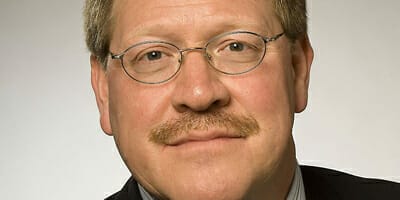
Eijffinger’s decade of financial repression

Financial repression will define the economic landscape for at least another decade, according to professor of financial economics at Tilburg University, Sylvester Eijffinger, which has serious implications for institutional investors.

Eijffinger, who also is also a visiting professor at Harvard, sits on the monetary experts panel of the European Union and is an adviser to the International Monetary Fund, says negative interest rates are the major issue of our time.

Negative real interest rates are here to stay, a realisation that has huge implications for investors.

“Governments have to de-leverage risk in times of low growth and they are not prepared to increase taxes; they have to do it with financial repression,” he says. “As an investor, be prepared. You have to realise that low interest rates are here to stay at the short-end and possibly at the long-end of the yield curve. This has huge implications for investments.”

By way of example, he says the European Central Bank’s policy rate stands at 0.5 per cent, while the eurozone’s annual inflation rate is 2.5 per cent. The Bank of England keeps its policy rate at only 0.5 per cent, despite an inflation rate that hovers above 2 per cent. And, in the United States, where inflation exceeds 2 per cent, the Federal Reserve’s benchmark federal funds rate remains at an historic low of 0 to 0.25 per cent.

This will be the financial and economic environment of the immediate future.

Sponsored Content

He says negative interest rates, which he describes as a kind of wealth tax, are necessary for governments to de-risk, but they come at the expense of savers.

“People who save should be aware that governments need to do this for at least a decade,” he says.

Eijffinger will give a keynote address at the Fiduciary Investors Symposium, an event that brings together institutional investors to examine the power and responsibility of fiduciary investment.

The event, which is convened by Conexus Financial, the publisher of conexust1f.flywheelstaging.com, will be held in Amsterdam from October 20 to 22, 2013. www.fiduciaryinvestor.com

Read an article by Eijffinger on the subject here.



Leave a Comment

Sort content by

Harvard endowment hones managers

Harvard Management Company will increase manager concentration levels, look closely at commodities and real estate, and bring more assets in-house where appropriate, as it moves into fiscal year 2011 with an unchanged long-term asset allocation.mrec4inarticleinline Sponsored Content scnative1 scnative2 scnative3

New world order: Mercer offers its blueprint to cope

Mercer Investment Consulting has produced its foreshadowed paper on global equities, which urges clients to have a major rethink about their benchmarks and portfolio construction. Greg Bright spoke with the paper’s main author, Nick White.mrec4inarticleinline Sponsored Content scnative1 scnative2 scnative3

Future Fund chief departs, alternative weightings increase

Four years after becoming its first employee, Paul Costello will leave his role as general manager of Australia’s Future Fund, saying “new leadership” was appropriate now that the A$87 billion ($81.2 billion) vehicle was beyond its “startup phase.” mrec4inarticleinline Sponsored Content scnative1 scnative2 scnative3

Commodities and emerging markets funds will run the gauntlet

There are eight “gauntlets” that any managed fund will have to run over the medium term,  according to Investec Asset Management investment strategist Michael Power, and while a Japanese equity fund might be lucky to meet one of them, funds investing in commodities or the emerging markets would satisfy almost all eight.mrec4inarticleinline Sponsored Content scnative1

Of cobras, newspapers and the Manchurian incident

Forget the Taiwan issue and China Sea disputes with Japan, the biggest threat to national security for the Chinese people went largely unnoticed last week: 160 illegally bred king cobra snakes escaped captivity from a farm on the outskirts of Beijing.mrec4inarticleinline Sponsored Content scnative1 scnative2 scnative3

Serving the servants: politics is hampering national wealth management

Poor communication and differing incentives between politicians and national wealth managers are undermining performance, argues global head of official institutions at BNP Paribas Investment Partners, Gary Smith. mrec4inarticleinline Sponsored Content scnative1 scnative2 scnative3

Previous




