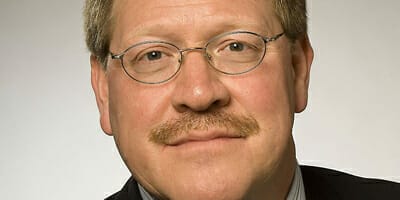
Eijffinger’s decade of financial repression

Financial repression will define the economic landscape for at least another decade, according to professor of financial economics at Tilburg University, Sylvester Eijffinger, which has serious implications for institutional investors.

Eijffinger, who also is also a visiting professor at Harvard, sits on the monetary experts panel of the European Union and is an adviser to the International Monetary Fund, says negative interest rates are the major issue of our time.

Negative real interest rates are here to stay, a realisation that has huge implications for investors.

“Governments have to de-leverage risk in times of low growth and they are not prepared to increase taxes; they have to do it with financial repression,” he says. “As an investor, be prepared. You have to realise that low interest rates are here to stay at the short-end and possibly at the long-end of the yield curve. This has huge implications for investments.”

By way of example, he says the European Central Bank’s policy rate stands at 0.5 per cent, while the eurozone’s annual inflation rate is 2.5 per cent. The Bank of England keeps its policy rate at only 0.5 per cent, despite an inflation rate that hovers above 2 per cent. And, in the United States, where inflation exceeds 2 per cent, the Federal Reserve’s benchmark federal funds rate remains at an historic low of 0 to 0.25 per cent.

This will be the financial and economic environment of the immediate future.

Sponsored Content

He says negative interest rates, which he describes as a kind of wealth tax, are necessary for governments to de-risk, but they come at the expense of savers.

“People who save should be aware that governments need to do this for at least a decade,” he says.

Eijffinger will give a keynote address at the Fiduciary Investors Symposium, an event that brings together institutional investors to examine the power and responsibility of fiduciary investment.

The event, which is convened by Conexus Financial, the publisher of conexust1f.flywheelstaging.com, will be held in Amsterdam from October 20 to 22, 2013. www.fiduciaryinvestor.com

Read an article by Eijffinger on the subject here.



Leave a Comment

Sort content by

Chinese growth prompts further inflation fears

The Chinese economy refuses to slow down. The latest GDP growth figures have once again surprised on the upside, prompting new fears about inflation.mrec4inarticleinline Sponsored Content scnative1 scnative2 scnative3

NEST to offer Sharia option

The UK’s National Employment Savings Trust (NEST) is looking for a Sharia-compliant funds manager to manage a global equity fund as it plans to offer more than its default strategy to members.mrec4inarticleinline Sponsored Content scnative1 scnative2 scnative3

New research on sovereign funds from EDHEC Asia

New thematic research programs examining sovereign investment funds management and a more general initiative on best investment practices will be a part of the academic work of the recently opened Asia office of Europe’s EDHEC-Risk Institute.mrec4inarticleinline Sponsored Content scnative1 scnative2 scnative3

Investors focus on hedge fund correlations: survey

Accessing non-correlated strategies has emerged as the top institutional aim in hedge fund investing, according to a survey by SEI Knowledge Partnership and Greenwich Associates, reflecting a shift in objectives since the 2009 survey, when institutions reported diversification and absolute return as priorities.mrec4inarticleinline Sponsored Content scnative1 scnative2 scnative3

Detecting crowded trades in currency funds

This article by Momtchil Pojarliev and Richard Levich proposes a methodology to measure crowded trades and applies it to currency managers. According to the authors, this methodology offers useful insights regarding the popularity of certain trades among hedge funds and provides regulators with another tool for monitoring markets.mrec4inarticleinline Sponsored Content scnative1 scnative2 scnative3

Investors suffer as Asian hedge funds ossify

As institutions take over from high-net-worth individuals and family offices as the main investors in hedge funds around the world, those hedge fund managers, too, are becoming institutionalised. This is not always a good thing for investors.mrec4inarticleinline Sponsored Content scnative1 scnative2 scnative3

Previous




