Deepwater execs strike oil with safety bonuses

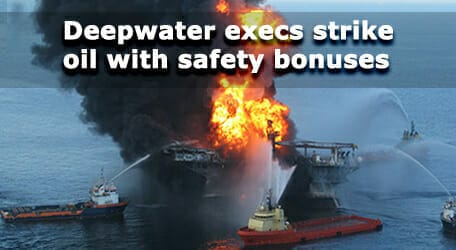
As incongruous as it sounds, executives at Transocean Ltd – the company that owns the Deepwater Horizon oil rig which exploded in the Gulf of Mexico last year killing 11 people – have been paid bonuses for their improved safety performance.

According to a company SEC filing last week, last year was its best-ever for safety, “notwithstanding the tragic loss of life in the Gulf of Mexico”.

Executives receive 25 per cent of their bonuses based on the company’s safety performance in a given year.

Last year, they were given two-thirds of this. In 2009, the company withheld all bonuses after four deaths.

The calculation for overall safety performance is not based on deaths alone, but rather the number of “incidents” and their “potential severity”.

The number of incidents fell 4 per cent in 2010 and their potential severity fell 15 per cent.

Sponsored Content

The Deepwater Horizon rig was leased by BP, which operated the rig. Transocean blames BP for the damage.

The US Government is continuing its investigation into the cause of the explosion.

Leave a Comment

Sort content by

CheckRisk rethinks the risk business

Beta-driven equity investors may currently be taking far greater risks than they are getting paid for when seeking broad market exposure, British risk expert Nick Bullman warns. Bullman, the founder of specialist risk consultancy CheckRisk, has developed a methodology using macroeconomic research along with econometric and behavioural risk inputs to identify what he describes as

Conservative Korea

Korean corporate pension funds have grown more conservative in their investments, increasing already high allocations to guaranteed-insurance contracts (GICs) and term savings, the Towers Watson Korea Pension Report shows. The annual snapshot of the Korean pension market found that 93 per cent of corporate pension-plan assets are allocated to principal-guaranteed products, of which nearly 58

Report reveals Norway’s SWF climate risk

Norway’s 3496 billion kroner (US$582.7 billion) sovereign wealth fund could suffer significant losses in a range of climate-change scenarios if it fails to hedge its risk by investing in climate-sensitive assets, the release of a confidential report shows. Norway’s Ministry of Finance recently released an extensive study by asset consultant Mercer on the effects of

Risk modelling
requires review

Advocating the use of financial models a six-year-old could understand and warning that the dogmatic belief in overly complex and unrealistic models contributed to the financial crisis were some of the challenging views put to the attendees of the recent CFA Institute’s annual conference. Throwing down the gauntlet was GMO asset-allocation team member James Montier,

Institutional investors fall behind USA Inc

Institutional investors are clearly behind in risk management compared to the innovative techniques implemented in treasury departments of corporate America, chief investment officer of Wurts and Associates, Jeff Scott says. Scott, who spent his career managing the balance sheet at Microsoft, Dow Chemical, the Alaska Permanent Fund and now investment consultant Wurts, says institutional investors

Pipes over promises

The Canadian Pension Plan Investment Board (CPPIB) is shunning European sovereign bonds, with the $152.8-billion fund’s head of investment saying European infrastructure offers far more attractive risk/return opportunities. Mark Wiseman, CPPIB’s executive vice-president of investments, told delegates at last week’s Milken Institute Global Conference 2012 in Los Angeles that the fund had chosen not to

Previous




