Deepwater execs strike oil with safety bonuses

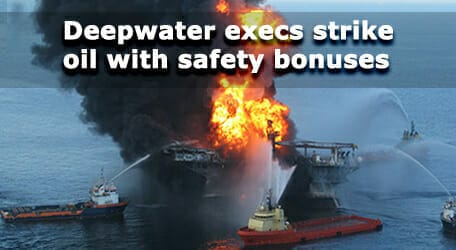
As incongruous as it sounds, executives at Transocean Ltd – the company that owns the Deepwater Horizon oil rig which exploded in the Gulf of Mexico last year killing 11 people – have been paid bonuses for their improved safety performance.

According to a company SEC filing last week, last year was its best-ever for safety, “notwithstanding the tragic loss of life in the Gulf of Mexico”.

Executives receive 25 per cent of their bonuses based on the company’s safety performance in a given year.

Last year, they were given two-thirds of this. In 2009, the company withheld all bonuses after four deaths.

The calculation for overall safety performance is not based on deaths alone, but rather the number of “incidents” and their “potential severity”.

The number of incidents fell 4 per cent in 2010 and their potential severity fell 15 per cent.

Sponsored Content

The Deepwater Horizon rig was leased by BP, which operated the rig. Transocean blames BP for the damage.

The US Government is continuing its investigation into the cause of the explosion.

Leave a Comment

Sort content by

In pursuit of the perfect fee model

Matteo Dante Perruccio and Mark Barker, chief executive and co-chief investment officer of Hermes BPK, the boutique fund of funds majority-owned by Hermes Fund Managers in turn owned by the BT Pension Scheme, speak to Amanda White about the benefits of focusing on investment management, and not asset gathering, in the hedge fund game and

CalPERS to hold public board meetings

CalPERS’ remaining board meetings for the year, in May, July and September, will be open to the public as the fund deliberates a full asset-liability assessment, culminating in a potential change to the benchmark rate of return in December. mrec4inarticleinline Sponsored Content scnative1 scnative2 scnative3

The Netherlands leads charge into government bonds

The Netherlands, an innovator in pension investment management, is leading a renaissance into government bonds at the expense of corporate bonds, as other European countries further reduce their domestic equities allocation, according to Mercer Investment Consulting’s 2010 European asset allocation survey. mrec4inarticleinline Sponsored Content scnative1 scnative2 scnative3

Flexible in-house thinking pays dividends for Canada’s HOOPP

A strategic shift into equities during 2009 and the completion of a multi-year strategy to bring all assets in house, has resulted in the Healthcare of Ontario Pension Plan (HOOPP) returning 15.18 per cent return for 2009, positioning it as one of very few pension funds around the globe to be fully funded. mrec4inarticleinline Sponsored

Australia’s UniSuper launches first internal capabilities

The $A25 billion ($23 billion) UniSuper will ramp up its internal funds management capabilities, with four of its own portfolios set to be running by the end of the year, in conjunction with a project that will see its defined benefit and defined contribution sections adopt differing investment strategies for the first time. mrec4inarticleinline Sponsored

CalSTRS cost breakdown supports internal savings…

A breakdown of CalSTRS’ investment costs confirms the cost savings of internal asset management, with the fund’s internal asset management costs making up only 0.07 per cent of the total portfolio management costs, but comprising 30 per cent of the total assets managed. mrec4inarticleinline Sponsored Content scnative1 scnative2 scnative3

Previous




