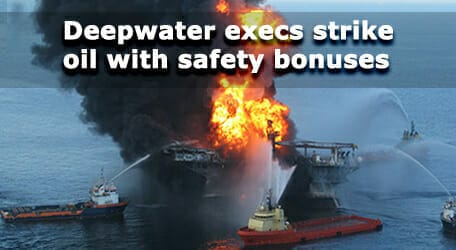
Deepwater execs strike oil with safety bonuses

As incongruous as it sounds, executives at Transocean Ltd – the company that owns the Deepwater Horizon oil rig which exploded in the Gulf of Mexico last year killing 11 people – have been paid bonuses for their improved safety performance.

According to a company SEC filing last week, last year was its best-ever for safety, “notwithstanding the tragic loss of life in the Gulf of Mexico”.

Executives receive 25 per cent of their bonuses based on the company’s safety performance in a given year.

Last year, they were given two-thirds of this. In 2009, the company withheld all bonuses after four deaths.

The calculation for overall safety performance is not based on deaths alone, but rather the number of “incidents” and their “potential severity”.

The number of incidents fell 4 per cent in 2010 and their potential severity fell 15 per cent.

Sponsored Content

The Deepwater Horizon rig was leased by BP, which operated the rig. Transocean blames BP for the damage.

The US Government is continuing its investigation into the cause of the explosion.

Leave a Comment

Sort content by

US instos swing back to equities

The Conference Board’s 2010 Institutional Investment Report: Trends in Asset Allocation and Portfolio Composition measures the asset growth and portfolio composition of institutional investors operating in the US.mrec4inarticleinline Sponsored Content scnative1 scnative2 scnative3

Blue-eared pigs challenge China’s leaders

Economists hate price and wages controls. They distort the natural forces of markets and usually result in pent-up demand and/or supply which will be unleashed at a later stage as well as a range of unexpected distortions. Investors, too, should hate them. mrec4inarticleinline Sponsored Content scnative1 scnative2 scnative3

Russell Axioma launches factor-based indexes

Institutional investors’ increasing use of factor-based models to understand their portfolio risk exposures is the conduit for Russell Investments’ collaboration with Axioma to launch a series of factor-based indexes to rival MSCI/Barra, according to Rolf Agather, managing director of research and innovation at Russell. mrec4inarticleinline Sponsored Content scnative1 scnative2 scnative3

Diversification is not enough for managing risk

Diversification alone is not enough to manage downside risk, rather academic research in dynamic portfolio theory suggests the three complementary techniques of diversification, hedging, and insurance can be used together to design customised investment solutions, that ultimately separate assets into performance seeking portfolios and liability hedging portfolios, according to EDHEC’s Felix Goltz and Stoyan Stoyanov.

CalPERS’ redesign creates CFO role

CalPERS will introduce a new leadership organisation design next year, which includes for the first time a dedicated chief financial officer function coordinating all corporate finance functions including cash flow. mrec4inarticleinline Sponsored Content scnative1 scnative2 scnative3

Why politics and pension fund management don’t mix

Thomas P DiNapoli was given a little scare in the recent US mid-term elections but, in the end, was returned fairly comfortably to his position of New York State Comptroller and sole trustee of the New York State pension fund. What happens next, though, may be more interesting. mrec4inarticleinline Sponsored Content scnative1 scnative2 scnative3

Previous




