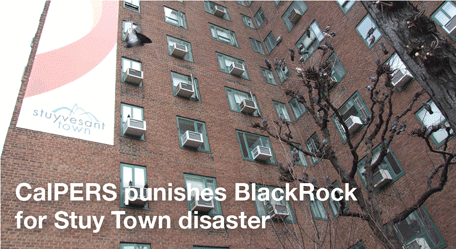
CalPERS punishes BlackRock for Stuy Town disaster

Another page has turned in the history of the Stuyvesant Town – Peter Cooper Village apartment buildings in New York, as iconic as they have been controversial since their initial construction in the 1940s. CalPERS, America’s largest pension fund, has terminated BlackRock, one of its property managers which led a 2006 purchase of the 80-acre site, after a 12-year relationship.

CalPERS wrote off US$500 million of its apartment portfolio after real estate manager Tishman Speyer Properties, which together with BlackRock and investors paid $5.4 billion for what the residents call “Stuy Town”, had given up control of the properties to avoid bankruptcy in January this year.

This week CalPERS terminated a $1 billion apartment management mandate with BlackRock, which had dated back to 1998. The fund has consolidated this with another long-time manager, the privately owned GID Investment Advisers.

The Stuy Town development marked the first major clearing of slum dwellings in New York, starting in 1943, financed largely by the insurer MetLife, which was awarded tax breaks and other government assistance.

It has been the subject of many court actions over the years, some on the basis of race. Courts ruled that the managers did not have to adhere to race discrimination laws applicable for public landlords, despite the government assistance in the development, and almost all the early tenants in the rent-controlled apartments were white.

CalPERS reported a loss of 37 per cent in its total real estate portfolio in the year to June. The fund is anticipating reduced costs and improved efficiency from consolidating its mandates under one partner/manager.


Sponsored Content

Leave a Comment

Sort content by

The Netherlands’ UWV battles to regain funding

The funding crisis that hit pension funds across the world may be easing – in common with the five-year long economic crisis – but restoring healthy funding levels remains a vital priority for many investors. The Netherlands’ €4.9-billion ($6.6-billion) UWV pension fund is one of that number. A funding ratio of 98.7 per cent at

The diminishing role of agents

I’ve always been frustrated by interviewing consultants and the lack of conviction they have about their decisions. “What would your ideal model portfolio look like?” I constantly ask. “It depends on the client” is the predictable and consistent answer. That may be valid, even true, but it speaks to a wider problem. Consultants are hired

Push the reset button at PRI in Person

At the United Nations-backed Principles for Responsible Investment conference Cape Town on October 1, general secretary of the International Trade Union Confederation Sharan Burrow delivered a speech entitled Push the Reset Button – a Line Between Speculation and Investment. She discussed the stability of the global economy, the necessity for investors to shift to long-term

OECD leads global infrastructure push

The OECD seeks to lengthen the time horizons of investors and get institutional money flowing from across the world into infrastructure gaps.

Sustainable investment goes to school

The Robert F Kennedy Centre for Justice and Human Rights and Columbia University’s Earth Institute will run a series of high-level courses on sustainable investment focused on environmental, social and governance approaches as well as human and labour rights this autumn. The Compass Sustainable Investing Certificate program, designed for long-term investors, will have a solutions-driven

Giving time to investment governance

Roger Urwin, global head of content at Towers Watson and governance specialist, says most organisations don’t spend enough time on it, but transformational change is all about giving time to investment governance. Culture and leadership, for example is so self-evidently important in people organisations and yet it is understated in asset owners, he says. “The soft

Previous



